How to Scale Content Creation: Master Systems, AI, and Automation to Grow Faster
Discover how to scale content creation with proven systems, AI tools, and automation to boost output without burning out.
If you've ever felt like you're stuck on a content hamster wheel, you're not alone. The constant pressure to create, publish, and promote across every platform can feel completely unsustainable. It’s a fast track to burnout, inconsistent quality, and ultimately, missed opportunities.
This is where most creators and marketers get stuck. They treat every blog post, video, or social update as a brand-new project, starting from scratch every single time. It feels productive, but it’s a trap.
The real key to growth isn't just about producing more content. It's about building a smart, repeatable system that amplifies your message without linearly increasing your workload.
Breaking Free From the Content Hamster Wheel

To successfully scale, you need to shift your mindset from one-off tasks to building a well-oiled machine. It’s about creating an engine that runs on a solid strategy, efficient workflows, and the right dose of automation.
This approach isn't just a "nice-to-have" anymore; it's essential for survival.
The Massive Opportunity in the Creator Economy
Let's talk numbers for a second. The creator economy is currently valued at over $250 billion and is on track to nearly double to $480 billion by 2027. Think about that. Since 2020, over 165 million new creators have jumped onto social platforms, making the space more crowded than ever.
Standing out requires consistency and quality at scale. Brands are hungry for reliable partners who can deliver, which is why right now is the perfect time to build your content engine. You can dig into more creator economy statistics to grasp just how big this wave is.
This guide will walk you through a practical, no-fluff framework to do just that.
The goal here is to stop being reactive and start being strategic. We're turning a chaotic, unpredictable process into a predictable asset that actually drives results for your business or brand.
The Four Pillars of Scalable Content Creation
To build a truly scalable system, you need to focus on four core components that all work together. Think of them as the legs of a table—if one is weak, the whole thing wobbles.
Getting these pillars right is the foundation of everything we'll cover. Here's a quick look at what we're building.
The Four Pillars of Scalable Content Creation
Pillar | Core Focus | Key Outcome |
|---|---|---|
Strategy | Defining your purpose, audience, and core content themes. | Every piece of content has a clear "why" and contributes to your goals. |
People | Assigning roles and responsibilities for content creation. | A clear system of ownership, whether you're a solo creator or a team. |
Process | Creating repeatable workflows, SOPs, and batching systems. | Consistent, efficient, and high-quality content production. |
Technology | Using AI, automation, and project management tools. | Reduced manual work and the ability to produce more with less effort. |
By mastering these four areas, you can finally get off the hamster wheel and start building a content operation that works for you, not the other way around. You'll move from feeling overwhelmed to being in complete control, ready to grow your brand's presence effectively and, most importantly, sustainably.
Building Your Scalable Content Blueprint

Before you can even think about scaling up, you need a solid plan. Trying to ramp up content production without a clear strategy is a recipe for disaster—it's chaotic, expensive, and you’ll burn out your team trying to keep up. A real content blueprint ensures your quality stays high as your quantity grows, preventing your brand message from getting lost in the noise.
The secret to making this work is the pillar content model. This approach pulls you out of the frantic, one-off content hamster wheel and into a smarter, more connected system. The concept is brilliantly simple: create one massive, in-depth piece of content (the "pillar") and then slice it up into dozens of smaller assets ("micro-content").
It’s the truest definition of working smarter, not harder.
Identifying Your Core Content Pillars
Your content pillars are the major themes your brand is going to own. These aren't just random blog post topics; they're the big, substantial subjects that tackle your audience's most pressing problems while also aligning with your business goals. A great pillar is evergreen, comprehensive, and deep enough to be deconstructed into countless smaller topics.
So, how do you find them? Start with this actionable exercise:
List 10 Questions Your Customers Always Ask: Open up your emails, DMs, and support tickets. What are the recurring pain points? For a personal finance coach, this might be "How do I create a budget?" or "What's the best way to invest with little money?"
Identify Your 3 "Unfair Advantages": What do you know better than anyone else? Maybe you're a SaaS founder with deep knowledge of product-led growth, or a realtor who understands the local market inside and out. Your pillars must be subjects where you are a credible authority.
Choose a High-Value Format: Your pillar format should be substantial. A real-world example is creating a comprehensive "Ultimate Guide to Homebrewing Coffee" as a 4,000-word blog post. This provides ample material for video tutorials, gear reviews, and quick tips.
From One Pillar to a Content Ecosystem
Once you have a solid pillar, the real fun begins. You can strategically "atomize" it, breaking it down into a whole ecosystem of micro-content designed for different platforms. This lets you meet your audience where they are, without having to reinvent the wheel every single time.
Here’s a practical example. Let’s say your pillar is a 60-minute webinar on a "Beginner's Guide to E-commerce SEO."
From that single piece of content, you could spin off:
Blog Content: A 2,500-word ultimate guide that covers everything discussed in the webinar.
Video Content: Ten bite-sized, 2-3 minute YouTube videos, each answering a specific question from the webinar's Q&A section (e.g., "How to Find Keywords for Product Pages").
Social Media:
Instagram: Five carousel posts visualizing key data points from the webinar, like "3 Common SEO Mistakes E-commerce Stores Make."
TikTok/Reels: Five quick, 15-second videos showing how to implement one fast SEO win, like optimizing an image's alt text.
LinkedIn: Three text-based posts sharing high-level insights from the webinar to spark conversations, such as "Why most e-commerce brands are thinking about site speed all wrong."
Lead Magnet: A one-page PDF checklist summarizing the 10-step SEO audit covered in the webinar.
From just one hour of initial effort, you’ve created over a month’s worth of high-value content for multiple channels. That’s the engine of a scalable content system.
Defining a Replicable Brand Voice
As you bring on more team members, freelancers, or even AI tools to help you scale, you absolutely have to maintain a consistent voice. This goes way beyond a simple tone like "friendly" or "professional." It's about the nitty-gritty details of how you communicate.
A documented brand voice isn't a creative restriction; it's a tool for freedom. It gives others the confidence to create on your behalf, ensuring everything that goes out sounds like you, no matter who actually wrote it.
Your brand voice guide needs to be a practical document that anyone can pick up and use immediately. Make sure it includes:
Core Messaging: Your mission, your values, and your one-sentence value proposition.
Tone & Personality: List 3-5 "we are" and "we are not" adjectives. Example: "We are: witty, educational, direct. We are not: sarcastic, academic, vague."
Language & Style: Specific, actionable rules. Example: "Always use the Oxford comma. Write in an active voice. Address the reader as 'you'."
Formatting Rules: Simple guidelines on using emojis, how you handle capitalization, and specific hashtag strategies. Example: "Use 1-2 relevant emojis at the end of social posts. Use title case for all blog post headings. Always use #YourBrandTag and two other relevant hashtags."
With a blueprint built on strong pillars and a crystal-clear voice, you now have a framework you can replicate again and again. You’re no longer just creating content—you’re building a scalable engine that drives consistent, high-quality work.
Assembling Your Content Creation Engine
Once you have a solid blueprint, it’s time to build the engine that brings your content strategy to life. Scaling content creation means making a crucial shift: you have to stop "doing everything" yourself and start designing a system. In this system, every task gets handled by the right resource—whether that’s a person, a tool, or a well-defined process.
When people hear "engine," they often picture a large, expensive team. That’s a common misconception. Your content engine can be a lean but powerful mix of human talent and smart technology, built to fit your current size and budget.
The real key is deciding what needs a human touch and what can be handed off to automation.
The Solopreneur’s Virtual Team
If you're flying solo or running a one-person marketing department, scaling can feel like a pipe dream. You can't just go out and hire a full team, but you can build a virtual one. This is all about thoughtfully delegating specific tasks to specialized tools and freelancers. Doing this frees you up to focus on the big-picture strategy and creative direction where you add the most value.
A practical virtual team for a solopreneur might look like this:
AI Writing Assistant (e.g., Jasper, ChatGPT): Task it with creating the first draft of a blog post from your detailed outline, or generating 10 social media post ideas from a single topic.
Graphic Design Tool (e.g., Canva): Use a set of 5-10 pre-made, branded templates. This ensures your social media visuals are consistent and take minutes, not hours, to create.
Scheduling Platform (e.g., Buffer, Later): Use it to bulk-schedule a week's worth of social media posts in one 30-minute session.
Freelance Editor (e.g., from Upwork or Fiverr): Hire someone for 2-3 hours a month to provide a final quality check and polish on your most important pillar content before it goes live.
In this setup, you become the Content Strategist and Creative Director. The tools and freelancers effectively become your "employees," each executing specific, repeatable tasks. This is how you multiply your output without having to multiply your hours.
Structuring a Small Content Team
For businesses that already have a small team, the focus isn't just on tools but on clearly defining roles. A well-structured team makes sure everyone knows exactly what they're responsible for, which is critical for preventing bottlenecks and people accidentally doubling up on work.
While the exact titles can change, a scalable content team usually centers around a few core functions.
Here’s a simple breakdown of the essential roles and how they contribute to the bigger picture:
Role | Core Responsibilities | Key Contribution to Scaling |
|---|---|---|
Content Strategist | Defines content pillars, manages the editorial calendar, and analyzes performance data to guide future content. | Ensures all content is purposeful and aligned with business goals, preventing wasted effort on low-impact ideas. |
Content Writer/Creator | Executes the creation of primary assets like blog posts, video scripts, and podcast outlines. | Focuses purely on producing high-quality, in-depth content that can be repurposed later. |
Designer/Visual Creator | Creates all visual elements, from social graphics and infographics to video edits and thumbnails. | Maintains brand consistency and makes content more engaging and shareable across platforms. |
Even with a dedicated team, you still need to be strategic about automation. For instance, your writer could use an AI tool to generate an initial outline, giving them more time to dive deep into research and craft a compelling story.
Investing in Your Content Infrastructure
Smart investments in your content infrastructure are a catalyst for growth, not just another line item on your budget. The global digital content creation market was valued at $32.28 billion in 2024 and is projected to explode to $69.80 billion by 2030. This massive growth is happening because businesses are realizing that efficient content systems are non-negotiable for staying competitive. You can discover more insights about the rise of the digital content market on Grandview Research.
Investing in the right tools and people doesn't just help you create more content—it helps you create better content, more consistently, with less friction. It’s the difference between rowing a boat with a single paddle and steering a speedboat.
When building your content engine, think about how specialized freelancers can handle specific needs much more efficiently. For niche topics, hiring a Photography Blog Writer Virtual Assistant can give you expert-level content, freeing up your core team to focus on broader strategic goals. The goal is a flexible system that combines your in-house talent with freelancers and automation.
To see how all these pieces can fit together, check out our guide on the best content marketing automation tools and start building your own tech stack.
Mastering Your Content Production Workflow
Alright, you've got your strategy mapped out and the right people on the bus. That's the foundation. But where the real magic happens—where you actually start to scale—is in your day-to-day execution. This is about building a well-oiled production machine that turns your plans into a consistent stream of high-quality content.
Without a defined workflow, even the best strategy crumbles under the weight of deadlines and last-minute requests. The goal is to move away from a chaotic, task-switching environment and toward something that feels more like an assembly line. It’s all about creating predictability, which is the secret ingredient to scaling anything effectively.
The Power of Content Batching
One of the most powerful shifts you can make is to embrace content batching. It's a surprisingly simple idea that completely changes the game. Instead of taking one piece of content from idea to publication before starting the next, you group similar tasks together and knock them out in dedicated blocks of time.
This approach is a direct attack on context switching, which is a massive productivity drain. Every time you jump from writing a caption to designing a graphic, then back to brainstorming, you lose momentum.
Think of it like meal prepping. You don't cook one meal from scratch every single night. You spend a few hours on Sunday chopping all the vegetables, cooking the protein, and portioning everything out for the week. Batching your content works the exact same way.
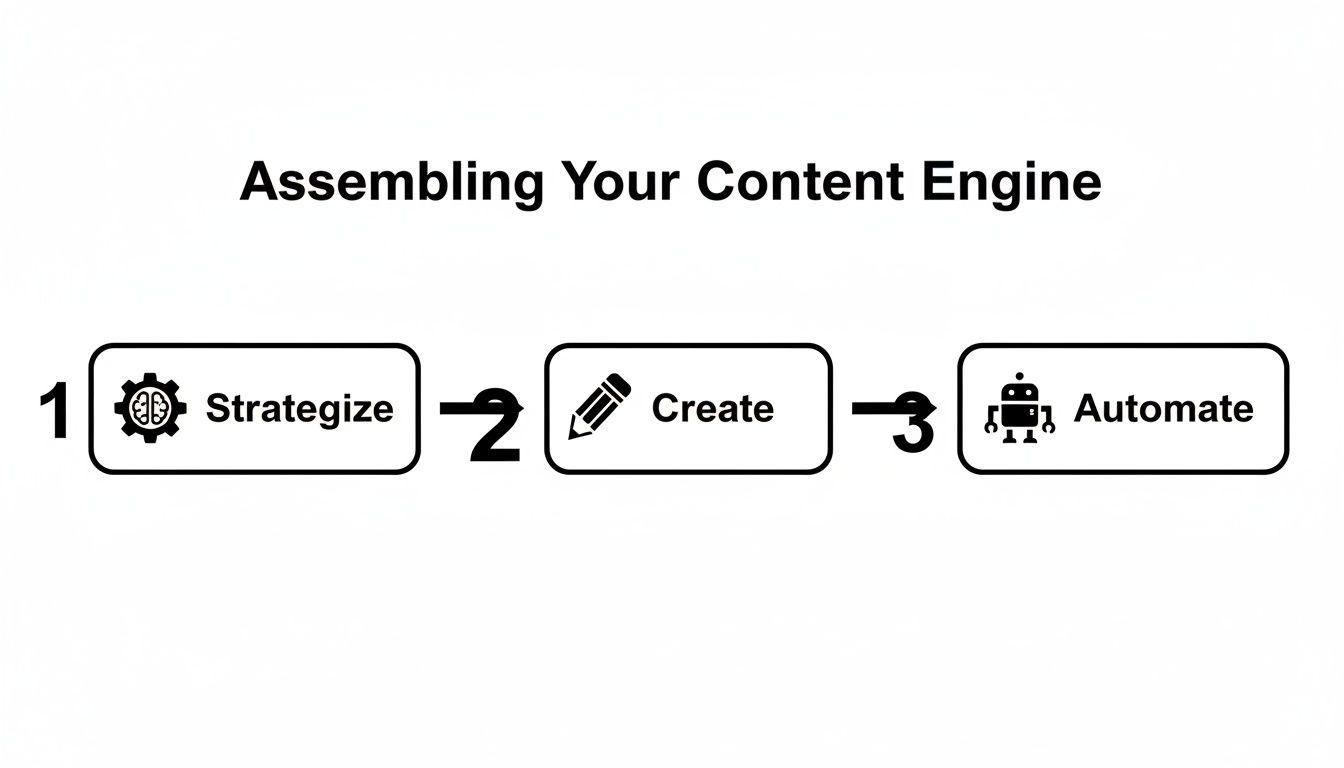
As you can see, a solid content engine flows logically from one stage to the next. Strategy informs creation, and automation makes the whole system repeatable and efficient.
Here's an actionable example for a social media manager: you can batch an entire month of content in just two highly-focused days.
Day 1 (Strategy & Creative - 4 hours):
Hour 1: Brainstorm and finalize 4 weekly themes.
Hour 2-3: Write all 20 captions for the month (5 posts/week).
Hour 4: Script out 4 short-form videos.
Outcome: All the text-based creative work is done. No design, no scheduling—just pure creative output.
Day 2 (Production & Scheduling - 4 hours):
Hour 1-2: Create all 20 graphics using Canva templates.
Hour 3: Film and edit all 4 videos.
Hour 4: Upload everything to a scheduler and set publish dates.
Outcome: All content is scheduled for the month.
The feeling of finishing those two days with a month of content ready to go is incredible. It frees up the next 28 days for what really moves the needle: engaging with your audience, analyzing performance, and planning your next strategic move.
To give you a clearer picture of the efficiency gains, let's compare a traditional workflow to a batched one.
Manual vs. Scaled Content Workflow Comparison
The table below breaks down the time spent on common content tasks. Notice how batching consolidates effort, leading to massive time savings over the course of a month by eliminating the constant start-and-stop of a daily workflow.
Task | Traditional Manual Workflow (Time/Week) | Scaled Batching Workflow (Time/Month) |
|---|---|---|
Topic Brainstorming | 1-2 hours | 2-3 hours |
Content Writing | 4-5 hours | 8-10 hours |
Graphic Creation | 2-3 hours | 4-5 hours |
Video Recording/Editing | 3-4 hours | 6-8 hours |
Scheduling & Publishing | 1-2 hours | 1-2 hours |
Total Time | 11-16 hours/week | 21-28 hours/month |
As you can see, the batched workflow accomplishes the same (or more) in roughly half the time. By dedicating focused blocks to specific tasks once a month, you reclaim dozens of hours that were previously lost to inefficiency and context switching.
Creating Your Standard Operating Procedures
Once you start batching, you'll naturally see patterns emerge in how you work. This is the perfect time to introduce Standard Operating Procedures (SOPs). An SOP is just a fancy term for a documented, step-by-step guide on how to get a recurring task done right, every single time.
Think of it as the official playbook for your content engine. It ensures anyone—a new hire, a freelancer, or even yourself after a vacation—can step in and execute flawlessly. Your SOPs don't have to be massive, formal documents. They can be simple checklists in a project management tool, a quick screen recording, or a shared doc with clear instructions.
An SOP removes the guesswork. It turns your best practices into a system, making quality and consistency the default outcome rather than something you have to constantly fight for.
Here are three actionable SOPs you can create today:
New Blog Post Checklist: Use a tool like Trello or Asana. Create a template card with checkboxes for each step: [ ] Keyword research complete, [ ] Outline approved, [ ] First draft written, [ ] On-page SEO optimized (meta title, description, alt text), [ ] Internal links added, [ ] Final proofread done.
Video Repurposing Workflow: Create a short Loom video showing your screen as you take a long-form video, use a tool like Opus Clip to generate social clips, add captions in CapCut, create a thumbnail in Canva, and write platform-specific copy.
Weekly Newsletter Assembly: Make a Google Doc template with predefined sections: [Introduction], [Link to Top Blog Post], [Quote of the Week], [Call to Action]. This standardizes the format and makes assembly quick and easy.
These documents are the backbone of a truly scalable system. They make it easy to delegate and ensure your brand’s quality never suffers, no matter who is doing the work. If you're building this from the ground up, our guide on how to create a content calendar can provide a fantastic starting point for organizing your workflow.
Finally, to truly make this system fly, you need the right tools. For a real-world perspective, one team spent 30 days testing various platforms to find the best options for integrating content marketing automation tools. Their findings can help you pick the software that will best support your new SOPs and batching schedule.
Using AI for Smart Content Repurposing

You just poured hours, maybe even days, into creating a fantastic piece of pillar content. It’s well-researched, insightful, and a genuine asset to your audience. The absolute worst thing you can do now is let it sit on your blog and collect dust after the first week.
To get real mileage out of your work, you need to squeeze every last drop of value from it. I'm not talking about just spamming the same link across all your social channels. That doesn't work.
Smart repurposing means breaking down your core content and rebuilding it into new, native formats for each platform you're on. This used to be a painfully manual process, but this is where AI has become a total game-changer. It turns a tedious chore into a fast, almost automatic workflow. Instead of one blog post, you suddenly have the raw material for a dozen different pieces of content.
AI tools can read a long-form article in seconds and pull out the most interesting hooks, stats, and takeaways. This completely changes the math on what it takes to scale your content.
From One Post to a Multi-Channel Campaign
Let's get practical. Say you just published a 2,000-word guide on "Improving Your Home Office Ergonomics." In the old days, you'd spend the rest of the afternoon trying to manually chop it up for social media.
With an AI-powered tool, you can execute an entire repurposing campaign with a few simple prompts:
For LinkedIn: Prompt: "Create a professional LinkedIn post from the following article. Focus on the top three ergonomic mistakes people make and end with a question to drive engagement."
For Instagram: Prompt: "Generate an outline and copy for a 5-slide Instagram carousel based on this article. Each slide should have a clear headline and a short, punchy description. Suggest a visual for each slide."
For YouTube Shorts/TikTok: Prompt: "Write a 30-second video script based on this article. It should show one quick ergonomic fix for a chair that someone can do right now. Make it fast-paced and engaging."
This is how you maintain a consistent, high-value presence everywhere without burning yourself out. You’re hitting your audience with the same core message, but it’s packaged perfectly for how they actually use each platform.
Adapting Content for Platform Nuances
Great repurposing isn't just about changing the file type. It’s about understanding the culture of each platform and adapting your tone, style, and even the substance of the content to match.
This is something AI is surprisingly good at. It understands the subtle differences between how people browse on different networks. What grabs attention on a visual platform is completely different from what works on a text-heavy one.
Think of your AI assistant as a platform-specific translator. It gets that Pinterest users want beautiful, informative graphics with clear action items. Meanwhile, your Twitter audience is looking for short, sharp insights that can kick off a conversation.
By telling the AI where the content is going, you get something that feels like it belongs there. This is the key difference between just cross-posting and building a truly sophisticated, scalable content strategy. If you want to go deeper on this, our guide on content repurposing strategies lays out a great framework for this.
Automating Distribution for Maximum Reach
Okay, so you’ve created all these great repurposed assets. That's only half the job. Now you need to get them in front of the right eyeballs at the right time.
Modern AI-powered scheduling platforms like Later or Buffer do more than just post on a timer. They bring intelligence to your distribution.
For example, many of these tools have a "Best Time to Post" feature. Instead of you guessing, the tool analyzes your past engagement data and recommends the precise times your specific audience is most active on each network. It might tell you to post your Instagram Reel at 7 PM EST but your LinkedIn article at 9 AM EST. This data-driven approach ensures your content doesn't just go live—it gets seen.
When you combine AI-driven repurposing with intelligent scheduling, you build a powerful, automated distribution engine. This system will save you countless hours, sure, but more importantly, it will dramatically increase the ROI of every single piece of content you create.
Using Performance Data to Fuel Your Growth
Putting out more content is only half the job. If you’re just throwing spaghetti at the wall to see what sticks, you're wasting energy. The real magic happens when you create a feedback loop—where the data from what you just published directly shapes what you create next.
This is all about shifting your mindset. Stop chasing vanity metrics like raw follower counts and start digging into the numbers that actually matter. You need to become a detective, figuring out what your audience genuinely loves, and then, quite simply, give them more of it.
Focus on the Metrics That Actually Matter
To scale effectively, you have to track the numbers that show a real connection with your audience and a real impact on your goals. Forget the fluff. These are the metrics you should live by:
Engagement Rate: This is the most honest feedback you'll ever get. A high engagement rate—meaning likes, comments, and shares relative to your audience size—is proof that you're on the right track.
Audience Growth: Are new, relevant people finding and following you? This tells you if your content is discoverable and interesting enough to earn that click.
Conversion Rate: This is the bottom line. Are people taking the action you want them to take? Whether it's signing up for your newsletter, clicking a link in your bio, or buying a product, this metric connects your content directly to business results.
When you prioritize these metrics, you stop being a content producer and start becoming a strategist. You're not just filling a calendar; you're building a system that predictably delivers what your audience wants.
Run a Monthly Content Review
Once a month, block out 90 minutes for a content review. The goal here is brutally simple: find your winners and losers so you can double down on what’s working. You don't need a complicated spreadsheet, just answer these three questions using your platform analytics:
Which content pillar drove the most engagement? Look at your Instagram insights or YouTube analytics. Did posts about "Productivity Hacks" get more comments than posts about "Team Management"?
Which format performed best? Did your Instagram carousels get more shares than your single-image posts? Did your 30-second Reels have a higher average view duration than your 60-second ones?
Which specific post was the top performer? Identify your single best piece of content from the last 30 days. Why did it work? Was it the hook, the topic, the visual?
Let's say you discover your 60-second "day in the life" videos on TikTok are getting 5x the engagement of your in-depth LinkedIn articles. That’s a clear signal to create more behind-the-scenes video content and perhaps re-evaluate your LinkedIn strategy to be more conversational.
This data-first approach is what separates hobbyists from creators building a real business. We know that 54% of consumers are more likely to buy from creators they find relatable. By seeing which topics spark the most heartfelt comments, you can lean into that authenticity. And with 51% of creators planning to launch online courses, your analytics can highlight recurring audience questions, essentially validating your next product idea before you even start building it. You can learn more about what's driving the creator economy on The Leap.
This whole process ensures that as you ramp up production, your content doesn't just get louder—it gets smarter, more impactful, and ultimately, more profitable.
Got Questions About Scaling Content?
When you start thinking about scaling your content, a lot of practical questions pop up. It's totally normal. Let's tackle some of the most common hurdles people run into when they're trying to shift from doing everything by hand to building a real system.
Can You Really Scale Content Without It Turning Into Generic Junk?
Yes, you absolutely can. The trick is to stop thinking about scaling as just "doing more, faster." It's actually about building smart systems.
When you create detailed Standard Operating Procedures (SOPs), lean on a solid brand style guide, and use AI to knock out first drafts—not final copy—you're essentially baking quality control right into the process.
A truly scalable system doesn't sacrifice quality; it makes quality the default. It sets a high bar and gives everyone—you, your team, even an AI—the guardrails to hit that mark every single time.
Okay, So What’s the Very First Thing I Should Do?
Before you even think about creating a single new piece of content, do a content audit. Seriously. Look at what you've already made.
Actionable Step: Open a simple spreadsheet. In one column, list your top 10 best-performing blog posts or videos from the last year (based on traffic or engagement). In the next column, brainstorm three ways you could repurpose each one. For example, a top blog post on "10 Tips for Better Sleep" could become 10 individual Instagram posts, a short animated video, and a downloadable checklist. This is your starting point.
What’s This Going to Cost Me?
Scaling doesn't have to break the bank. You can get started for less than you think. Many of the best AI writing assistants and social media schedulers have free or really affordable plans to get you started.
Honestly, the biggest initial investment isn't money; it's your time. You'll need to set aside a few hours to map out your first workflow templates and get a content calendar organized. But that upfront effort will pay you back tenfold in the months ahead.
Ready to stop the content grind and build a true growth engine? NicheTrafficKit is an all-in-one AI platform that automates everything from research and creation to multi-platform publishing and analytics. Start your free trial today and see how easy scaling can be.