How to Generate Leads on LinkedIn: A Practical Guide
Learn how to generate leads on LinkedIn with actionable strategies for profile optimization, content creation, and outreach that deliver real business growth.
If you want to generate leads on LinkedIn, your first job is to stop thinking of your profile as a resume. It’s not. It’s a landing page, and its only purpose is to convince your ideal client that you’re the person who can solve their problem.
This means you need to flip the script. Every part of your profile should be less about you and more about them. Before you ever think about outreach or content, you need to get this foundation right. A weak profile will kill your campaigns before they even start, but a great one can bring leads to your digital doorstep without you lifting a finger.
Turn Your Profile into a Lead Generation Magnet
Think about it: every person who lands on your profile is silently asking, "What's in it for me?" Your job is to answer that question, and answer it fast. From your headline to your experience, every word should be geared toward attracting, educating, and ultimately, converting the right people.
Rewrite Your Headline to Solve Problems
Your headline is your single most important piece of real estate on LinkedIn. It follows you everywhere—search results, comments, connection requests. A bland job title like "Sales Director at Acme Inc." is a massive waste of that space.
Instead, your headline should immediately tell people who you help, how you help them, and what results they can expect. It's a mini-pitch that does the pre-qualification for you.
Before: "Marketing Manager"
After: "I Help B2B SaaS Companies Build Predictable Sales Pipelines with LinkedIn Content | Content Strategy & Lead Generation"
Actionable Tip: Use a simple formula: "I help [Your Ideal Client] achieve [Their Desired Outcome] through [Your Method]." For example, a financial advisor might use: "I help tech founders create wealth-building investment portfolios so they can achieve financial freedom."
See the difference? The second one is a magnet for the right audience. It repels irrelevant connections and pulls in prospects who are actively looking for a solution like yours.
Craft a Compelling About Section
The "About" section is where you connect the dots. Most people fill this with a dense block of text about their skills and career history. Don't do that.
You need to tell a story. Start with a hook that speaks directly to your ideal client's biggest frustration. Then, use scannable bullet points to highlight the tangible outcomes you deliver.
Practical Example: Instead of starting with "I'm a seasoned sales professional...", try "Are you tired of inconsistent lead flow and sales forecasts that never seem to pan out? I help sales teams fix that." Then, follow up with outcome-focused bullets:
Better Lead Quality: I help you move from random inquiries to a steady stream of qualified decision-makers.
Shorter Sales Cycles: We build trust upfront with value-driven content so deals close faster.
Stronger Brand Authority: I position you as the undeniable go-to expert in your industry.
Finally, you absolutely must end with a clear call to action (CTA). Tell them exactly what to do next. For instance: "Ready to build a predictable pipeline? Send me a DM with the word 'Pipeline' and let's chat."
Infuse Your Experience with Tangible Results
Let's be honest, nobody cares about your old job duties. They care about what you achieved. Go through your "Experience" section and ruthlessly reframe every responsibility as a quantifiable accomplishment.
Actionable Example: Instead of writing that you "managed marketing campaigns," say you "Led a multi-channel marketing campaign that generated $1.2M in pipeline revenue and decreased cost-per-lead by 22% in six months." If you don't have revenue numbers, use percentages or scale. For example: "Grew the organic social media following by 300% in one year."
This simple switch provides instant social proof and builds credibility on the spot. It's the difference between telling and showing. For a deeper dive into how all these pieces fit together with modern outreach tools, check out this ultimate guide to LinkedIn lead generation.
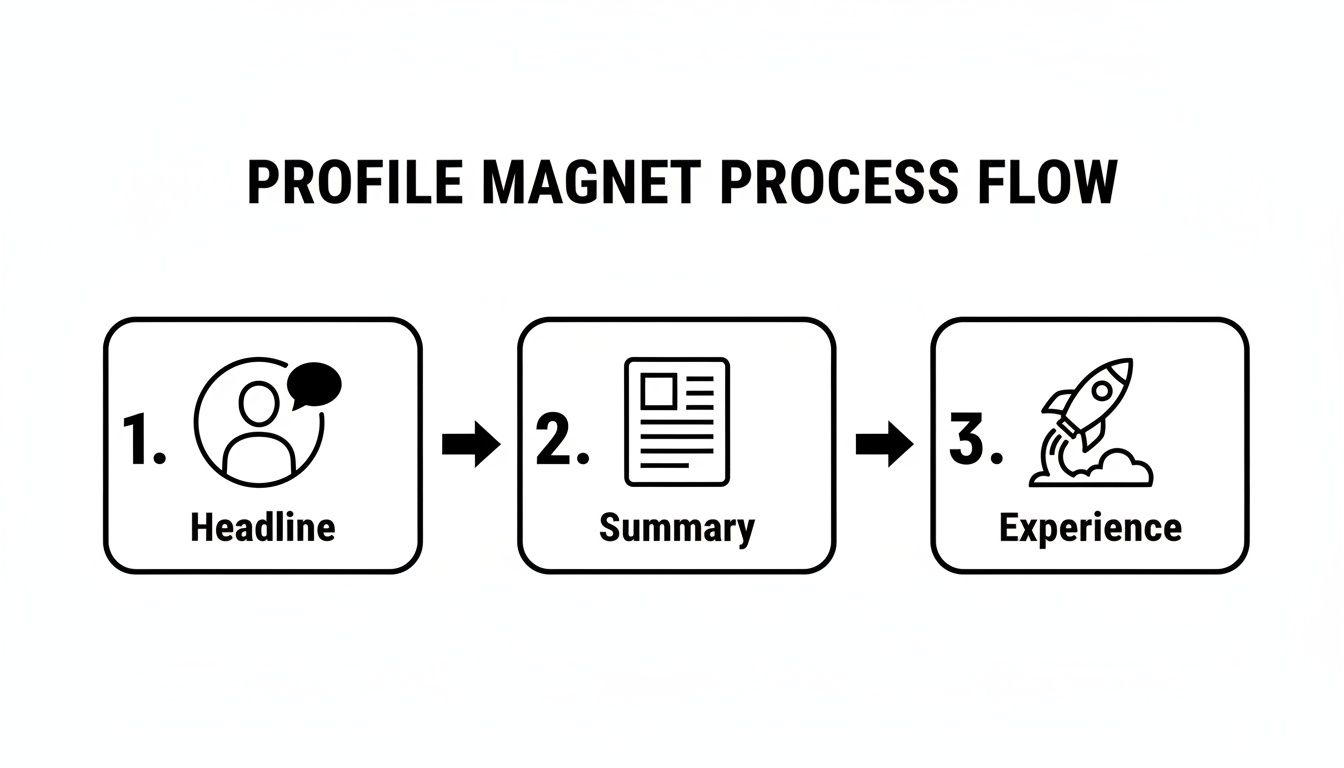
The flow is simple but powerful: your headline grabs their attention, your summary tells them you understand their problem, and your experience proves you know how to solve it.
This isn't just theory. An optimized profile positions you to take advantage of a massive, engaged audience. LinkedIn just crossed the 1 billion member mark. Think about that. It's the go-to platform where 89% of B2B marketers hang out, and it's credited with generating 80% of all B2B leads from social media. Getting your profile right is your ticket to that game.
Pinpoint Your Ideal Clients with Precision
So, you’ve got a killer profile. That’s a great start, but it’s just setting the stage. A great profile won't magically bring leads to your door; you have to go find them. This is where the real work begins: figuring out exactly who you want to attract.
Blasting out connection requests to anyone and everyone is the quickest way to burn out on LinkedIn. The key to building a predictable pipeline is precision. You need to know your ideal client inside and out.
Build Your Ideal Client Profile
This means going way beyond just a job title and industry. You need to build a detailed Ideal Client Profile (ICP) that gets into the nitty-gritty of their professional world. Think of it as a living, breathing document that describes the perfect customer for what you sell.
To start sketching out your ICP, ask yourself these kinds of questions:
What are their biggest headaches at work? I’m talking about the specific, nagging problems they face every single day.
What are they trying to achieve professionally? Are they gunning for a promotion, trying to make their team more efficient, or under pressure to hit a revenue target?
What do they talk about online? Look at the articles they share or the posts they comment on. Is it all about industry trends, leadership hacks, or something else?
Which business metrics keep them up at night? If you can connect your solution directly to the KPIs they're judged on, you've got a powerful hook.
Actionable Insight: When you can answer these questions, your outreach stops being a generic sales pitch. It becomes a relevant, helpful conversation about a problem they already know they have. You’re no longer just selling a service; you're solving their specific pain.
This deep understanding is your secret weapon. It lets you craft every message and every piece of content to feel like it was made just for them, which makes a "yes" infinitely more likely.
Use Sales Navigator for Hyper-Specific Targeting
Once your ICP is crystal clear, it’s time to unleash your superpower: LinkedIn Sales Navigator. The free version of LinkedIn search is fine, but Sales Navigator is where you can get surgically precise. Its advanced filters let you build incredibly specific lists of prospects who are a perfect match.
Let’s walk through a real-world example. Say you run a FinTech company selling compliance software. A simple search for "CFO" is way too broad and will give you a ton of noise.
With Sales Navigator, you can get much smarter. You can find:
CFOs at banks with 500-1,000 employees.
Based in the New York City metro area.
Who have changed jobs in the last 90 days (a massive buying trigger).
And have recently posted about "regulatory compliance".
Now, let's flip to a different scenario. Imagine a marketing agency that wants to connect with brand managers in the consumer goods space.
Their search might look like this:
Title: Brand Manager OR Senior Brand Manager.
Industry: Consumer Packaged Goods.
Company Headcount: 1,001-5,000 employees.
Keywords in Profile: "product launch," "brand strategy," OR "market expansion."
See the difference? This isn’t just a random list of people. It’s a curated group of high-intent prospects who are actively engaged in the world you operate in. Mastering these granular searches is the foundation of generating high-quality leads on LinkedIn, ensuring every minute you spend is focused on your most valuable potential customers.
Create Content That Attracts High-Value Leads
Think of your LinkedIn content as your best salesperson—the one who works 24/7 without a single complaint. It's out there building trust, proving you know your stuff, and pulling high-value prospects right to your digital doorstep.
We're moving beyond generic company updates. The real goal is to build a content engine that consistently solves real problems for your ideal clients. When you become the go-to source for answers, you're the first person they think of when it's time to make a purchase. It’s a complete flip of the script: you stop chasing leads and start attracting them.
Build Your Content Around Key Pillars
Throwing random content at the wall and hoping something sticks is a recipe for frustration. A strategic content mix is what separates the pros from the amateurs. You need different types of posts, each with a specific job to do, to keep your feed interesting and connect with people at every stage of their buying journey.
Here's a simple, powerful mix that just works:
Authority-Building Posts: This is your expert-level content. Share a contrarian take on an industry trend, break down a complex topic into simple steps, or detail a framework you've developed. The mission here is to prove you're a true authority.
Trust-Building Posts: Nothing builds trust faster than social proof. Post client testimonials, short case studies, or stories that show off real-world results. This content directly answers the question every prospect has: "Is this person for real?"
Engagement-Boosting Posts: Not every post needs to be a novel. Simple questions, relevant polls, or "fill-in-the-blank" prompts are fantastic for starting conversations and boosting your visibility in the LinkedIn algorithm.
This blend ensures you're not just selling; you're also educating, engaging, and building relationships. For a deeper dive into the mechanics of each post type, our guide on how to post on LinkedIn breaks it all down.
Actionable Insight: A common trap is getting stuck only posting heavy, authority-building content. While essential, it can feel a bit formal. By mixing in lighter, engagement-focused posts, you become more approachable and human, making it much easier for prospects to slide into your DMs.
To bring this to life, here’s a practical look at what a balanced content schedule could look like for a week.
A Practical LinkedIn Content Mix for Generating Leads
This table outlines how to blend different content formats to create a well-rounded and effective strategy. Each piece serves a unique purpose, from establishing credibility to sparking direct engagement.
Content Type | Primary Goal | Example | Frequency |
|---|---|---|---|
Thought Leadership | Establish Expertise | A text-only post sharing a unique perspective on a recent industry shift. | 1-2 times per week |
Case Study / Testimonial | Build Trust & Credibility | A carousel post walking through a client win, with a quote and key metric. | 1 time per week |
Educational Video Clip | Deliver Value Quickly | A 90-second video sharing a single, powerful tip from a longer webinar. | 1-2 times per week |
Interactive Poll / Question | Drive Engagement | A poll asking, "What's your biggest challenge with [your topic]?" | 1 time per week |
Behind-the-Scenes | Humanize Your Brand | A photo of your workspace with a story about a lesson you learned this week. | 1 time every 1-2 weeks |
By following a mix like this, you create multiple touchpoints that appeal to different people in your audience, nurturing them from curious follower to qualified lead.
The Power of Repurposing One Core Asset
Listen, you don't need to reinvent the wheel every single day. The smartest and most sustainable approach is to create one big piece of content—like a webinar, a detailed guide, or a podcast interview—and then slice it up into smaller, bite-sized pieces for the rest of the week.
This is the "Create Once, Distribute Forever" model. It’s a game-changer for saving time and squeezing every last drop of value from your best ideas.
Let’s say your big content piece is a 30-minute webinar on "Scaling a Remote Sales Team." Here’s how you can spin that into a full week of high-impact LinkedIn content:
Monday (Video Clip): Post a 60-second video clip of the most powerful moment from the webinar. Add captions, a strong headline, and a hook in the text.
Tuesday (Carousel Post): Turn the webinar's main framework into a 5-7 slide carousel. Carousels are fantastic for engagement because they're interactive and easy to consume.
Wednesday (Text-Only Post): Share a personal story related to the webinar's topic. Maybe talk about a big mistake you made managing a remote team and what you learned. Authenticity always wins.
Thursday (Poll): Run a poll asking your audience about their biggest remote sales challenge, which tees up your webinar perfectly.
Friday (Link to Full Asset): Drop the link to the full webinar recording. By now, your audience has seen snippets all week and is primed to dive deeper.
Once you have that core piece, learning how to repurpose content effectively is the skill that helps you stay consistent without burning out. This system turns one big effort into a week of valuable, lead-generating touchpoints.
Use Articles and Newsletters to Own Your Audience
While daily posts are great for visibility, LinkedIn Articles and Newsletters give you something far more valuable: a direct line to your most dedicated followers.
When someone subscribes to your newsletter, they get a notification every time you publish. It’s like having a VIP list right inside LinkedIn.
Use Articles for your big, cornerstone pieces—the definitive guides and deep-dive analyses you want to be known for. Treat your Newsletter like a weekly conversation with your community, sharing fresh insights, behind-the-scenes stories, and exclusive tips. This strategy turns passive followers into a loyal subscriber base, making your lead generation efforts far more consistent and predictable.
Master Outreach That Actually Builds Relationships

This is where the rubber meets the road. You’ve polished your profile and started sharing valuable content. Now, it's time to proactively connect with the right people, but not in the spammy, automated way that plagues most inboxes.
Effective outreach is the engine that drives a predictable sales pipeline. The goal isn't just to blast out messages; it's to start genuine conversations. We're going to build a scalable system for connecting with prospects that feels human because it is human. It’s all about mixing smart personalization with efficient workflows to turn cold contacts into warm opportunities.
Ditch the Cold Pitch for a Warm-Up Strategy
Before you even think about hitting that "Connect" button, you need to get on your prospect's radar. The easiest and most effective way to do this? Engage with their content first. This simple step completely changes the dynamic of your future outreach.
Instead of showing up as a random stranger, you become a familiar face. Try spending a week or two genuinely interacting with the top prospects on your list.
Leave thoughtful comments. Go way beyond "great post." Add a unique insight, ask a smart follow-up question, or share a related experience. Make a real contribution.
Share their content. If they post something genuinely useful, share it with your network and be sure to tag them. It's a huge sign of respect for their expertise.
Engage with their comments. See what they're saying on other people's posts and jump into those conversations.
This multi-touchpoint approach warms up the entire interaction. So when your connection request finally lands in their inbox, they’re far more likely to recognize your name and click "Accept."
Craft Connection Requests That Actually Get Accepted
Your connection request is the very first direct ask you'll make, and it has to count. LinkedIn gives you just 300 characters, which forces you to be concise and impactful. The secret is making it about them, not you.
Whatever you do, don't use the default "I'd like to add you to my professional network" message. It screams low effort. Personalize every single request with a specific, relevant reason for wanting to connect.
Here are a few proven, non-robotic templates you can adapt:
The Content Engagement: "Hi [Name], I really enjoyed your recent post on [Topic]. Your point about [Specific Insight] was spot on. I'd love to connect and follow your work."
The Shared Interest: "Hi [Name], I noticed on your profile that you're also passionate about [Shared Hobby/Interest]. It's great to see other [Job Title]s who share that interest. Would be great to connect."
The Mutual Connection: "Hi [Name], I see we're both connected with [Mutual Connection's Name]. I've been following your work in the [Industry] space and would welcome the chance to connect."
The only goal here is to get the connection accepted. The sales pitch can wait. Focus on opening the door to a relationship first.
Follow Up with Value, Not a Sales Pitch
Once they accept your request, the clock starts ticking. Your first follow-up message is absolutely crucial. Do not, under any circumstances, immediately pitch your product or service. This is the single biggest mistake people make, and it instantly torches any trust you've started to build.
Your initial message should be a simple "thank you" that offers value with zero strings attached.
Key Takeaway: The goal of your first follow-up is not to book a meeting. It is to start a genuine conversation by being helpful. Give first, and you'll earn the right to ask later.
A great follow-up message might look something like this: "Thanks for connecting, [Name]! Since you're interested in [Topic from their profile or post], I thought you might find this recent article on [Related Topic] useful. No opt-in or anything, just thought it could help. Hope your week is off to a great start!"
This approach is disarming because you aren't asking for a thing. You're just providing value, which builds reciprocity and positions you as a helpful expert. Keeping track of all these moving parts can get tricky, which is where some of the best social media management tools come in handy for scheduling content and monitoring conversations.
Pairing this kind of targeted outreach with high-value content can also slash your sales cycle. For instance, using LinkedIn’s native Lead Gen Forms in sponsored posts can skyrocket conversions. Recent data shows these forms convert at around 13% on average, a massive jump from the typical 2% on external landing pages. That six-fold difference is because they pre-fill a user's profile data and keep them on the platform, eliminating friction.
By building a system that combines this human-first outreach with high-converting tools, you can generate leads on LinkedIn at scale without ever sacrificing authenticity.
Know Your Numbers to Fine-Tune Your Results

If you're putting in all this effort on LinkedIn but aren't tracking your performance, you're essentially flying blind. It's so easy to get distracted by vanity metrics like post views and likes, but let's be honest—those numbers don't pay the bills.
To turn your LinkedIn activity into a predictable lead-generation machine, you have to measure what actually moves the needle. This is how you stop guessing and start making smart, data-driven decisions that consistently improve your outcomes.
Focus on the Metrics That Actually Matter
For most businesses running outreach campaigns on LinkedIn, success really boils down to a handful of core metrics. These are the numbers that tell the true story of whether your efforts are paying off.
You'll want to laser-focus on tracking these three KPIs above all else:
Connection Acceptance Rate: This is your first major checkpoint. It tells you how well your profile and initial outreach are resonating. If your rate is dipping below 20-30%, it's a strong signal that either your targeting is off or your connection note isn't compelling enough to grab attention.
Message Reply Rate: Once someone connects, how many are actually engaging with your first follow-up message? This metric is a direct reflection of your value proposition and your ability to spark a genuine conversation.
Qualified Conversations Started: This is the end goal, right? How many of those replies evolve into real, meaningful conversations with prospects who fit your ideal client profile? This is the number that directly feeds your sales pipeline.
Actionable Tip: Don't overcomplicate the tracking process. A simple spreadsheet is all you need to get started. Just create columns for requests sent, requests accepted, replies received, and qualified conversations. Log your numbers each week, and you'll start seeing clear patterns emerge.
Understanding these activities is a crucial part of any solid social media strategy. If you want to go deeper on this topic, our guide on how to measure social media ROI is a great next step.
Systematically Test and Improve Everything
Once you've established a baseline for your core metrics, the real fun begins: optimization. The most effective way to do this is with simple A/B testing—changing one variable at a time to see what impact it has. This methodical approach turns your outreach from an art into a science.
Your profile headline and your connection message are the two best places to start. They have the biggest impact on your connection acceptance rate, which is the first domino that needs to fall.
A/B Testing Your Headline: A Real-World Example
Let's say you're a consultant who helps SaaS companies reduce customer churn.
Version A (Benefit-Focused): "I Help B2B SaaS Founders Reduce Churn and Increase Customer Lifetime Value"
Version B (Problem-Focused): "Fighting High Customer Churn? I Help SaaS Companies Build Retention Strategies That Work"
To run the test, you'd use Version A for two weeks while meticulously tracking your acceptance rate. Then, switch to Version B for the next two weeks and compare the data. The numbers will give you a clear winner, showing you which angle resonates most with your audience.
A/B Testing Your Connection Message
You can apply the same logic to that crucial 300-character connection request.
Version A (Content-Based): "Hi [Name], loved your recent post on scaling engineering teams. The point about documentation was spot on. Would be great to connect."
Version B (Group-Based): "Hi [Name], I saw we're both in the 'SaaS Growth Hacks' group. I'm always looking to connect with other leaders in the space."
Run each version for a set period, making sure to send a similar number of requests for both. Whichever one gets you a higher acceptance rate is the one you stick with. By constantly running small tests like these, you'll see small improvements that compound over time, turning your LinkedIn efforts into a truly efficient growth engine.
Common Questions on LinkedIn Lead Generation
Even with a rock-solid system, a few common questions always pop up when you're trying to generate leads on LinkedIn. Let's tackle some of the most frequent hurdles I see people run into. Getting these right is key to making the whole process work without getting on the wrong side of the platform.
How Many Connection Requests Should I Send Per Week?
This one comes up a lot. LinkedIn has a weekly invitation limit designed to curb spam, which means quality is now officially more important than quantity. While the exact number can change, blindly hitting the maximum is a terrible strategy.
A much smarter approach is to focus on sending 10-15 highly personalized requests each day.
This keeps your account in good standing and, more importantly, gets you way better results. Think about it: a request that mentions a recent post they shared, a mutual interest, or something specific about their company is so much more likely to get accepted than a generic template. This is how you build a network that actually leads to conversations.
Practical Example: Your weekly connection limit is like a budget. You can blow it on 100 low-quality "penny stocks" that will probably go nowhere, or you can invest it in a handful of high-quality "blue-chip" connections that are far more likely to pay off.
Are LinkedIn Automation Tools a Good Idea?
This is a big one, and the answer isn't a simple yes or no. Using automation tools wisely is the secret to scaling your efforts without getting your account flagged.
Let’s be clear: tools that completely automate personal interactions, like sending connection requests and DMs for you, are a direct violation of LinkedIn's rules. Using them is a fast track to getting your account restricted or even permanently banned. The entire point of the platform is genuine human connection, and those kinds of tools destroy it.
But not all automation is created equal. Some tools are incredibly helpful because they support your strategy instead of faking it.
Content Schedulers: Using a tool to plan and schedule your posts is a massive time-saver.
Analytics and Research: Tools that help you track what’s working or research prospects more effectively give you a real advantage.
The golden rule here is to automate the tasks, not the relationships. Keep your outreach, your comments, and your conversations authentic. That’s where the real business opportunities come from.
Should I Focus on Inbound or Outbound Strategies?
Why choose? The most powerful and sustainable lead generation systems don't rely on just one. They blend both inbound and outbound strategies, with each one making the other stronger.
Inbound marketing is your long game. It’s all about consistently creating great content and dialing in your profile so that warm, qualified prospects find you. It’s like planting a garden—it takes consistent effort, but eventually, it produces a reliable harvest. This is your marathon.
Outbound marketing, on the other hand, is your short-term driver. Proactively reaching out to ideal clients with personalized messages gets you more immediate, predictable results. It fills your pipeline right now. This is your sprint.
A winning strategy weaves the two together. Your outbound messages will see a much higher success rate when someone clicks on your profile and finds a feed full of valuable content. At the same time, your smart outreach is constantly bringing new, relevant people into your world, giving your inbound efforts a bigger audience.
Ready to put these strategies on autopilot? NicheTrafficKit uses AI to handle your entire social media workflow, from researching viral trends to generating platform-specific content for LinkedIn. Stop spending hours on manual tasks and start generating leads with a system that works for you. Explore how NicheTrafficKit can transform your social media presence.