Unlocking Growth with B2B Social Media
Discover how to leverage B2B social media with proven strategies for content, platform selection, and measuring real business impact. Your complete guide.
When people hear "social media," they often picture consumer brands, viral trends, and impulse buys. But for B2B, it's an entirely different game. B2B social media is about using platforms like LinkedIn and X to build real relationships, establish yourself as an authority, and carefully guide professionals through long, complex buying cycles. It's less about advertising and more about earning trust through expertise and valuable content.
What B2B Social Media Really Means for Your Business
It’s tempting to write off social media as a B2C playground, but that’s a huge mistake. B2B social media isn't a megaphone for blasting your sales pitch. Think of it more like a digital conference room where you can have smart conversations, forge genuine connections, and prove you know your stuff.
Here's a simple analogy. B2C social media is like a loud, colorful street festival. The goal is mass appeal, sparking quick, emotional purchases. B2B social media, on the other hand, is like an exclusive industry roundtable. The conversation is nuanced, the topics are deep, and the real aim is to build lasting trust among peers and decision-makers.
The Modern Buyer's Journey Starts Online
The old sales playbook is officially dead. Today’s B2B buyers complete nearly 70% of their research online before they ever agree to a sales call. They’re digging for solutions, vetting vendors, and checking out what industry experts are saying on professional platforms.
This shift to self-education makes a strong social presence absolutely essential. If you're not part of the conversation, you're invisible. Your social channels become the first place you can start to:
Build Authority: Share sharp insights, data-backed posts, and expert commentary that shows you’re a leader in your field. Actionable example: A financial software company could post a LinkedIn analysis of new SEC regulations and what they mean for CFOs.
Nurture Relationships: Jump into relevant discussions, answer questions thoughtfully, and build rapport over weeks and months, not minutes. Actionable example: A project manager from a SaaS company can join a conversation under an industry influencer's post and offer a helpful tip about Agile methodologies, without mentioning their product.
Demonstrate Value: Let your results do the talking. Share case studies and client wins that provide undeniable proof of your solution's impact. Actionable example: Post a screenshot of a client's performance dashboard (with permission) showing a 50% increase in efficiency after using your tool.
From Posts to Partnerships
Success in B2B social isn't about vanity metrics like likes or going viral. It’s measured by the quality of the relationships you build and, ultimately, the qualified leads you generate. Every single post, comment, and direct message is a chance to move a prospect forward, giving them the right piece of information exactly when they need it.
B2B social media is a long-term investment in credibility. It’s about being the go-to resource potential clients trust long before they are ready to make a purchase decision.
This isn't something you can just wing. Shifting from broadcasting a message to building relationships requires a real plan. To see a genuine impact on your business, you need a comprehensive B2B social media strategy. This framework keeps your efforts focused and measurable, ensuring everything you do is tied directly to bottom-line goals like generating MQLs and closing deals faster. The aim is to turn your social feed from a marketing checklist item into a powerful engine for business growth.
Choosing The Right Platforms for B2B Success

Trying to be everywhere at once on social media is a classic rookie mistake. It’s a fast track to burnout, not business growth. A smart b2b social media strategy isn't about blanketing every platform; it's about making deliberate, focused bets where you know your audience is listening.
The real trick is to stop thinking about a social media checklist and start thinking like your buyer. Where do they go to troubleshoot a problem? Which channels do they trust for industry news? Answering these questions is how you turn social media from a chore into a reliable pipeline for high-quality leads and brand authority.
LinkedIn: Your Digital Headquarters
When it comes to B2B, LinkedIn isn't just another channel—it's the main office. This is your digital headquarters, the place for serious networking, in-depth industry conversations, and razor-sharp account-based marketing (ABM). Professionals don't just scroll here; they come to learn, connect, and make buying decisions.
The numbers don't lie. A massive 95% of B2B marketers use LinkedIn for their organic content strategy. And when it comes to results, a staggering 80% of B2B leads generated from social media come straight from LinkedIn. It’s no surprise that learning how to use LinkedIn for business is non-negotiable for anyone serious about B2B marketing.
To really make an impact, your content has to deliver genuine value. Our guide on how to post on LinkedIn breaks down exactly how to craft posts that stop the scroll and start conversations.
X: The Real-Time Industry Ticker
If LinkedIn is your polished corporate office, then X (what we all still call Twitter) is the bustling trading floor. It’s your real-time industry news ticker, moving at the speed of conversation. This is where you jump on breaking news, share quick-fire insights, and keep a close eye on what your competitors and customers are talking about right now.
X is tailor-made for:
Rapid Response: Instantly engage with industry news, customer questions, or trending hashtags. Actionable example: When a major industry report is released, post a thread with your company's top three takeaways.
Networking at Scale: Build relationships with journalists, influencers, and partners in a less formal, more direct way. Actionable example: Follow key industry journalists and reply to their posts with insightful comments, building rapport before you ever pitch them a story.
Driving Traffic: Drop links to your latest blog posts, case studies, or webinar sign-ups to pull people back to your site. Actionable example: Post a poll asking about a common challenge, then reply to the thread with a link to a blog post that solves it.
The pace on X is relentless, which means consistency is everything. It’s less about crafting a masterpiece and more about showing up consistently to add your voice to the day's most important conversations.
YouTube: Your Digital Demo Room
For complex B2B solutions, telling someone your product is great is one thing. Showing them is a different game entirely. That's where YouTube comes in. Think of it as your virtual demo room, where you can prove your product’s value with undeniable visual evidence.
YouTube transforms abstract value propositions into tangible proof. It’s where you can visually answer your prospect’s biggest question: "How will this actually work for me?"
Use the platform to build an evergreen library of helpful videos. Create in-depth product tutorials, film powerful client testimonials, or pull back the curtain with behind-the-scenes content that puts a human face on your brand. Actionable example: A data analytics company can create a 5-minute video series called "Dashboard Drills," where each episode shows how to build one specific, high-value report using their software.
Beyond the Big Three: Niche Communities
While the major platforms are your bread and butter, don't sleep on the power of niche communities. Specialized subreddits, industry-specific forums, or private Slack channels can be absolute goldmines for connecting with a hyper-targeted audience.
The key here is to leave your sales pitch at the door. Your goal is to listen, learn, and contribute. By genuinely participating in conversations and offering expert advice without asking for anything in return, you build a rock-solid reputation. Actionable example: A developer from an API integration company can actively answer technical questions in the r/devops subreddit, establishing themselves as a credible expert. This grassroots approach uncovers insights and builds trust in ways the big platforms just can't match.
Deciding where to invest your time can feel overwhelming. To make it easier, we've broken down the top contenders and their core strengths for B2B marketers.
B2B Social Media Platform Comparison
Platform | Primary B2B Use Case | Target Audience | Best Content Formats |
|---|---|---|---|
Networking, lead generation, thought leadership | Professionals, decision-makers, industry experts | Text posts, articles, carousels, short videos, case studies | |
X (Twitter) | Real-time news, community engagement, brand voice | Journalists, industry influencers, tech-savvy audiences | Short text updates, polls, threads, links to articles, quick videos |
YouTube | Product demos, tutorials, customer stories | Visual learners, researchers, prospects in consideration | How-to videos, webinars, customer testimonials, thought leader interviews |
Community building, market research, brand listening | Niche enthusiasts, highly engaged community members | Answering questions (AMAs), sharing expertise, engaging in subreddits |
This table serves as a starting point. The best mix for your brand will depend entirely on where your specific audience spends their time and what kind of information they're looking for.
Aligning Your Content with the B2B Buyer Journey
Great B2B social media isn't about throwing content at the wall and hoping something sticks. It’s a deliberate strategy, guiding potential customers from "I have a problem" to "I need your solution." To do this, you need to map your content directly to the three core stages of the B2B buyer journey: Awareness, Consideration, and Decision.
Think of yourself as a trusted guide. When someone is just starting their journey (Awareness), you’re not shoving a map in their face; you’re talking about the destination. As they get more serious (Consideration), you compare the different routes and gear. And when they’re ready to go (Decision), you’re there to give them that final nudge of confidence. Each stage requires a totally different conversation, which means it needs a different type of content.
Stage 1: Awareness - When They Don't Know You Exist
In the Awareness stage, your audience isn't looking for you. They’re looking for answers. They're feeling a pain point and turning to Google, LinkedIn, or industry forums to figure out what's going on. Your goal here is simple: educate, don't sell. The mission is to become the helpful, knowledgeable resource they stumble upon first.
This is top-of-funnel stuff. You're trying to get discovered by professionals who are just beginning their research.
Here’s what that looks like in practice:
Insightful Industry Reports: Don't just publish a PDF. Pull out the juiciest stats and turn them into a LinkedIn carousel. Actionable example: A cybersecurity firm might post, "Our 2024 Threat Report found that 68% of small businesses are unprepared for phishing attacks. Here are three things you can fix today."
Data-Driven Infographics: Take a complex topic and make it simple. An infographic shared on X is perfect for this. Actionable example: A logistics company could visualize the supply chain chaos of the last year, instantly showing they understand the market's pain.
Short Educational Videos: Think 60-second YouTube Shorts or LinkedIn videos that explain a core concept without ever mentioning your product. Actionable example: A SaaS company could create a clip titled, "What Is 'Technical Debt' and Why Should Your CFO Care?"
Stage 2: Consideration - When They're Weighing Their Options
Okay, so they know they have a problem. Now they’re in the Consideration stage, actively researching and comparing solutions. Your goal shifts. You're no longer just educating them on the problem; you're showing them why your approach to solving it is the smartest one. This is all about building credibility.
Your content needs to go deeper here, offering real proof that you know your stuff and that your solution actually works.
This is where you transition from being a helpful resource to a trusted advisor. Your content has to show, not just tell, how you solve the problem better than anyone else.
Content that wins in the Consideration stage:
In-Depth Webinars: Host a live webinar that gets into the tactical details. Actionable example: A marketing automation company could run a session like, "Build Your First Lead Nurturing Sequence in 5 Steps." Promote it everywhere.
Detailed Case Studies: A link to a case study is boring. Instead, create a LinkedIn carousel that tells a story: here was the client's challenge, this is the solution we implemented, and here are the incredible results (e.g., "40% increase in qualified leads in Q3").
Client Testimonial Snippets: Grab a glowing customer review and turn it into a sharp quote graphic or a short video. Actionable example: Post a 30-second video of a client saying, "Before we used [Your Product], we were wasting 10 hours a week on manual reporting. Now it takes 10 minutes." That kind of social proof is infinitely more powerful than anything you can write about yourself.
Stage 3: Decision - When They're Ready to Commit
Finally, the Decision stage. Your prospect is on the verge of making a purchase. They’ve whittled down their options to a shortlist—and hopefully, you’re on it. The goal now is to convert their interest into action. You need to make choosing you the easiest, most logical decision they can make.
Content at this stage is highly targeted. It’s about removing any last-minute friction and giving them the final bit of validation they need.
Targeted Social Proof: With their permission, tag a well-known client in a post celebrating a recent win. This sends a powerful signal to prospects: "See? The people you respect, respect us."
Invitations to Live Demos: A generic "request a demo" form feels like a big commitment. Instead, try posting an open invitation to a live group demo on a specific date. It feels lower-pressure and creates a little urgency.
Personalized Outreach: Fire up LinkedIn Sales Navigator to find people who engaged with your Consideration-stage content. Actionable example: Send a direct message saying, "Hey [Name], I saw you liked our case study on reducing churn. We're hosting a small Q&A on that topic next week, thought you might be interested. No pitch, just strategy."
2. Creating B2B Social Content That People Actually Want
Knowing your audience and their journey is step one. But the real work? That's creating content that actually connects with them.
Effective B2B social media isn't about just broadcasting your message. It's about delivering real value—content so useful and insightful that it solves problems, builds trust, and makes your ideal customer feel like you truly get them. This means ditching the generic corporate updates for content that showcases genuine expertise and hard proof.
Let's break down four formats that consistently hit the mark for B2B brands. The goal is to create content so good, your audience starts looking for it.
The flowchart below shows how different types of content map to the buyer journey, guiding someone from simply being aware of a problem to choosing you as the solution.
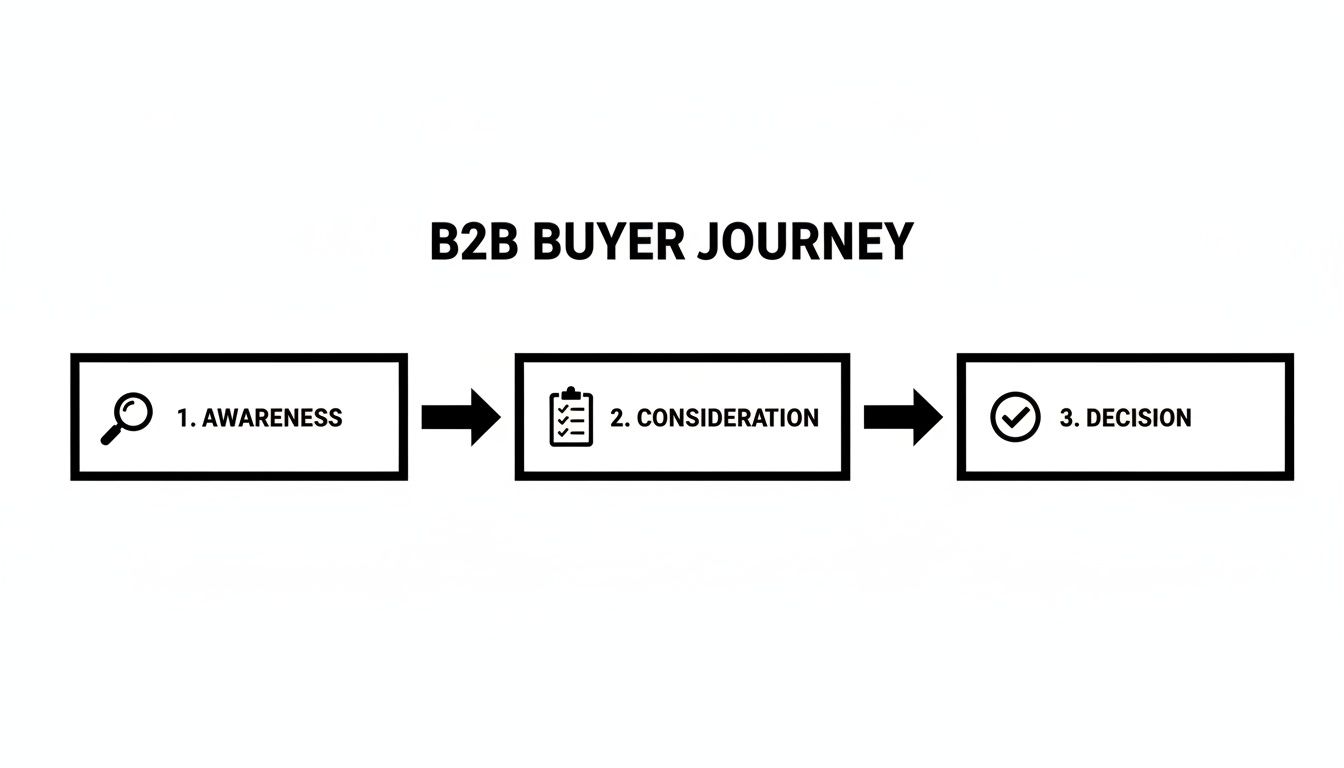
As you can see, a smart content strategy doesn't just sell; it nurtures. It meets prospects where they are with the right information at the right time, building a foundation of trust along the way.
Establish Authority with Thought Leadership
Thought leadership isn't just having an opinion. It’s offering a unique perspective that changes how your audience sees their own industry. When you do it right, you stop being just another vendor and become an essential resource. This is how you earn trust long before a sales conversation ever begins.
Actionable Insight: Look for "common knowledge" in your industry that is outdated or wrong. Craft a well-reasoned LinkedIn post that challenges it. For instance, "Everyone says you need a massive email list. We'll argue you only need 1,000 true fans. Here's why..." This contrarian take sparks debate and positions you as a forward-thinker. Did your CEO give a killer conference presentation? Repurpose the best slides into a punchy carousel post.
Prove Your Value with Compelling Case Studies
Every B2B buyer is worried about one thing: risk. Case studies are your single best tool for showing them they're making a safe bet. They offer concrete proof that you can deliver on your promises.
But a link to a dry PDF won’t grab anyone's attention on social media. You have to tell a story.
Instead of just listing facts, frame your case studies as a simple, powerful narrative:
The Challenge: What specific pain was the client dealing with? Make it relatable.
The Solution: How did your product or service fix it? Keep it concise.
The Result: Hit them with the hard numbers. Think "50% reduction in support tickets" or "30% increase in qualified leads."
One of the best ways to do this is with a LinkedIn carousel. Each slide can build on the last, telling a complete story that makes the impressive results feel both real and achievable for the person scrolling.
B2B buyers are looking for validation. A well-told case study on social media doesn’t just show what you did; it allows a prospect to see their own success story in your client’s win.
Simplify Complexity with Short-Form Video
Let's be honest, most B2B products are complex. Explaining them with text alone can be a real struggle. Short-form video—think under 90 seconds—is your secret weapon for breaking down complicated topics into bite-sized, engaging clips.
This is your chance to show the real people behind your logo and make your solution feel less intimidating. You don't need a massive production budget. Just focus on:
Quick Feature Demos: A simple screen recording walking through one powerful feature can be incredibly effective. Actionable example: Record a 60-second clip showing how your software's new filtering feature can save users 30 minutes a day. No fancy editing needed.
Answering FAQs: Have a team expert hop on camera to answer a common customer question. It's authentic and builds instant credibility.
Showcasing Company Culture: A quick clip from a team outing or volunteer day reminds people they're buying from other humans.
A modern smartphone and decent lighting are all you need to create valuable content for platforms like LinkedIn or YouTube Shorts. The goal is clarity, not a Super Bowl commercial.
Spark Conversations with Interactive Content
The final piece of the puzzle is to stop the scroll and get people involved. Interactive content like polls, quizzes, and open-ended questions turns passive viewers into active participants.
This makes your audience feel seen and heard, but it's also a fantastic way to gather direct feedback from the market. Actionable example: Post a simple LinkedIn poll asking, "What's your biggest challenge with [industry topic]? A) Budget, B) Team bandwidth, C) Proving ROI, D) Other (comment below)." This not only drives engagement but also gives you a goldmine of content ideas for your next blog post or webinar.
The data backs this up. A staggering 80% of B2B social leads come from LinkedIn alone, making it the perfect place for these tactics. And since 62% of buyers say social content influences their purchasing decisions, engaging them directly is one of the most powerful things you can do. You can dig deeper into the numbers by checking out this detailed report on B2B social media statistics.
Measuring B2B Social Media Success and Proving ROI
Likes and follows are nice, but they don't exactly keep the lights on. The real test for any B2B social media pro is proving its worth in real dollars and cents—showing a clear return on investment (ROI). Your boss, and their boss, couldn't care less about your follower count. They want to see revenue, leads, and growth.
To keep your budget (and maybe even grow it), you have to connect the dots between your social media activity and the company's bottom line. It’s all about turning that "engagement" into something tangible.
Moving Beyond Vanity Metrics
The first step is a mental one. Sure, metrics like reach and impressions tell you people are seeing your content, but they don’t tell you if anyone actually cares or if it's moving them to act. You need to focus on KPIs that track influence and, ultimately, conversion.
These metrics start to paint a much clearer picture of your actual impact:
Engagement Rate: This isn't just about likes. A high engagement rate on a post that links to a detailed case study is a powerful signal that you're attracting the right kind of attention from potential buyers.
Website Referral Traffic: Pop open your analytics. How many people are actually clicking through from your social channels to your website? Actionable insight: Use UTM codes on all your social links (e.g.,
?utm_source=linkedin&utm_medium=social&utm_campaign=q3-webinar) to see exactly which posts are driving traffic in Google Analytics.Click-Through Rate (CTR): This measures how many people who saw your post cared enough to click the link. A strong CTR on a webinar sign-up link tells you your message and call-to-action are hitting the mark.
Ultimately, you need to answer one question: "How is social media helping us get and keep customers?" Every KPI you track should bring you closer to a solid answer.
Tracking KPIs That Matter to the C-Suite
If you really want to prove your value, you need to speak the language of the executive team. That means tracking metrics tied directly to sales and marketing goals, like the quality of your leads, how much it costs to get a new customer, and where revenue is coming from.
This has become absolutely critical, especially with paid social. A whopping 83% of B2B marketers are now running social media ads, so it's a noisy, competitive space where ROI is king. With total ad spend soaring to $276.7 billion and growing faster than other channels, you can't just throw money at it and hope for the best. You can discover more insights about social media advertising trends on sproutsocial.com.
To build a rock-solid business case, zoom in on these high-impact metrics:
Social-Sourced MQLs (Marketing Qualified Leads): How many leads coming from your social channels are good enough to hand off to the sales team? You can't guess here; you need your social platforms integrated with your CRM to track this properly.
Lead Quality from Social: Are the leads you get from LinkedIn better than the ones from X? By analyzing which platforms deliver leads that actually turn into customers, you can get much smarter about where you spend your time and money.
Impact on Customer Acquisition Cost (CAC): A great social media strategy can actually lower your CAC by attracting high-intent prospects organically. If you can prove that leads from social cost less to acquire than leads from other channels, you've just made a powerful argument for your strategy's efficiency.
Connecting these dots isn't magic—it requires a solid technical foundation. You'll need to use UTM parameters on all your links and have a well-configured CRM. This setup lets you follow a person's journey from their first click on a social post all the way to a closed deal, giving you undeniable proof of your ROI. If you're ready to get into the weeds, our guide on how to measure social media ROI breaks down the entire process.
Building a Scalable B2B Social Media Workflow
Let's be honest: a brilliant B2B social media strategy is just a nice document without a system to bring it to life consistently. The real goal isn't to work harder; it's to build a repeatable marketing engine that delivers predictable results without burning out your team. A scalable workflow is what turns the daily social media scramble into a well-oiled machine.
It all starts with a solid foundation: your content calendar. Think of this as your single source of truth, a shared map that lays out themes, post types, and publishing dates weeks or even months ahead. This kind of foresight lets you line up your social campaigns with bigger business goals—like product launches or key industry events—making sure every single post has a purpose.
The Power of Content Batching and Repurposing
With your calendar in place, you can start batching your content creation. Instead of scrambling to create a post every day, block off dedicated time to produce a full week's or month's worth of content all at once. It's an incredibly efficient way to work, letting your team get into a creative flow instead of constantly switching gears.
But the real secret to scaling up? It's getting really, really good at repurposing your content. One big, high-value asset can easily fuel your social media calendar for weeks.
Don’t think of it as creating more content; think of it as getting more mileage from the content you already have. One webinar is not one asset—it's a dozen.
For example, take a single 45-minute webinar. You can slice and dice that into:
Five short video clips: Each one pulling out a key takeaway, perfect for LinkedIn or YouTube Shorts.
Ten quote graphics: Grab the most powerful statements and turn them into shareable images for X.
One detailed LinkedIn carousel: Break down the main points of the presentation into a visual summary.
One follow-up blog post: Embed the full webinar recording and go deeper on the topic.
This approach squeezes every last drop of value from your initial time investment, ensuring you always have a steady stream of high-quality, relevant content for all your channels.
Choosing the Right Tools to Streamline Operations
To make this entire workflow fly, you need the right tech stack. Investing in a few key tools can cut down on manual work and seriously amplify your reach. You'll want to look for platforms that handle scheduling, analytics, and employee advocacy. A good starting point is to explore guides that show you how to automate social media posting, as they can give you a solid framework for picking the right tools.
Here are the essential tool categories to consider:
Scheduling Platforms: These are non-negotiable. They let you batch-load your content and ensure it goes live at the best times, all without you having to press a button.
Analytics Dashboards: A unified dashboard is a lifesaver. It helps you track what’s working (and what isn't) across all your channels, so you can make smart, data-driven decisions on the fly.
Employee Advocacy Programs: These platforms make it incredibly easy for your whole team to share company content. This not only boosts your reach but also adds a layer of authenticity that you just can't buy.
Got Questions About B2B Social Media? We've Got Answers.
Jumping into B2B social media can feel a bit like navigating a maze. Everyone has an opinion, but solid, practical answers can be hard to find. Let's clear up some of the most common questions marketers get stuck on so you can move forward with confidence.
How Often Should We Actually Be Posting?
This is the million-dollar question, isn't it? But the answer isn't about hitting a magic number. Consistency trumps frequency, every single time.
Instead of churning out low-value posts just to stay "active," focus on showing up reliably with great content. For most B2B brands, posting 3-5 times per week on your main channel (like LinkedIn) is the sweet spot.
Here’s a practical weekly schedule you can steal:
Monday (Insight): Share a third-party article with your commentary. "Great read from [Publication] on the future of AI in logistics. Our take: the real challenge isn't the tech, it's the implementation. Here's what we mean..."
Wednesday (Value): Post a short, practical tip. "Pro Tip: Stop using vague email subjects. 'Quick Question' gets ignored. 'Question about your Q3 content strategy' gets opened. Try it."
Friday (Engagement): Ask a smart, open-ended question. "What's one task you wish you could automate in your workflow right now? Curious to hear what's slowing people down."
This approach keeps your brand visible without burning out your team or annoying your audience. The goal is to become a dependable source of insight, not just another voice in the noise.
How Can I Get My Team to Share Our Content?
Your employees are your secret weapon. Their networks are gold, but you can't just expect them to become brand advocates overnight. The key? Make it ridiculously easy for them.
Think about it: a post from a person feels more authentic and trustworthy than one from a brand logo. When your team shares, they're not just amplifying your message; they're adding their own credibility to it. It’s the difference between a broadcast and a real conversation.
Actionable Insight: Set up a dedicated Slack channel (e.g., #social-sharing) where you drop ready-to-go content. Provide three different copy options for each post—one formal, one casual, one question-based. This way, all they have to do is copy, paste, and maybe add a personal touch. By removing all the friction, you empower them to become your best marketers.
Is Social Media Pointless for a "Boring" Industry?
Not at all. Let's reframe this: there are no "boring" industries, just uninspired marketing. Whether you're in logistics, manufacturing, or enterprise software, your customers are still people who need help solving problems.
The trick is to shift your focus. Stop talking about your product and start talking about your customer's world.
Practical example: A company that sells industrial ball bearings shouldn't be posting glamour shots of ball bearings. They should be posting content like:
A video titled: "3 Telltale Signs Your Manufacturing Equipment is Headed for a Breakdown."
A LinkedIn post: "We analyzed 500 equipment failures. 70% had this one thing in common. A thread..."
An infographic: "Calculating the True Cost of Unplanned Downtime."
See the difference? You're not selling a product; you're selling a solution to a painful problem. When you become the go-to resource for solving those problems, you'll earn your audience's trust and attention, no matter how niche your industry is.
Ready to transform your B2B social media from a manual chore into a powerful growth engine? NicheTrafficKit uses AI to automate everything from content creation and scheduling to trend research and analytics. Stop guessing and start scaling. Start your free trial today and see how thousands of marketers save hours while driving real results.