
What Is The Best Time To Post? whats the best time to post on instagram
Unlock whats the best time to post on instagram with data-backed insights, practical tests, and proven tips to boost engagement and reach.
If you've ever Googled "what's the best time to post on Instagram," you’ve probably seen the same answer pop up again and again. Let's get that out of the way first. Broadly speaking, the data points to weekdays between 11 AM and 6 PM as a solid bet, with another little spike in the evening from 8 PM to 10 PM.
Why? It’s pretty intuitive. These windows usually catch people during their lunch breaks and when they’re winding down at night, scrolling through their phones. A practical example is an office worker who checks their feed at 1 PM while eating a sandwich, or a student scrolling through Reels before bed at 9:30 PM.
The "Best" Posting Times And Why It’s Deeper Than That

While those generic time slots are a decent starting point, that's all they are—a starting point. Think of them like a basic recipe. It gives you a good foundation, but the real flavor comes when you start tweaking the ingredients to match what your dinner guests actually like.
The problem with a "universal" best time is that it completely ignores the unique habits of your followers. Your audience—whether they're college students pulling all-nighters or professionals up at the crack of dawn—has its own distinct daily rhythm. Posting based on a generic chart means you're missing the most important piece of the puzzle: your community's real-life behavior.
Why Data-Backed Averages Are Still a Good First Step
So, why even bother with these averages? Because they help you make an educated guess instead of just throwing content at the wall and hoping it sticks. These widely shared peak hours are pulled from millions of posts, so they give you a proven foundation to build from. They tap into general human patterns, like scrolling on the bus to work or catching up on feeds before bed.
These general trends aren't just for Instagram, either. You can see similar patterns across different platforms. We actually dive deeper into this in our guide on the best times to post on social media, which you can find here: https://nichetraffickit.com/blog/best-times-to-post-on-social-media.
The goal isn’t to find one magic hour that works forever. It's about understanding broad user trends and then zeroing in on the specific windows where your content will make the biggest splash.
For instance, one analysis of over two million posts found that midweek evenings—especially Thursdays at 9 PM—could give engagement a serious boost. That study saw huge spikes in likes and comments right around that time, with Wednesdays at 9 PM being a close second. It just goes to show that while broad windows are helpful, pinpointing specific hours can deliver incredible results.
Ultimately, your perfect posting time is where these general guidelines and your audience's unique habits meet. To really get the most out of every post, you'll want to pair smart timing with proven strategies to increase Instagram engagement.
In the sections ahead, we’ll walk you through exactly how to uncover that personalized, high-impact schedule for your own account.
Why Your Audience's Clock Is The Only One That Matters
Those articles claiming to have the universal best time to post on Instagram? You can pretty much ignore them. They're like a one-size-fits-all t-shirt—sure, it technically fits, but it never looks quite right on anyone.
The single most important shift you can make is to stop searching for a magic number and start looking at your specific audience's schedule. The real secret isn't a time, it's a deep understanding of the unique rhythm of your followers.
The Three Pillars of Perfect Timing
To get this right, you have to stop guessing and start thinking like a strategist. Your ideal posting time is found where three critical elements overlap, all of which are totally unique to your brand and its community.
Pillar 1: Audience Routine: This is everything. You have to get inside the head of your target follower. Are they students? Professionals? Stay-at-home parents? Actionable insight: Create a simple "audience persona." For example: "Our ideal follower is 'Marketing Maria,' age 32. She commutes by train from 8:15-8:45 AM, takes lunch around 12:30 PM, and unwinds on the couch after 8 PM." This simple exercise immediately gives you three potential time slots to test.
Pillar 2: Content Type: Not all content is created equal, and it isn't consumed in the same way, either. A funny, bite-sized Reel is perfect for a morning commute scroll, but a detailed, educational carousel post needs the kind of focused attention someone might only have during their lunch break.
Pillar 3: The Algorithmic "Golden Hour": Instagram’s algorithm is watching. It pays incredibly close attention to how much engagement a post gets in the first hour or so after it goes live. If you post when your audience is online and ready to interact, you give your content that critical early push of likes, comments, and shares that tells the algorithm, "Hey, this is good stuff!"
Think about it this way: a company that sells B2B software has an audience of busy professionals. It’s a safe bet they’re scrolling Instagram during their lunch break around 1 PM or after wrapping up the workday around 6 PM. Posting at 10 PM would be a complete waste, missing their peak activity window entirely.
The biggest mistake I see is brands treating all their followers like they live on the exact same schedule. The reality is that a B2B audience in London checks Instagram at completely different times than a teen audience in California. Your strategy has to account for that.
Putting It Into Practice: Audience-Centric Examples
Let's look at a couple of real-world scenarios to see why this is so important.
Imagine a fitness creator whose content is geared toward stay-at-home parents. Their audience is probably most active mid-morning, maybe around 10 AM, right after the chaos of school drop-off. That's their prime time for a quick scroll and some engagement.
Now, flip that completely. Think about a gaming influencer whose audience is mostly college students. They're going to see a massive spike in activity late at night, probably somewhere between 10 PM and 1 AM. Posting a new video at 10 AM would be pointless—their core audience is either in class or still asleep.
These examples make it crystal clear: there is no single answer. The best time to post isn't a static number but a dynamic window that changes based on who you're trying to reach. Once you start tuning into your audience's clock, you'll move from following generic advice to building a smart, effective posting strategy that actually works.
How To Find Your Personal Peak Posting Times
General advice is a great starting point, but it won’t unlock your account's true potential. To find the specific times that get your audience buzzing, you need to play detective with your own data. This isn't about getting lost in complicated analytics—it's about a simple, repeatable process of listening to what your followers are already telling you with every like, comment, and share.
The whole process boils down to understanding your audience's daily routine, the type of content that makes them stop scrolling, and how the Instagram algorithm reacts to that initial burst of engagement.
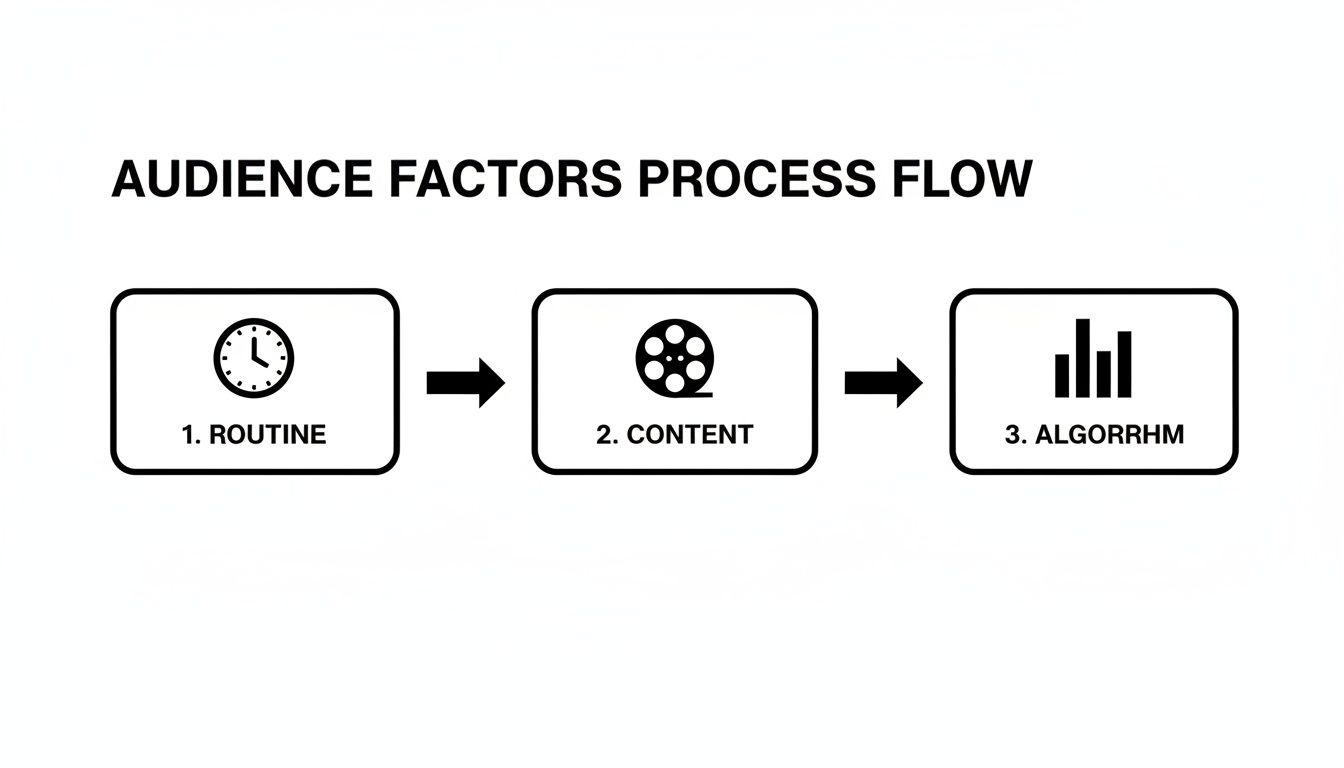
As you can see, your ideal posting times are found right at the intersection of your audience’s habits, your content, and the algorithm’s critical first-hour window.
Let's walk through the exact steps to pinpoint your personal engagement goldmine, so you can move from educated guesses to data-backed decisions.
Step 1: Look Into Your Instagram Insights
Your first clues are hiding in plain sight, right inside the Instagram app. If you have a Business or Creator account, Instagram Insights is an absolute goldmine of information about who your followers are and, most importantly, when they're actually online.
Actionable Insight: Go to your Profile > Professional Dashboard > Total Followers. Scroll to the bottom to find the "Most Active Times" chart. Don't just glance at it—take a screenshot. This image is now your starting hypothesis for the best times to test. For example, if it shows strong activity on Wednesdays at 6 PM, that becomes your first test slot for next Wednesday.
Step 2: Create a Simple Testing Schedule
Armed with your audience activity data, the next move is to set up a structured experiment. Don't just post whenever you feel like it; a systematic approach is the only way to get clear, reliable results. The goal here is to test different time slots consistently over a few weeks.
Here’s a simple way to approach it. Pick your most active days and test three key windows:
Morning: Maybe around 9:00 AM to catch people on their morning commute.
Midday: Try 1:00 PM to target the classic lunch break scroll.
Evening: Post at 8:00 PM when people are winding down for the day.
Map this out for at least a few weeks. A well-organized plan is crucial for accurate testing, which is why we always recommend using a tool to create a content calendar. It keeps you honest and ensures the data you collect is actually useful.
Here's an example of what a simple test schedule could look like. You can use this framework to systematically test different posting times and discover what truly resonates with your specific audience.
Example Posting Time Test Schedule
Day | Week 1 Test Slot | Week 2 Test Slot | Week 3 Test Slot | Key Metric to Track |
|---|---|---|---|---|
Tuesday | 9:00 AM | 1:00 PM | 8:00 PM | Comments |
Wednesday | 1:00 PM | 8:00 PM | 9:00 AM | Saves |
Thursday | 8:00 PM | 9:00 AM | 1:00 PM | Reach |
Friday | 9:00 AM | 1:00 PM | 8:00 PM | Shares |
After running this for a few weeks, you'll have a much clearer picture of which time slots are driving the most meaningful engagement for your account.
Step 3: Track The Right Performance Metrics
Hitting "Publish" is only half the job. The real answers are found in tracking the results, especially within the first few hours after posting—that’s the critical window when the algorithm decides how widely to show your content.
Focus on these key metrics for each test post:
Reach: How many unique accounts saw your post?
Likes: The most direct measure of initial appeal.
Comments: A powerful signal of high engagement and community interaction.
Shares & Saves: These show your content is genuinely valuable and resonates deeply.
Actionable Insight: Create a simple spreadsheet with columns for: Date, Time Posted, Content Type (e.g., Reel, Carousel), Reach (1hr), Likes (1hr), Comments (1hr), and Saves (1hr). Set a timer for 60 minutes after you post and fill in the data. This "golden hour" data is the most important for your analysis.
Step 4: Analyze Your Results to Find Your Best Times
Once you have a few weeks of data, it’s time to connect the dots. Look for the days and times that consistently delivered the highest reach, comments, and saves. You’ll probably find that Tuesdays through Thursdays stand out as powerhouse days, with engagement windows from 11 AM to 6 PM driving the most interactions.
Practical Example: Looking at your spreadsheet, you might see that posts at 1 PM on Wednesdays consistently get the most Saves, while posts at 8 PM on Thursdays get the highest Reach. This tells you to schedule educational carousels on Wednesday afternoons and entertaining Reels on Thursday evenings.
This four-step process transforms you from a content creator who guesses into a strategist who knows. By systematically testing and measuring, you can confidently figure out the absolute best time to post on Instagram for your unique audience.
Posting Strategies For A Global Audience
Figuring out the best time to post gets tricky when your audience is scattered all over the map. What do you do when your biggest fans are in Los Angeles, London, and Sydney? This is a great problem to have, but it means you need to stop thinking local and start thinking global.
The secret is finding a "sweet spot" that hits multiple time zones while people are active. Instead of just posting in your own afternoon, you have to consider how that time translates for everyone else. A single, smartly timed post can catch different segments of your audience just as they’re starting their day, taking a lunch break, or winding down.
To pull this off, you need to become a student of your audience's geography. The first step is to dive right back into your Instagram Insights. Pinpoint your top cities and countries—this data is the bedrock of your global strategy. It tells you exactly which clocks you need to get in sync with.
Finding Your Global Sweet Spot
Once you know where your followers are, you can start looking for overlapping windows of high activity. The goal isn't to find a time that's perfect for everyone, but a time that's pretty good for the largest chunks of your audience.
A classic move is to post early in the morning, North American time. Let's say you post at 7 AM EST. You’ll catch the East Coast crowd as they're waking up and starting their commute. But at the same time, it’s already midday in Europe (12 PM in London, 1 PM in Berlin)—prime time for people scrolling through their phones on a lunch break. Just like that, one post serves two massive continents.
This strategy is all about maximizing your impact. You’re not trying to be perfect for everyone, but strategic for the majority. It's better to be great for 70% of your audience than just okay for 100%.
Some data even points to very early mornings as a powerful, and often overlooked, window for global reach. Posting between 5-7 AM can catch people during their wake-up routines and commutes. In fact, one extensive analysis crowned 5 AM as a surprisingly effective time, with other performance spikes seen at 7-9 AM and 11 AM-1 PM across various time zones. You can dive deeper into the data from over 6 million posts in this Instagram analysis from Later.com.
Tailoring Content To Your Global Strategy
Your content format can also play a huge role in your global strategy. Not every post has to be for every single follower. You can start mixing and matching formats to strategically target different segments of your audience.
Here's how that might look in practice:
Broad Reach Content: Use pre-recorded Reels and carousels for your global "sweet spot" times. Practical Example: Schedule a highly shareable Reel to post at 7 AM EST to hit both North American and European audiences.
Targeted Engagement Content: Schedule things like Instagram Live sessions or Q&A Stories for the peak time of your most engaged time zone. Practical Example: If your Insights show your top city is Sydney, Australia, host a live Q&A at 8 PM AEST. Even if it's 3 AM for you in Los Angeles, this targeted event will build immense loyalty with that key audience segment.
This hybrid approach helps you stay visible to your entire global audience while creating high-impact, targeted moments for your core community. By blending broad scheduling with specific, format-driven targeting, you can effectively grow your Instagram presence across borders.
Using Smart Tools To Automate Your Schedule
So, you’ve done the hard work and figured out your peak posting times. Now for the real challenge: how do you actually hit those times consistently without it turning into a full-time job?
Manually posting at precise moments, especially if your audience is spread across different time zones, is a fast track to burnout. It's just not practical. This is where you graduate from analyzing your data to automating your strategy.
Smart scheduling tools are your secret weapon for turning those insights into a real, functioning routine. Think of them as your personal social media assistant, pushing your content live at the perfect moment for maximum impact—even while you're asleep. This isn't about taking a lazy shortcut; it's about gaining a strategic edge.
How Intelligent Schedulers Work
A modern scheduling tool is like having a data scientist working on your account 24/7. Instead of just giving you a calendar to plug times into, the best platforms dig into your account’s unique performance history to give you smart recommendations.
These tools analyze your past engagement to see exactly when your specific audience is most likely to be scrolling and interacting. They pinpoint the days and hours that drove the most likes, comments, and shares on your best posts, taking all the guesswork out of the equation.
Many top-tier platforms will even suggest optimal posting slots for you or offer a "publish at best time" button. It’s a simple feature that gives every piece of content the strongest possible start in that critical first hour after it goes live.
By automating your schedule, you free up valuable mental energy. Instead of constantly watching the clock, you can refocus on what truly matters: creating high-quality content that your audience loves.
Automation is also the key to maintaining the consistency that the Instagram algorithm loves. Whether you're posting to your feed or need to figure out how to schedule Instagram Stories, using a tool ensures your content pipeline never runs dry.
Key Benefits Of Using Automation Tools
Putting your schedule on autopilot does more than just save time—it gives you a massive strategic advantage. It lets you plan your content weeks or even months ahead, helping you build a more cohesive and professional-looking feed.
Here are the main upsides:
Flawless Consistency: Never miss a peak posting window again. Automation guarantees your content is published reliably, which builds trust with your audience and the algorithm.
Time Efficiency: You can batch-create and schedule all your content in one go. A task that used to eat up hours every week can be knocked out in a single, focused session.
Data-Driven Decisions: The best tools offer analytics that go way beyond Instagram’s native insights, helping you constantly refine your content strategy.
Global Reach Management: Easily schedule posts for different time zones without having to set an alarm for 3 AM.
Using the right tools can streamline your entire Instagram workflow, not just your timing. For a bigger-picture view, check out these top content creation tools for social media. Bringing automation into your process is the final piece of the puzzle, turning your Instagram from a reactive chore into a strategic powerhouse.
Got Questions? We’ve Got Answers.
Even with the best data in hand, a few questions always come up. Let's tackle some of the most common ones so you can fine-tune your Instagram strategy.
Do Reels and Feed Posts Have Different "Best" Times?
They absolutely do. You wouldn't schedule a late-night drama in a morning cartoon slot, right? The same idea applies here. Different content formats serve different purposes, and people consume them at different times.
Reels are all about quick, snappy entertainment. They tend to do incredibly well during commutes (7-9 AM) or when people are winding down for the night (8-11 PM). These are the moments when your audience is looking for a quick laugh or a bit of escapism, not a deep dive.
On the other hand, a detailed carousel or an educational infographic asks for more attention. These often shine during a lunch break (12-2 PM) when someone has a few minutes to sit down, focus, and really digest what you're sharing.
Actionable Insight: Look at your top 5 best-performing Reels. Note the time they were posted. Do the same for your top 5 carousels. You will almost certainly see two different "peak time" patterns emerge. Use this data to create separate posting schedules for each format.
How Often Should I Post to Grow My Account?
Here's the truth: consistency trumps frequency. The algorithm values a steady, reliable posting rhythm much more than a frantic burst of mediocre content. For most brands and creators, posting high-quality content 3-5 times a week is the sweet spot.
This cadence keeps your audience engaged without leading to your own creative burnout. Focus on making those feed posts count, and use Instagram Stories for your daily, more casual check-ins and behind-the-scenes moments.
My Audience is Global. Which Time Zone Do I Focus On?
Your Instagram Insights is your best friend here. Head over to the follower analytics and look at the "Top Locations" to see which cities and countries your followers call home. This is your road map.
If you notice a few key regions dominating the list, find a time that overlaps nicely for the majority. For example, posting at 4 PM EST is perfect for catching your American audience as their workday ends, while simultaneously reaching your UK followers during their evening scroll.
What if your audience is scattered all over the map? Try testing a universally popular time like 7 AM EST. This hits the morning crowd in the Americas and catches the afternoon scrollers across Europe, giving you a pretty wide net with one post.
I Missed My Best Time. Should I Delete and Repost?
I'd advise against it. Deleting and immediately reposting the same content can look a little strange to the algorithm—sometimes even spammy. The potential hit to your reach just isn't worth the risk.
Instead of seeing it as a mistake, treat it as a data point. Take note of how the post performs and let it be a reminder of why your optimal schedule matters. If the post is too important to let slide, a much better move is to share it to your Stories with a strong call-to-action, driving your followers back to the feed to check it out.
Ready to stop guessing and start growing? NicheTrafficKit uses AI to analyze your unique audience, pinpoint your peak engagement times, and automatically publish your content for maximum impact. Free up your time and let our smart automation handle the scheduling, so you can focus on creating content your followers will love. Start your free trial today at nichetraffickit.com.