Unlock Growth with trending hashtags on facebook: A Fast, Actionable Guide
Discover trending hashtags on facebook to boost reach and engagement with practical tips, real-world examples, and proven strategies.
Tapping into the right trending hashtags on Facebook is one of the most direct ways to get your content in front of an audience that's already looking for it. A sharp hashtag strategy basically gives the algorithm a roadmap, helping it categorize your posts and serve them up to users who are most likely to engage.
Why Trending Facebook Hashtags Still Matter Today
I get this question all the time: do hashtags even work on Facebook anymore? The truth is, they absolutely do—but only if you use them strategically. They aren't just for show; they're functional tools that help Facebook’s algorithm make sense of your content and push it out to fresh, relevant audiences.
Think of it less as a visibility booster and more as a discovery tool. When someone clicks on or searches for a hashtag you've used, your public post can show up in that curated feed. Suddenly, your brand is front-and-center for people who have already raised their hand to say, "I'm interested in this!" That kind of targeted exposure is gold compared to just crossing your fingers and hoping your content finds its way.
A Real-World Scenario
Let's say you run a small online boutique focused on eco-friendly clothing. You could slap generic tags like #fashion or #style on a post about your new collection, but you’d be instantly drowned out by millions of others. It’s a needle-in-a-haystack situation.
Instead, you do a little digging and find a niche, trending hashtag like #SustainableStyleFinds. It’s gaining momentum with environmentally conscious shoppers. By adding that one specific tag, you’re creating a direct line to a pre-qualified audience. This simple pivot can drive a serious spike in website traffic and sales because you're reaching people who are actively looking for exactly what you sell. Understanding this dynamic is key when you consider all the essential website traffic sources, including social media that can grow your business.
The Data Behind the Trend
If you need more proof, just look at the numbers. The hashtag #trending has been used in a staggering 875 million posts worldwide. That alone shows how hungry both users and brands are to be part of what's popular right now. For smaller accounts, jumping on these trends can boost interactions by as much as 29%.
Key Takeaway: The goal isn't just to reach more people; it's to reach the right people. A thoughtful hashtag strategy shifts your marketing from broad and hopeful to precise and effective.
This targeted approach is fundamental if you want to seriously increase your reach on Facebook.
Finding Trending Hashtags Without Leaving Facebook
Believe it or not, you don’t need a bunch of fancy, expensive tools to figure out which hashtags are buzzing on Facebook. The platform itself is a treasure trove of real-time insights, as long as you know where to dig. By using Facebook's own features, you can catch trends right as they start to pop, making sure your content hits the mark every time.

This really comes down to being a good observer. A great starting point is to simply watch what the leaders, competitors, and major influencers in your niche are doing. Check out their best-performing posts—they’re often a dead giveaway for which hashtags are currently resonating with the audience you're trying to reach. This simple monitoring habit can give you a surprisingly accurate read on what's hot right now.
Put the Facebook Search Bar to Work
Your most direct tool is sitting right at the top of the page: the Facebook search bar. It's not just for finding old high school friends; it’s a powerful engine for discovering trends. When you type in a hashtag, say #ShopLocal, Facebook shows you more than just a list of posts. It gives you context, showing you how people are using it and even suggesting related tags.
Here’s an actionable example: Imagine you own a bakery.
Type
#bakinginto the Facebook search bar.On the results page, click the "Hashtags" filter on the left.
You'll see a list showing that
#bakinghas millions of posts (too broad!), but you might also see related tags like#HomeBakingChallengewith a smaller, more engaged audience. That's your sweet spot.
This process helps you find a hashtag popular enough to have an audience, but not so massive that your post vanishes in a second.
Keep an Eye on Relevant Facebook Groups
Facebook Groups are a goldmine. They are focused communities built around specific interests, hobbies, and industries, making them one of the best places to find hyper-relevant hashtags that broader tools often overlook. These are the places where trends are born.
Here’s an actionable way to use this:
For a local business: A real estate agent in a community group for "Austin, TX New Homeowners" might notice the hashtag
#AustinHomesForSaleis used in every other post. That's a clear signal to use that tag in all their local listings posts to connect directly with active buyers.For a niche hobby: A craft supply store owner could join a "Knitting & Crochet Circle" group and see
#HandmadeWithLovepicking up steam for holiday gift ideas. That's the perfect tag to add to their promotions for new yarn colors.
These smaller, community-focused hashtags can drive much more meaningful engagement because you're tapping into conversations people are already passionate about.
Lastly, don't forget to check out the "Topics to follow" feature. Facebook suggests these based on your own activity and interests. This section can point you toward broader trending subjects, which you can then narrow down into specific, relevant hashtags for your content. It’s a simple way to keep your strategy aligned with what people are actually talking about on the platform.
Using Third-Party Tools for Deeper Hashtag Insights
While Facebook's built-in features are great for a quick look, they really only scratch the surface. To get a real competitive edge with trending hashtags, you need to bring in the heavy hitters: third-party tools.
These platforms are where you graduate from just spotting trends to actually understanding them. They give you the hard data you need to make smart, strategic choices instead of just throwing hashtags at the wall and hoping something sticks.
For example, a B2B software company could use a specialized tool to spot an up-and-coming tag like #AIforAutomation weeks before it goes mainstream. By tracking its growth and engagement metrics, they can jump on it early, publish insightful content, and establish themselves as experts. They get to own that conversation before their competitors even know it's happening.
Going Beyond the Basics With Data
Dedicated hashtag finders and social listening platforms dig up a goldmine of information that Facebook itself just doesn't provide. They look at the metrics that truly tell you whether a hashtag is a winner or a dud.
A few key metrics you'll want to watch are:
Post Volume: This shows you exactly how many posts are using a hashtag over time. Is it a flash in the pan or a sustained trend?
Engagement Rates: How are people actually reacting? This looks at the average likes, comments, and shares on posts using the tag.
Potential Reach: This gives you an estimate of how many unique eyeballs your post could get in front of by using that hashtag.
This kind of data is invaluable. It helps you find that sweet spot: hashtags that are popular enough to get you noticed but not so oversaturated that your content is buried in seconds. For a detailed breakdown of different platforms, check out this excellent social media listening tools comparison.
Choosing the Right Tool for Your Needs
Not all tools are built the same. Some are basic hashtag generators, while others are full-blown analytics suites. Figuring out what you actually need is the first step.
The table below breaks down the key differences between what you can do directly on Facebook versus what a more robust third-party tool can offer.
Hashtag Research Tool Comparison
Feature | Facebook Native Tools | Third-Party Tools (e.g., Sprout Social) |
|---|---|---|
Basic Discovery | Excellent for seeing what's currently trending and exploring related tags. | Good, but often supplemented with deeper analytics. |
Historical Data | Very limited. You can only see current volume and recent top posts. | Comprehensive. Track a hashtag's performance over weeks, months, or years. |
Engagement Metrics | Not available. You have to manually check individual posts. | Detailed analytics on average likes, comments, and shares per hashtag. |
Audience Demographics | None. You can't see who is using or engaging with the hashtag. | Often provides insights into the demographics and locations of users. |
Competitor Analysis | Manual and time-consuming. Requires searching competitor pages one by one. | Automated tracking of which hashtags competitors are using and how they perform. |
Best Use Case | Quick, on-the-fly research for daily posts and spotting immediate trends. | In-depth campaign planning, strategic content creation, and performance analysis. |
As you can see, third-party tools provide a much deeper level of insight that's essential for building a long-term strategy. For instance, data from platforms like Sprout Social reveals that #trending is the absolute king on Facebook, used in over 743 million posts, dwarfing even perennial favorites like #love. A good tool helps you decide if you should jump into that massive conversation or focus on a smaller, more targeted niche tag.
Key Takeaway: The best tools don't just spit out a list of hashtags. They give you the context behind the trend, helping you understand its entire lifecycle. This lets you join the conversation at the perfect moment for maximum impact.
By taking the manual guesswork out of the equation, you free up a ton of time. If you want to streamline this even further, looking into a suite of social media automation tools can help you manage everything from research to scheduling and reporting, all in one place.
Choosing the Right Mix of Hashtags for Your Posts
Finding a list of potential hashtags is just the first step. The real magic happens when you start building the perfect combination for each individual post. A common mistake I see all the time is people just grabbing the biggest, most popular tags they can find. That's a surefire way to get your content completely lost in the noise.
Think of it like fishing. You could just throw a giant net into the middle of the ocean and hope for the best, or you could use specific bait in targeted spots where you know the exact fish you want are swimming. A smart hashtag strategy does both, giving you a shot at broad exposure while zeroing in on the people who are most likely to care about what you're posting.
The Power Trio of Hashtag Types
A winning strategy almost always involves a blend of three distinct types of hashtags. Each one serves a different purpose, and when they work together, they maximize both your reach and your relevance. This isn't about "hashtag stuffing"—it's about precision.
Here’s the breakdown I recommend to all my clients:
High-Volume Hashtags: These are the giants, the ones with millions of posts like
#SocialMediaor#Travel. Think of this as your lottery ticket. You'll use just one or two to give your post a chance to be seen by a massive, general audience.Niche & Community Hashtags: These are my favorite. They're much more specific and have a smaller but far more engaged following. Think
#SanDiegoFoodieor#VintageCameraGear. These connect you directly with a dedicated community that's actively looking for content just like yours.Branded Hashtags: This is a tag that's all yours, like
#NicheTrafficKitTipsor#JoesCoffeeRoasters. It's fantastic for building brand identity, collecting user-generated content, and giving your followers a single place to find everything you've ever posted.
Actionable Insight: Don't sleep on those smaller, niche hashtags. While a high-volume tag offers a chance at massive reach, niche tags give you a direct line to the people who are most likely to become actual customers and loyal fans.
A Practical Example in Action
Let’s put this into practice. Imagine a personal chef named Maria who wants to promote her new seasonal menu on Facebook. Instead of just slapping #food on her post and calling it a day, she builds a strategic mix.
Her High-Volume Tag: She starts with
#Foodie. It's huge, competitive, but it gives her post a chance to be discovered by anyone browsing for general food content.Her Niche Tag: Next, she adds
#PrivateChefLA. This is where she gets specific. It connects her with people in Los Angeles who are actively looking for or interested in private chefs—a highly qualified audience.Her Branded Tag: Finally, she includes her own
#ChefMariaCooks. This tag reinforces her personal brand and, over time, creates a beautiful, searchable portfolio of her work right on Facebook.
With just this simple, three-part mix, Maria’s post is now set up to attract a wide audience, connect with high-intent local prospects, and strengthen her own brand identity. It's a world away from just using ten generic food tags. This balanced approach ensures your content about trending hashtags on Facebook isn't just seen, but seen by the right people.
Putting Your Hashtag Strategy Into Action (and Seeing if It Works)
So, you've done the research and have a solid list of hashtags. That’s a fantastic start, but the real magic happens when you put them to work and actually track what happens next. A strategy is just a theory until you test it, and this is how you turn those ideas into real, measurable growth.
First, let's get one thing straight about Facebook: it's not Instagram. Piling on a dozen hashtags might fly over there, but on Facebook, it just looks messy and desperate. It can even confuse the algorithm, making your post seem like spam.
How to Use Hashtags in Your Posts
Where you put your hashtags is just as important as which ones you choose. On Facebook, there's no debate about where they should go.
Keep them in the caption. For your post to get discovered, the hashtags need to be right there in the main text. The old Instagram trick of hiding them in the first comment is a complete waste of time on Facebook—the algorithm simply won't see them for search purposes.
Stick to 3-5. Seriously, less is more here. A handful of well-chosen, super-relevant hashtags gives Facebook all the context it needs without cluttering your post. Think of it as precision targeting, not a shotgun blast.
A smart approach involves blending different types of hashtags to cover all your bases—attracting a wide audience, zeroing in on your niche, and reinforcing your brand.
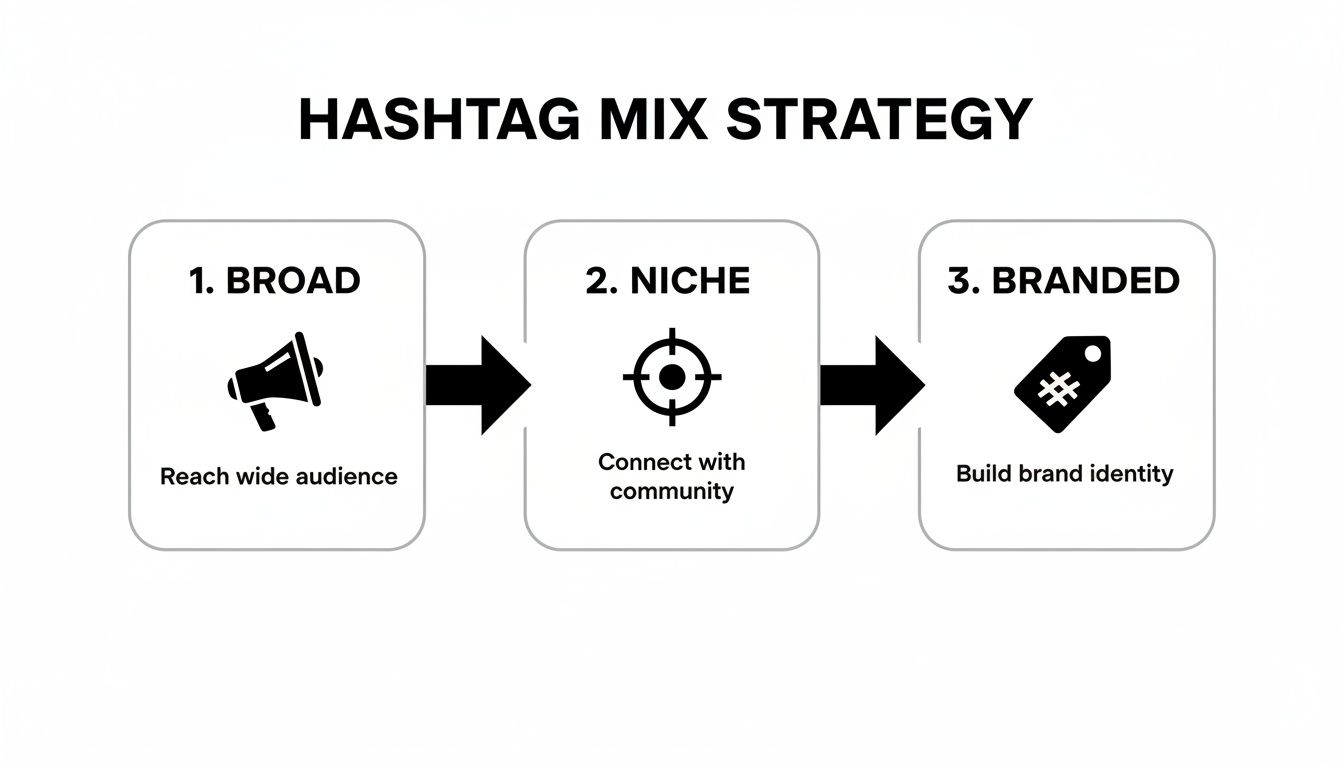
This balanced mix is how a single post can effectively reach different people, from casual scrollers to your ideal customers.
Tracking Your Results to Find What Works
If you’re not measuring, you’re just guessing. The only way to know if your hashtags are actually helping is to look at the numbers. Don't worry, this doesn't have to be complicated.
Head over to your Facebook Page's Insights tab and dig into your individual post analytics. Pay close attention to reach and engagement. While Facebook won't give you a neat little "reach from hashtags" number, you can connect the dots by comparing the performance of posts that used different hashtag combinations.
Actionable Tip: Keep a simple spreadsheet for this. Create columns for Post Date, Post Content, Hashtags Used, Reach, and Engagements. After posting for a few weeks, sort the sheet by 'Reach' or 'Engagements'. The top-performing posts will immediately show you which hashtag combinations are your winners. You'll literally see which are pulling their weight and which are duds.
This feedback loop is what allows you to stop guessing and start making data-backed decisions. If you want to go deeper into tracking your efforts, this guide on how to measure social media ROI breaks it down even further. By keeping an eye on the data, you can ditch the underperformers, double down on what’s working, and make sure every post gets the visibility it deserves.
Answering Your Top Facebook Hashtag Questions
Even with the best strategy, questions always pop up. It's often the little details that separate a post that soars from one that sinks. I've heard the same questions from marketers time and time again, so let's clear up the confusion around using trending hashtags on Facebook.
Think of this as your go-to FAQ for getting your hashtag game just right.
How Many Hashtags Should I Actually Use?
This is a big one. While Facebook doesn't put a hard limit on it, less is definitely more here. The sweet spot is 3-5 highly relevant hashtags per post.
Forget the Instagram "hashtag cloud" approach. On Facebook, stuffing your caption with too many tags looks spammy and can actually hurt your post's performance. The audience just doesn't respond well to it.
The key is quality, not quantity. A solid mix usually looks something like this:
One broad/trending tag: Example:
#MarketingTwo niche tags: Example:
#DigitalMarketingTips,#SEOforBeginnersOne branded tag: Example:
#YourCompanyName
Caption or First Comment: Where Do the Hashtags Go?
For Facebook, there's no debate. Always put your hashtags directly in the post caption.
The platform's algorithm is designed to scan the original post's text to categorize it and show it in search. Placing them in the comments is a completely wasted effort.
Practical Example: Correct: "Here's our latest blog post on SEO! Hope you find it helpful. #SEO #MarketingTips #YourBrand" Incorrect: Placing
#SEOand other tags in the first comment of the post. They will not be indexed for discovery.
That popular Instagram trick of hiding hashtags in the first comment to keep the caption clean is totally useless on Facebook.
Can Using an Irrelevant Trending Hashtag Backfire?
Yes, and it's a mistake I see people make all the time. It's tempting to jump on a huge trend, but using an unrelated hashtag will absolutely hurt you in the long run.
Sure, adding #TaylorSwift to a post about your new accounting software might get you a momentary blip in impressions. But you’re attracting the wrong crowd.
This mismatch sends a terrible signal to the Facebook algorithm. When thousands of people see your post but almost no one engages, the platform flags it as low-quality content. This can throttle the reach of that post and your future ones.
Remember, relevance will always beat reach. It’s far better to connect with 100 people who are genuinely interested in what you have to say than to get a fleeting glance from 1,000 who couldn't care less. Real growth comes from building a real audience, not chasing vanity metrics.
Ready to stop guessing and start growing? NicheTrafficKit uses AI to research viral trends and generate the perfect platform-specific posts, captions, and hashtags for your brand. Reduce your social media workload from hours a week to minutes a month. Start your free trial today at NicheTrafficKit and see the difference automation can make.