Finding The Best Time to Post on Instagram: A Practical Guide
Discover the best time to post on Instagram with our data-driven guide. Learn how to analyze your unique audience data and boost your engagement.
If you've ever Googled "best time to post on Instagram," you've probably seen the same answers everywhere: post between 11 AM and 1 PM or from 7 PM to 9 PM on weekdays. And to be fair, those are solid starting points. They generally line up with lunch breaks and evening wind-down time when people are glued to their phones.
But let's be real—relying on those generic benchmarks alone is like trying to find a specific address in San Francisco using a map of New York. You're in the right country, but you're not going to get where you need to go. This guide provides actionable insights to help you move beyond generic advice and find the specific, high-impact posting times that work for your unique audience.
Why There’s No Magic "Best Time to Post"
Everyone is looking for that silver bullet, that one perfect time slot that guarantees a flood of likes and comments. The truth? It doesn't exist. The real magic happens when you stop looking for a universal answer and start digging into the unique habits of your audience.
Those widely-cited posting times come from massive studies that average out user behavior across millions of accounts. While helpful, they smooth over all the details that make your audience unique. The latest data from 2025–2026 studies consistently points to three broad daily peaks in local time zones: early morning (6–9 AM), midday (11 AM–2 PM), and evening (6–9 PM). But these are just foundational benchmarks.
Your Audience Has Its Own Rhythm
What truly dictates your best posting time are the real-world routines of the people who follow you. The difference can be night and day.
Imagine two totally different but successful accounts:
A neighborhood bakery in Boston: Their followers are most engaged between 7 AM and 9 AM while grabbing a croissant on their way to the office. Actionable Insight: The bakery should schedule a daily Reel at 8 AM EST showing fresh-baked sourdough hitting the shelves. This aligns perfectly with the morning commuter's mindset and routine, making them more likely to stop by. Posting that same Reel at 9 PM would completely miss the mark.
A video game streamer with a global following: Their fans are everywhere—from California to Germany to Japan. Their "best time" isn't a single hour. Actionable Insight: The streamer should post major announcements at 4 PM EST. This catches American teens after school, hits prime evening gaming time in Europe, and is still seen by early birds in Asia, maximizing global reach in a single strategic window.
The goal isn't just to catch people when they're online. It's to catch them in the right frame of mind to actually care about what you're posting. A motivational quote lands very differently at 7 AM on a Monday morning than it does at 10 PM on a Friday night.
The Big Picture: Factors That Shape Your Schedule
Your niche, the type of content you create, and where your followers live all have a massive impact on your ideal posting windows. And remember, the best times to post on social media can change drastically from one platform to the next.
Here are the key variables you need to consider:
Follower Location: Time zones are everything. If your audience is scattered, you need a strategy that accounts for that.
Audience Demographics: Are your followers college students with unpredictable schedules? 9-to-5 professionals scrolling on their lunch break? Or stay-at-home parents who are most active after the kids are in bed?
Your Industry: A B2B tech account will likely see engagement spike during business hours. A travel influencer’s content will probably perform best on weekends when people are dreaming up their next vacation.
Content Format: A quick, hilarious Reel is perfect for the morning commute. A deep-dive educational carousel post, on the other hand, is better for the evening when people have more time to read, absorb, and save.
Instead of chasing a generic answer, this guide will walk you through how to uncover your own high-impact posting schedule, tailored specifically for your account.
Finding Your Best Posting Times with Instagram Insights
Industry benchmarks are a fantastic starting point, but they're just educated guesses. The real, undeniable truth about the best time to post on Instagram for your account is already waiting for you, tucked away inside your own data. Your Instagram Insights is a goldmine, showing you exactly when your followers are most active.
Getting to this data is simple. If you have a Professional account (either Creator or Business), just head to your profile and tap the "Professional Dashboard" button. From there, you’ll find all the analytics you need on your audience's behavior.
This simple process is the core of a data-driven posting strategy.
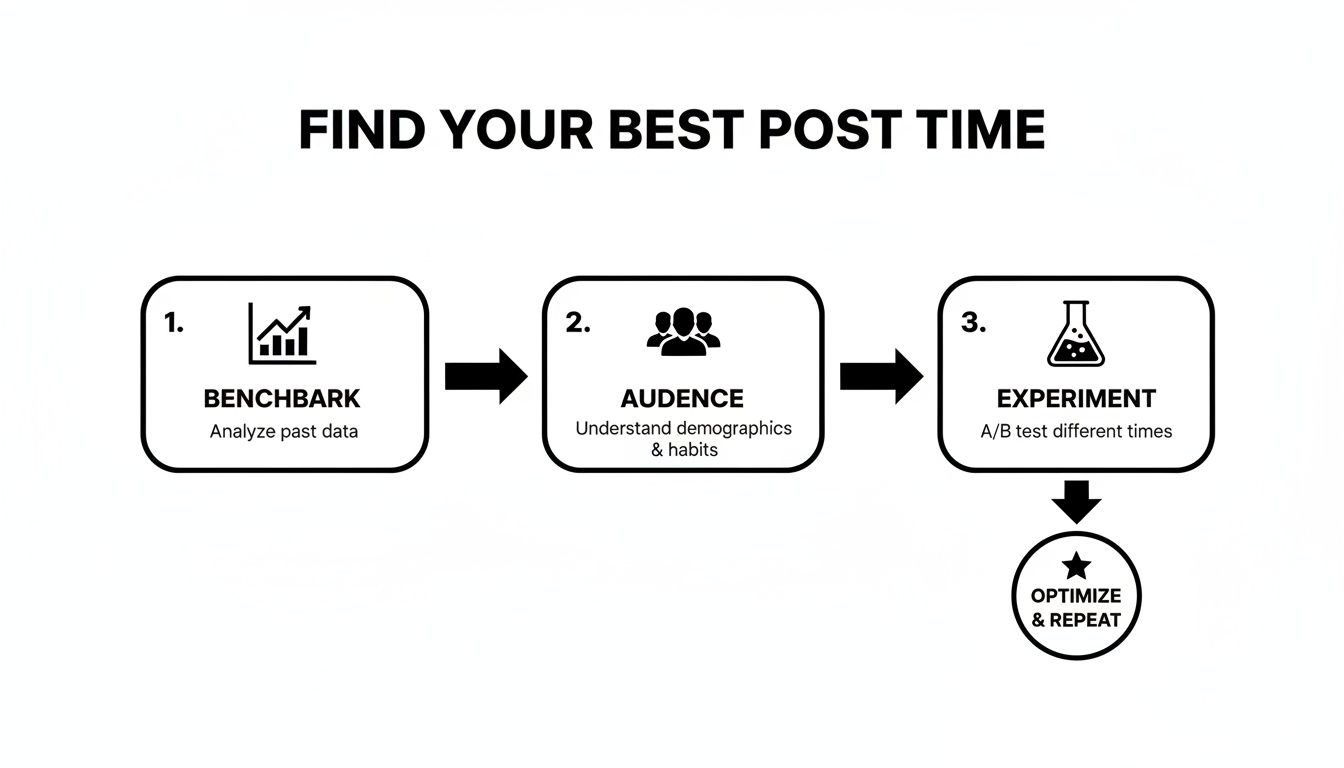
Think of it as a continuous cycle: benchmark, analyze, experiment, and repeat. This keeps your schedule perfectly in sync with your audience's habits, even as they change over time.
How to Read Your Audience Activity Chart
Once you're in your insights, find the "Total Followers" section and look for "Most Active Times." This brings up a colorful bar chart that maps out when your followers were online over the last week. This chart is your personal roadmap to higher engagement.
Actionable Insight: Don't just give it a passing glance. You're searching for consistent peaks in activity, not just random spikes. A single busy hour on a Saturday could be a fluke, but if you notice a strong, recurring peak every Tuesday and Thursday around 6 PM, that's a reliable pattern you can build a strategy on. Treat these recurring peaks as your top-priority posting slots.
The taller the bars, the more followers are active. Pinpoint the days and hours with the highest, most consistent bars—these are your prime-time slots.
Turning Insights Into Action: A Real-World Scenario
Let's put this into practice. Imagine you're a freelance graphic designer. Based on general advice, you've been posting your best portfolio pieces at 3 PM on Fridays, thinking everyone is winding down for the weekend. For months, the engagement has been just... okay.
Frustrated, you finally dig into your Instagram Insights. What you discover is a complete surprise. While Friday afternoon shows decent activity, a much larger and more consistent peak appears every Tuesday morning between 8 AM and 10 AM. This is your lightbulb moment. Your audience of fellow creatives and potential clients isn't zoning out on Fridays; they're actively seeking inspiration at the start of their workday.
The most powerful data is your own. General benchmarks are a map, but your Instagram Insights is the GPS telling you exactly where to turn next. It reflects the real, current behavior of the people who chose to follow you.
Based on this new data, you run a simple test. You move your weekly portfolio showcase from Friday afternoon to Tuesday at 9 AM. The results are immediate and dramatic. Over the next month, you see:
A 40% increase in initial reach within the first three hours.
A 30% jump in post saves, a clear sign your content is hitting the mark.
More comments from other designers and inquiries from potential clients.
This one small adjustment, driven by your data, completely changed your content's performance. You weren't just posting when people were online; you were posting when they were in the right mindset to engage with professional, creative work.
Cross-Reference Activity with Post Performance
The final piece of the puzzle is connecting your audience activity data with your actual post performance. An active audience is one thing, but an engaged audience is what really moves the needle.
Actionable Insight: Go through your top-performing posts from the last three months. Create a simple list with two columns: the post description and the day/time it was published. Now, compare this list to the peak activity hours you just identified in your Insights.
If your most-saved Reel was posted at 7 PM on a Wednesday, and your activity chart shows a consistent peak at that exact time, you’ve confirmed a sweet spot. But if your best posts don't align with your peak hours, it's a huge sign that you have a massive opportunity to get even better results just by shifting your schedule. By combining these two data sets, you create a posting schedule that isn't just a guess—it's proven to work for your account.
It's Not Just When You Post, It's What You Post
Nailing the exact time your audience is online is a huge win, but it’s only half the equation. The real secret sauce is matching the right type of content to that specific moment. A successful Instagram strategy isn't just about scheduling; it’s about understanding your follower's mindset throughout the day and delivering exactly what they're in the mood for.
Think about it: a quick, funny Reel just doesn't hit the same as a deep-dive educational Carousel. One is for a quick laugh while waiting for coffee, and the other is for when you have a few minutes to learn something new. The best time to post on Instagram is less about a time slot and more about a specific context.

For instance, a fast-paced, 15-second Reel with a trending sound is a perfect match for that morning commute scroll between 7 AM and 9 AM. Your audience is looking for a burst of energy or a quick smile before their day gets serious. They simply don't have the bandwidth to swipe through a ten-slide tutorial.
On the flip side, that in-depth Carousel explaining a complex topic? That's prime content for a midday lunch break, somewhere around 12 PM to 2 PM. People have more time to sit, swipe, read, and—most importantly—save content they find valuable. Pushing that same high-effort post during the morning rush would likely get it swiped away and lost in the feed.
Match Your Content to Your Audience's Daily Rhythm
Every content format on Instagram has its own sweet spot. It’s not just a hunch; the data backs this up. A 2025–2026 analysis of over two million posts showed that Reels, Feed posts, Stories, and Lives all have different peak hours. In fact, one study found that Reels often do best between 9 AM–12 PM on weekdays, while Stories see more action from 4–6 PM, and Live videos capture attention during the 7–9 PM wind-down when followers have more uninterrupted time. If you're curious about the latest stats, you can find more Instagram posting trends on RecurPost.com.
Actionable Insight: Here’s a breakdown of how to think about pairing formats with your audience's schedule:
Instagram Reels: These are your attention-grabbers. Post high-energy, entertaining, or visually stunning Reels during peak scrolling times—think morning commutes, lunch breaks, and early evenings (7-9 PM).
Carousel Posts: Perfect for storytelling, tutorials, and deeper dives. Schedule these for times when your audience has a few minutes to spare, like their lunch break (12-2 PM) or later in the evening.
Single Image Posts: Ideal for big announcements, beautiful photos, or powerful quotes. They're versatile but can be especially effective during the afternoon slump (2-4 PM) when users are looking for a quick visual refresh.
Instagram Stories: The home for your casual, behind-the-scenes, and interactive content (polls, Q&As, etc.). Since they're more informal, you can post them throughout the day, but they often get great engagement in the late afternoon as people finish work.
The real goal here is to create a consistent rhythm that feels reliable to your followers. It’s less about chasing one magic time slot and more about building a predictable schedule where your audience knows when to expect great content from you.
Build a Content Calendar That Knows What to Post, and When
This is where a content calendar becomes your best friend. Instead of just plugging in topics, you'll start mapping specific content formats to your data-backed time slots. Planning this out in advance is a total game-changer for consistency and strategy. If you need help getting started, check out our guide on how to create a content calendar for a solid framework.
Let’s imagine a weekly schedule for a fitness coach whose audience is most active in the mornings and evenings.
Day | 7:30 AM (Morning Motivation) | 12:30 PM (Lunch Break) | 6:30 PM (Evening Wind-Down) |
|---|---|---|---|
Mon | Quick Tip Reel | — | Carousel: "5 Stretches for Desk Workers" |
Tue | — | Story Q&A Session | — |
Wed | Client Testimonial (Image) | — | Live Workout Session |
Thu | Motivational Quote (Image) | — | Reel: "Healthy 15-Min Dinner" |
Fri | — | Carousel: "Weekend Workout Plan" | — |
See the difference? This schedule isn't random. It strategically places high-energy Reels in the morning, saves the educational Carousels for when people have more time, and uses interactive content like a Live session during prime evening hours. When you align your content formats with the natural flow of your audience's day, you're not just scheduling posts—you're building a real content strategy.
How to Run Smart Experiments to Validate Your Schedule
Your Instagram Insights are a great starting point, but they only give you a hypothesis. Sure, the chart shows you when your followers are online, but the real test is seeing when they actually engage with your content. The only way to truly know the best time to post for your account is to stop guessing and start experimenting.
You don't need a fancy analytics suite for this. A simple A/B test is all it takes to turn your assumptions into a proven strategy. It's a straightforward process: you’ll pit two different time slots against each other to see which one consistently gets you better results.
This isn’t just for big brands with dedicated marketing teams. It’s a super practical approach that any creator or small business can use to pinpoint those unique engagement sweet spots.
Designing Your First Posting Time Experiment
To run a clean test, you have to isolate your variables. The whole point is to figure out if the time is what’s making the difference, not the content itself. If you post a killer Reel at one time and a low-effort photo at another, you'll completely skew your results.
Actionable Insight: Here’s a step-by-step guide to set up your experiment for reliable data:
Pick Your Test Slots: First, choose two different times to compare. A great place to start is testing your current go-to posting time (we'll call it Time A) against a new time suggested by your Instagram Insights (Time B). For example, if you always post at 6 PM, but your data shows a spike at 1 PM, those are your two contenders.
Keep Your Content Consistent: The posts you share in each time slot should be really similar in format and quality. For example, create two similar "quick tip" Reels. Don’t compare a beautifully designed Carousel to a blurry behind-the-scenes photo.
Alternate Your Days: Post one "quick tip" Reel at Time A on Monday (e.g., 6 PM) and the second one at Time B on Wednesday (e.g., 1 PM). This helps you avoid comparing a high-engagement Monday to a typically slower Saturday, which would muddy the waters.
The golden rule of A/B testing is to change only one thing at a time. In this case, that one thing is the posting time. Everything else—content format, caption style, topic—should be as consistent as you can possibly make it.
Run this test for at least two weeks. One week can always be an anomaly, but two weeks gives you a much more reliable set of data to spot a real pattern.
Tracking Your Results for Clear Winners
Now comes the fun part: measuring success. You’ll need to track the right metrics to see what’s working. A simple spreadsheet is perfect for logging the performance of each post—nothing fancy, just a way to see the numbers side-by-side.
Focus on the metrics that matter most for engagement and reach, especially within the first few hours of posting.
Here’s a simple template you can use to systematically track and compare the performance of your posts at different times. Just plug in your own data as you go.
A/B Test Tracking Template for Instagram Posting Times
Date | Post Content/Type | Time Slot (A or B) | Reach | Likes | Comments | Saves | Notes |
|---|---|---|---|---|---|---|---|
11/4 | Skincare Tip Reel | A (6 PM) | 2,105 | 154 | 12 | 28 | Good initial comments |
11/6 | Morning Routine Reel | B (1 PM) | 3,450 | 289 | 25 | 67 | More shares than usual |
11/11 | Product Demo Reel | A (6 PM) | 2,300 | 168 | 15 | 31 | Average performance |
11/13 | "Get Ready" Reel | B (1 PM) | 3,890 | 310 | 30 | 81 | Hit Explore Page briefly |
After a couple of weeks, add up the totals for your "A" posts and your "B" posts. The winner should be pretty obvious. This simple tracking method removes all the guesswork and gives you a clear, data-backed answer.
A Real-World Example: A Local Bakery’s Discovery
Let’s look at how this plays out in the real world. A small neighborhood bakery always posted their "daily special" photo at 10 AM, thinking they were catching people planning their lunch. The engagement was fine, but never great.
Their Instagram Insights, however, showed a huge activity spike around 4 PM. They decided it was time to run an A/B test.
Time Slot A: Their usual 10 AM post time.
Time Slot B: The new 4 PM time suggested by their data.
For two weeks, they posted similar high-quality photos of their daily specials—a croissant on Monday at 10 AM, a cupcake on Wednesday at 4 PM, and so on.
The results were undeniable. The 4 PM posts consistently received over 50% more likes and comments. They realized they weren’t just catching people planning lunch; they were catching the after-school crowd looking for a treat and adults thinking about dessert after dinner. This one simple experiment totally changed their Instagram engagement and directly led to more afternoon foot traffic.
Using Automation to Nail Your Posting Schedule
You've done the hard work of figuring out the perfect time to post on Instagram. But let's be realistic—manually posting at those exact times is a huge pain. If your audience is spread across the globe or you're juggling multiple accounts, trying to hit every peak window is a fast track to burnout.
This is exactly where automation shifts from being a nice-to-have to a strategic necessity.
Today’s scheduling tools aren't the simple "set it and forget it" apps of the past. The best platforms now have AI baked in, acting like a data analyst that works for you 24/7. Instead of you poring over Instagram Insights every week, these systems constantly crunch your account's performance data in the background.
They figure out when your specific audience is most likely to see and engage with your content, then adjust your schedule on the fly. This means your posting times are always based on fresh, current data, not a snapshot you took a few weeks ago.
Let AI Pinpoint Your Peak Engagement Windows
The most powerful feature of these tools is their AI-driven time-slot recommendations. This completely takes the guesswork out of the equation. The platform digs into your past post performance—looking at everything from reach and likes to comments and saves—and cross-references that with your followers' activity patterns.
What you get back is a "smart schedule" of recommended times that have the highest probability of success. It's like having a data scientist on call for your social media.
This approach gives you a few major advantages:
Time Zone Headaches Disappear: It automatically schedules posts for peak times in your audience's main time zones, making sure your followers in London see your content at their prime time, not yours.
It Adapts With You: The AI is always learning. If your audience's habits change, the recommendations adjust right along with them, keeping your strategy sharp.
A Glimpse into the Future: Some tools even offer predictive analytics, giving you an estimate of a post's potential engagement before you even publish it in a certain time slot.
Relying on automation isn't about being lazy; it's about being strategic. It frees you from the tedious job of manual scheduling so you can focus on what really matters: creating incredible content.
When you're ready to make your life easier, checking out some of the best social media automation tools is a great next step. You'll get a solid overview of the different platforms out there and what each one does best.
Automation in the Real World: A Multi-Client Agency
Picture a social media agency managing ten different client accounts. Each one has a completely different audience. One is a local restaurant, another is a B2B software company, and a third is an e-commerce brand with customers all over the world.
Manually analyzing insights and scheduling posts for each account’s unique peak times would eat up dozens of hours every single week. It's just not scalable.
By bringing in an AI-powered scheduler, the agency completely changes its workflow.
Actionable Insight: The platform automatically analyzes each account’s data and finds that the restaurant’s sweet spot is 11:30 AM on weekdays (for lunch specials). The B2B client needs to post at 9 AM on Tuesdays (when decision-makers are planning their week). And the e-commerce brand requires posts scheduled for 8 PM EST, 8 PM GMT, and 8 PM AEDT to cover its bases for peak evening shopping times in North America, Europe, and Australia.
The agency team just has to load the content. The tool handles the rest, pushing every post live at the perfect moment for maximum impact. This saves a staggering amount of time and, more importantly, delivers better, measurable results for every client.
Moving Beyond Scheduling to Full Automation
The most advanced platforms are now integrating scheduling with content creation itself. A tool like NicheTrafficKit, for instance, doesn't just tell you when to post; it can help generate platform-specific content to fill those time slots. This opens the door to a nearly hands-off system where an AI researches trends, creates content, and publishes it at the data-proven best times.
To see how that whole process comes together, check out our guide on how to automate social media posting. It walks through the end-to-end strategy. By combining smart scheduling with automated content creation, you can maintain a consistent, high-performing Instagram presence without being chained to your screen.
Still Have Questions About Instagram Posting Times?
You've got the data and the strategy, but a few nagging questions might still be bouncing around. That's completely normal. Let's tackle some of the most common ones I hear from brands and creators trying to nail down their timing.
Does Timing Matter if I'm Running Paid Ads?
Yes, it absolutely does. It’s easy to think that paying for reach makes timing irrelevant, but that's a missed opportunity. Think of it as giving your ad a running start.
Actionable Insight: When you launch a promotion during your audience's peak activity hours, you capture a wave of initial organic engagement. All those early likes, comments, and shares are powerful social proof. This tells the Instagram algorithm your content is valuable, which can lead to better ad performance, a lower cost-per-click, and a more effective use of your budget. For a new product launch, try running the ad from Thursday 7 PM to Sunday 9 PM to capture weekend shopping intent.
It's like opening a brand-new coffee shop. You could pay for a huge billboard, but you'll get way more customers if you also open your doors during the morning rush instead of at 10 PM.
My Audience Is All Over the World. How Do I Handle Different Time Zones?
A global audience means there's no single "magic hour" for everyone. The trick is to find the overlap. Your goal is to identify a few key windows that cover the most ground.
Actionable Insight: Dive into your Instagram Insights and pinpoint the top three to five cities or countries where your followers are. From there, look for times that hit multiple sweet spots. For example, a post at 8 AM EST is perfect for the morning scrollers on the US East Coast, but it also catches the lunchtime crowd across much of Europe. Similarly, posting at 9 PM EST can hit North Americans winding down for the evening and followers in Australia just starting their day. Focus your key posts in these high-overlap windows.
How Can I Be Sure That Changing My Post Times Is Actually Making a Difference?
The proof is in the data you collect. The secret is to look past the obvious metrics like likes and focus on the numbers that really show what's working.
Actionable Insight: When you A/B test your time slots, track these specific data points:
Reach in the first three hours: This is a fantastic indicator of how quickly Instagram is pushing your content. A big jump here tells you the timing is right.
Engagement Rate: Don't just count likes. Calculate your engagement rate (likes + comments + saves + shares) divided by your reach. This shows how receptive your audience is at that specific time.
Profile Visits & Website Clicks: If your goal is to drive action, this is your holy grail. Which time slot is actually sending people to your link-in-bio?
I once worked with a small e-commerce brand that noticed their 7 PM posts got fewer likes than their noon posts, but they generated three times as many website clicks. That data proved the evening slot was far more valuable for their actual business goals.
How Often Should I Re-evaluate My Posting Schedule?
Your audience's habits can and will change over time. As a general rule, it's a good idea to do a full review of your posting schedule at least twice a year.
Actionable Insight: Set a calendar reminder every six months to spend 30 minutes reviewing your Instagram Insights and top-performing posts. That said, you'll want to be more nimble if something big changes, like a major algorithm update or a shift in your business (e.g., you start targeting a new demographic). Staying agile means your schedule never gets stale.
Ready to stop guessing and start growing? NicheTrafficKit uses AI to analyze your unique audience and automatically publishes your content at the perfect time for maximum impact. Free yourself from manual scheduling and let data-driven automation build your brand. Start your free trial of NicheTrafficKit today.