Boost Social Media ROI: Practical Steps to Measure and Maximize Returns
Discover practical methods to measure, analyze, and maximize social media roi with actionable steps and real-world examples.
Social media ROI, or Return on Investment, is a simple but powerful idea. It measures the total value you get back from your social media efforts compared to everything you put in. In short, it tells you if your time, money, and resources are actually paying off.
It’s the proof that your strategy is more than just collecting likes and follows—it’s actively growing your business.
What Is Social Media ROI and Why It Matters
Think of your social media strategy like a vending machine. You wouldn't judge its success just by how many people glance at it, right? You'd want to know exactly how much money you spent stocking it (your investment) versus how much you made selling snacks (your return). That's precisely what social media ROI does for your marketing.
Your investment isn't limited to ad spend. It's the full picture: the cost of your scheduling tools, content creation, and even the salary hours your team dedicates to managing it all. Likewise, the return isn't always direct sales. It can be anything that holds real value, like qualified leads for your sales team, new email subscribers, or even a measurable lift in customer loyalty.
Calculating ROI is what separates wishful thinking from a winning strategy.
Moving Beyond Vanity Metrics
It's easy to get caught up chasing vanity metrics—things like likes, shares, and follower counts. They look impressive on a report and feel good, but they don't directly contribute to your bottom line.
A post with 10,000 likes that drives zero traffic is ultimately less valuable than a post with just 100 likes that brings in five new paying customers. Shifting your focus to ROI forces you to connect social media activity to tangible business goals. It's the difference between being busy and being effective.
Why Tracking ROI Is Non-Negotiable
If you’re not measuring social media ROI, you're essentially marketing with a blindfold on. Here’s why tracking it is so critical:
Justify Your Marketing Spend: Hard numbers are the best way to show stakeholders or clients that your social media budget isn't just an expense—it's a revenue-generating machine. For example, you can say, "We spent $1,000 on Facebook ads last month, which generated $4,000 in direct sales, giving us a 300% ROI."
Sharpen Your Strategy: When you know which platforms, campaigns, or content formats deliver the highest returns, you can double down on what works and cut what doesn't. You might discover your Instagram Reels drive more sales than your static posts, so you shift your content creation time accordingly.
Make Smarter Decisions: Consistent ROI tracking gives you the data you need for real strategic planning. It helps you set achievable goals and build a more predictable path to growth.
To help you get started, here's a quick breakdown of what goes into an ROI calculation.
The Core Components of Social Media ROI at a Glance
Component | What It Includes (Examples) | Why It Matters |
|---|---|---|
Investment | Ad spend, social media tools, content creation costs, agency fees, team salaries. | This is the "cost" side of the equation. You need a full accounting to understand your true expenses. |
Return | Revenue from sales, value of new leads, customer lifetime value (LTV), cost savings. | This is the "value" you generate. It must be a tangible business outcome, not just a vanity metric. |
Goals & Metrics | Conversion rate, cost per lead (CPL), lead close rate, website traffic, sign-ups. | These are the specific data points you'll use to connect your investment to your return. |
Ultimately, a clear understanding of these components is your first step toward building a truly effective social media presence.
At its core, understanding social media ROI is about mastering data-driven decision-making. It’s the practice of using hard numbers, not guesswork, to guide your strategy and prove that your social efforts are directly contributing to the bottom line. This approach is fundamental for any business aiming to grow sustainably.
How to Calculate Social Media ROI
So, how do you actually calculate the ROI from your social media efforts? It’s not about getting lost in complicated spreadsheets. It’s about drawing a straight line from your social media activity to your core business goals. This is where the rubber meets the road—turning all that data into a clear story about what’s working and what’s a waste of time.
It all starts with solid tracking. You absolutely need to have your analytics tools, like the native insights on each platform and Google Analytics, set up correctly from day one. More importantly, you must get comfortable with UTM parameters. Think of these special tags you add to your URLs as digital breadcrumbs. They let you trace every single click back to its origin, telling you if a visitor came from that Instagram Story, a specific LinkedIn post, or a tweet. Without them, you're flying blind.
Key Metrics and Formulas Across the Funnel
To get a real handle on social media ROI, you need to look at the entire customer journey, from the first time someone sees your brand to the moment they become a paying customer. Different numbers tell different parts of that story.
This diagram does a great job of breaking down the fundamental relationship between what you put in (your investment) and what you get out (your return).
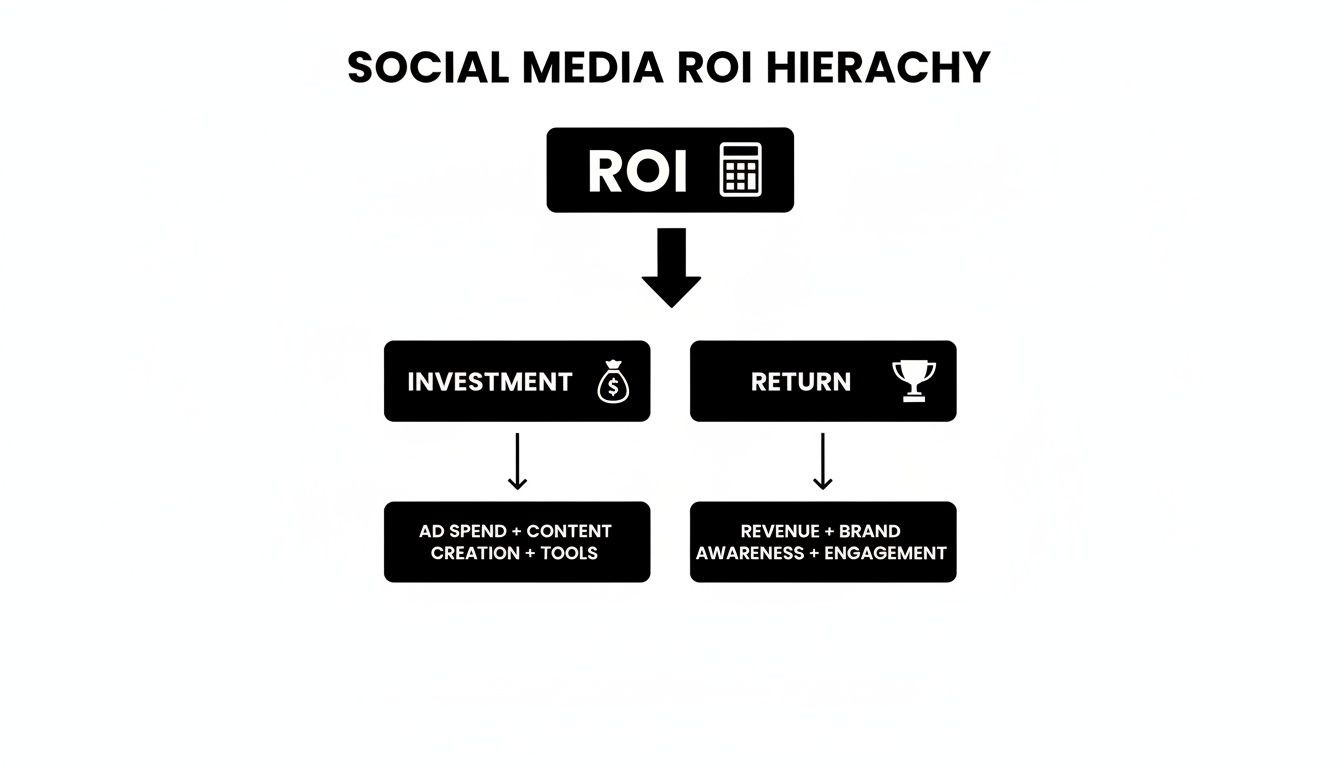
It’s a simple but powerful reminder: for every dollar of return you celebrate, you have to account for the full cost it took to get there.
Here are the essential formulas you'll be using constantly:
1. Reach and Impressions (Top of Funnel)
These are your starting-line metrics. They tell you how many eyeballs are on your content. While they don't directly translate to dollars, they're the foundation for everything else.
Reach: The total number of unique people who saw your post.
Impressions: The total number of times your post was seen (one person could see it multiple times).
2. Engagement Rate (Middle of Funnel)
This is your first real sign that people are paying attention. Engagement shows how well your content is hitting the mark with your audience, and a high rate is often a leading indicator of future conversions.
Formula: Engagement Rate = (Total Engagements / Total Impressions) x 100
Real-World Example: A B2B tech company posts an industry report on LinkedIn. It gets 2,000 impressions and 150 engagements (likes, comments, shares). That’s an engagement rate of 7.5%, which is a fantastic signal that the content is resonating.
3. Click-Through Rate or CTR (Middle of Funnel)
CTR tells you how many people were intrigued enough by your post to actually click the link. This is a critical step for getting people off the social platform and onto your website where the magic happens.
Formula: CTR = (Total Clicks / Total Impressions) x 100
Real-World Example: An e-commerce store runs a Facebook ad that’s shown 10,000 times and gets 300 clicks. Their CTR is 3%.
Connecting Clicks to Conversions
Getting traffic is great, but the real value is in what people do once they land on your site. This is where tools like tracking pixels (think the Meta Pixel) become your best friend, connecting the dots between a social media click and a sale.
4. Conversion Rate (Bottom of Funnel)
This is one of the most powerful metrics for proving direct ROI. It tells you exactly what percentage of visitors took the action you wanted, whether that’s buying a product, filling out a form, or signing up for a newsletter.
Formula: Conversion Rate = (Total Conversions / Total Clicks) x 100
Real-World Example: A lifestyle creator promotes an affiliate product in an Instagram story. The link drives 500 clicks to the product page, and 25 of those people make a purchase. The conversion rate is a solid 5%.
By tracking conversion rate, that creator can confidently say their Instagram story generated 25 sales. That’s how you move past vanity metrics and start talking about real, tangible revenue.
5. Customer Lifetime Value (CLV)
Finally, CLV helps you zoom out and see the big picture. It’s about understanding the long-term value of the customers you acquire through social media. A customer who buys from you repeatedly for years is infinitely more valuable than a one-and-done shopper.
Formula: CLV = (Average Purchase Value x Average Purchase Frequency) x Average Customer Lifespan
Real-World Example: A subscription box service learns that customers who come from their Pinterest ads stick around for an average of 12 months, paying $50/month. That means the CLV for each of those customers is $600.
Getting a grip on these metrics gives you a 360-degree view of your performance. If you want to go even deeper, many of the same principles apply to other marketing channels; for instance, guides on how to measure content marketing ROI often cover similar ground. This complete view is what allows you to make smart, data-backed decisions that actually boost your bottom line.
Platform-Specific Strategies and Benchmarks

Calculating social media ROI is definitely not a one-size-fits-all game. Each platform is its own world, with a unique audience, a different algorithm, and its own set of strengths. To really get the most out of your efforts, you have to treat each channel like a specialized tool in your marketing toolbox.
Trying to apply the same strategy everywhere is like using a hammer to turn a screw. Sure, you might make some progress, but it’s going to be messy, inefficient, and you'll probably break something. A much smarter approach is to play to each network's strengths, whether that's LinkedIn's professional focus or Instagram's visual flair. This way, your budget and time go where they'll make the biggest impact.
Facebook for E-commerce and B2B Leads
Even with all the new platforms popping up, Facebook is still a beast for generating a clear, measurable ROI, especially if you're in e-commerce or B2B. Its true power comes from its enormous, diverse user base and hyper-detailed ad targeting. You can zero in on specific demographics, interests, and behaviors with pinpoint accuracy.
Don't just take my word for it. Recent surveys show Facebook is still the undisputed king, with 28% of global marketers calling it their highest-return platform. This is largely because of its sophisticated targeting, which is why 89% of marketers invested there in Q1, driving a median 4.6x ROI for e-commerce brands and a steady flow of B2B leads. You can dig into more of these numbers in Sprout Social's social media marketing ROI statistics.
To really boost your Facebook ROI, here are a few things to focus on:
Utilize Retargeting Campaigns: Set up dynamic product ads that follow people who have already visited your website. For example, if someone views a specific pair of sneakers but doesn't buy, show them an ad for those exact sneakers in their Facebook feed the next day.
Leverage Lookalike Audiences: Take your customer list, upload it, and let Facebook find new users who share similar traits with your best customers. This makes your ads incredibly relevant from the get-go.
Run Lead Generation Ads: Use Facebook's built-in lead forms to capture contact info right on the platform. It removes friction, which is a huge win for increasing B2B conversions. A consulting firm could offer a free PDF guide, capturing names and emails without ever sending users off-site.
LinkedIn: The Hub for High-Value B2B Connections
For anyone in the B2B space, LinkedIn is in a league of its own. Yes, the cost per click can be higher, but the potential return is massive because you’re connecting directly with decision-makers who are already in a business mindset. The ROI here isn’t always about instant sales; it’s about nurturing high-value leads and building strategic partnerships.
Think about it: a single great connection on LinkedIn could turn into a multi-year, five-figure contract. That's a huge return on your initial time investment. The secret is to stop broadcasting and start building relationships with genuinely helpful content.
The most successful B2B marketers on LinkedIn don't sell; they educate. By consistently sharing industry insights, case studies, and expert analysis, they establish themselves as trusted authorities, making their audience naturally gravitate toward them when a need arises.
TikTok and Instagram: Driving Viral Commerce
TikTok and Instagram are all about discovery and impulse buys, fueled by visual, trend-driven content. The ROI on these platforms often comes from those explosive, viral moments that can create massive brand awareness and sales almost overnight. Here, authenticity and speed are everything.
We’ve all seen the "TikTok Made Me Buy It" phenomenon. A single, clever video showing off a product's cool feature can lead to it selling out in hours. The investment is often just the time it takes to create a short, catchy video, but the return can be thousands of dollars in direct sales.
Here’s how to make these platforms work for you:
Instagram Reels and Stories: Use interactive features like polls, Q&As, and shoppable stickers. They're great for engaging your audience and making it super easy for them to buy.
TikTok Trends: Jump on relevant trends and challenges, but always find a creative way to tie them back to your brand or product. It has to feel natural, not forced.
User-Generated Content (UGC): Encourage your customers to share photos and videos of them using your product. When you repost UGC, it builds powerful social proof and gives you amazing content for free.
Ultimately, maximizing your social media ROI means having a multi-platform strategy that respects what makes each channel unique. By tailoring your approach and aligning your content with the platform's culture and your business goals, you'll build a powerful and profitable presence online. Of course, a great strategy also depends on posting at the right time. For more on this, check out our guide on the best times to post on social media to ensure your content gets seen.
Choosing the Right Attribution Model for Your Business
Attribution is one of those topics in marketing that can feel endlessly debatable, but it doesn't have to be a headache. Just think of your marketing channels like a soccer team working together to score a goal. Who really deserves the credit? Is it the striker who kicked the ball into the net, the midfielder who made the perfect final pass, or the defender who started the whole play from your side of the field?
An attribution model is simply the rulebook you use to decide which player—or in our case, which marketing channel—gets credit for that goal. Getting this right is a big deal because it directly shapes how you value your social media efforts, which ultimately guides your budget and overall strategy.
Last-Touch Attribution: The Simplest Model
The most common and easiest-to-understand model is Last-Touch Attribution. It’s straightforward: 100% of the credit for a conversion goes to the very last touchpoint a customer interacted with before converting. It’s clean, simple to track, and usually the default setting in analytics platforms like Google Analytics.
Imagine a customer clicks a Google Search ad for your product and buys it right then and there. In a last-touch world, Google Ads gets all the glory.
But its simplicity is also its greatest flaw. This model completely ignores every other step that guided the customer on their journey. Someone might have first discovered your brand through a TikTok video, followed you on Instagram for weeks, and then finally searched for you on Google. Last-touch gives TikTok and Instagram zero credit, making them look useless when they were actually doing the heavy lifting.
Last-Touch Attribution is like only celebrating the person who scores the goal, ignoring the crucial assists and defensive plays that made it possible. This can lead you to undervalue top-of-funnel channels that are excellent for building brand awareness.
First-Touch Attribution: Valuing the Introduction
On the flip side, we have First-Touch Attribution. This model gives 100% of the credit to the very first channel that introduced a customer to your brand. It’s fantastic for figuring out which channels are best at filling the top of your marketing funnel and driving that initial discovery.
Practical Example: A potential customer sees an influencer’s post on Instagram for the first time and clicks through to your site. They leave, but a week later, they come back directly and make a purchase. With a first-touch model, that influencer's Instagram post gets full credit for the sale.
This model is a go-to for businesses laser-focused on growth and spreading brand awareness. The downside? It overlooks all the middle and bottom-of-funnel work that nurtured that initial interest into an actual sale.
Multi-Touch Models: Getting a Balanced View
Since a customer’s path to purchase is rarely a straight line, multi-touch models aim to spread the credit more fairly across several touchpoints. They give you a much more holistic and accurate picture of how all your channels are working in concert to drive conversions.
Here are a couple of the most popular multi-touch approaches:
Linear Attribution: This model is the diplomat of the group, assigning equal credit to every single touchpoint in the customer's journey. If a customer saw a Facebook ad, read a blog post, opened an email, and then clicked a Google ad before buying, each of those four channels would get 25% of the credit. It's democratic, but it doesn't separate a quick glance from a game-changing interaction.
Time-Decay Attribution: This model operates on the idea that the touchpoints closest to the sale matter most. It gives more credit to the interactions that happened nearer to the time of conversion. The first interaction gets a little credit, but the final one gets the most. This model recognizes that the interactions right before a purchase are often the most persuasive.
Ultimately, the right model comes down to your business goals. If you're all about generating new leads, a First-Touch model might be your best bet. But if you have a longer sales cycle and want to truly understand the entire customer journey, a multi-touch model like Linear or Time-Decay will give you much richer insights into your true social media ROI.
Actionable Strategies to Boost Your Social Media ROI
Knowing your social media ROI is one thing, but actually improving it is where the magic happens. Once you have a baseline, you can start making smart tweaks to squeeze more value out of every dollar and minute you invest. It's time to stop guessing and start letting your data guide your decisions.
These aren't abstract theories. They're practical, feet-on-the-ground tactics you can roll out today to see a real difference in your returns. The mission is simple: find out what's working, do more of it, and cut everything else.
Reallocate Ad Spend to Top Performers
One of the fastest ways to lift your social media ROI is to do a quick-and-dirty audit of your paid campaigns. Just look at your ad performance over the last 90 days and find the obvious winners and losers. It’s a common mistake to spread your budget thin across every campaign just for the sake of it.
Don't do that. Get aggressive. Pause the campaigns with the highest cost per lead or the weakest conversion rates. Then, funnel that money directly into your all-star ads—the ones you already know are delivering the goods. This one move alone forces your budget to work as hard as it possibly can.
Harness the Power of User-Generated Content
User-Generated Content (UGC) is a game-changer for ROI. Why? Because it’s authentic social proof, building trust in a way polished, branded content never could. When potential customers see real people using and loving your product, it just feels more genuine.
Encouraging and reposting UGC gives you a constant stream of free, high-quality content and turns your customers into a community of brand advocates. You slash content creation costs while boosting conversion rates—a clear win-win for your bottom line.
A great way to get started is to run a contest or create a branded hashtag. Ask your followers to share photos or videos with your product for a chance to be featured on your page. This kickstarts a cycle of authentic content you can use across all your channels, which is a fantastic way to drive sales and engagement. If you want to dive deeper into building this kind of interaction, check out our guide on how to increase engagement on social media.
Leverage Influencer Marketing for Targeted Reach
Influencer marketing isn't just a trend anymore; it's a legitimate business driver with some seriously impressive returns. When you partner with the right creator, you get a direct line to an engaged community that already trusts their recommendations. That’s worlds more effective than shouting at a cold audience.
The numbers don't lie. According to research from Sprinklr, influencer marketing is now a $32.55 billion industry for a good reason: it delivers an average ROI of $5.78 for every $1 spent. And it clearly works—49% of consumers say they buy something based on an influencer's recommendation at least once a month, especially on platforms like Instagram and TikTok.
Micro-Influencer ROI in Action
Let’s break it down with a real-world example. Imagine a small e-commerce brand that sells handmade candles. They team up with five micro-influencers in the home decor space, each with about 15,000 followers.
Investment:
Influencer Fees: They pay each influencer $250 for one Instagram Reel and three Stories. (5 x $250 = $1,250)
Product Cost: They send each a product set valued at $50. (5 x $50 = $250)
Total Investment: $1,500
Return:
Each influencer gets a unique discount code to track sales.
Between the five of them, the campaigns drive 1,000 clicks to the website.
With a conservative 3% conversion rate, that results in 30 sales.
The average order is $60. (30 sales x $60 = $1,800 in revenue)
Calculating the ROI:
Profit: $1,800 (Revenue) - $1,500 (Investment) = $300
ROI: ($300 / $1,500) x 100 = 20%
A 20% ROI is a great result, especially when you remember this simple calculation doesn't even factor in the long-term value of the high-quality content they now have or the increased brand awareness. By putting these strategies into play, you can start turning your social media from a cost center into a reliable engine for growth.
Using Automation to Streamline ROI Measurement

Trying to manually calculate your social media ROI across a half-dozen platforms is a soul-crushing task. It's a constant grind of exporting spreadsheets and wrestling with messy reports that never seem to match up. This isn't just a waste of time—it's a recipe for costly mistakes, leaving you guessing about what’s actually working.
This is where automation flips the script. Instead of juggling a dozen browser tabs, you can plug all your channels into a single, unified dashboard. Suddenly, you have a clear, high-level view of your performance, making it simple to see which channels are pulling their weight without drowning in data entry.
From Manual Analysis to Automated Insight
Modern automation tools are much more than just content schedulers. Think of them as an AI-powered assistant that not only publishes your content but helps you brainstorm and create it. These systems can spot viral trends, see what’s working for others in your niche, and generate content perfectly formatted for each platform.
This means you can get back to creating great posts, carousels, and videos without spending your entire day on research and design. The best part? The system automatically tells you which posts are home runs, so you know exactly what your audience wants more of.
The real magic of automation is that it lets you ‘double down on what works’ in near real-time. You don’t have to wait for a monthly report to see what resonated; the tool flags your winners as they happen, so you can amplify them right away.
Increasing Effectiveness and Saving Time
This automated approach gives your social media ROI a serious boost in two ways. First, it cuts down the hours you sink into content creation and management, which directly lowers the "Investment" part of the ROI equation. Second, by using real data to guide what you post, it makes your content far more effective, driving up the "Return."
Look at the paid side for a moment. The average ROI from social media ads recently hit a remarkable $5.28 for every $1 spent, which is up 7.9% from the previous year. Good automation helps your organic content act more like a precision-targeted ad campaign by analyzing what’s hot and posting when your audience is most active. You can dig deeper into these trends in recent social media statistics.
For creators, agencies, or any small business trying to do more with less, this is a total game-changer. With the right social media automation tools in your corner, you can get better results in a fraction of the time and make a high social media ROI a realistic goal.
Common Questions About Social Media ROI
So, you're trying to wrap your head around social media ROI. It's normal to have questions—everyone does. Let's tackle some of the most common ones that come up, so you can feel more confident in how you're tracking your efforts.
How Often Should I Calculate My Social Media ROI?
The short answer? It depends. The right rhythm for checking your ROI really comes down to what you’re doing on social media.
If you’re running paid ad campaigns, you need to be on top of things. A monthly review is non-negotiable. It lets you see what's working and what isn't, so you can shift your budget around and make smart adjustments on the fly.
For your overall organic efforts, pulling back a bit is actually better. A quarterly review gives you a much clearer picture. It smooths out the day-to-day noise and helps you spot the real, meaningful trends that should guide your strategy.
What Is a Good Social Media ROI?
This is the million-dollar question, isn't it? The truth is, there’s no magic number. A "good" ROI is completely different for a SaaS company versus an e-commerce brand because profit margins, goals, and industries vary so much.
You might hear people throw around a 5:1 ratio—meaning $5 in return for every $1 you spend—as a general benchmark. But take that with a grain of salt.
The only benchmark that truly matters is your own. Are you improving? If your ROI is consistently getting better each quarter, that’s the real sign of a winning strategy.
Can I Measure ROI Without Any Ad Spend?
You absolutely can. Just because you're not spending money on ads doesn't mean your efforts are free. Your investment is simply measured differently.
Think about the time your team spends creating content, the cost of any scheduling tools, and the salary hours dedicated to managing your accounts. That’s your "investment."
The "return" comes from things like leads generated through your bio link, direct traffic to your website, or even sales that came from someone searching your brand name after seeing your posts. For example, if your team puts in 10 hours a month (let's say that's a $500 value) and that work brings in three solid leads worth a combined $1,000, you’ve just achieved a 100% ROI.
How Do I Prove the Value of Brand Awareness?
Brand awareness can feel a bit fuzzy and hard to pin down, but you can definitely measure its impact. You just have to look at the ripple effects.
Instead of a direct sales metric, track the signals that show your brand is gaining traction and becoming more recognizable.
Keep an eye on trends for:
Branded Search Volume: Are more people typing your company's name directly into Google?
Direct Website Traffic: Are you seeing more visitors who type your URL straight into their browser?
Social Media Mentions: Are people talking about you, even when they don't tag your official account?
When these numbers go up, it’s a strong indicator that your top-of-funnel social media work is paying off.
Ready to stop guessing and start growing? NicheTrafficKit uses AI to automate your content creation, scheduling, and analytics, giving you the insights to consistently boost your social media ROI. Start your free trial today and see the difference.