How to Increase Engagement on Social Media
Learn how to increase engagement on social media with proven strategies for content, community building, and platform-specific tactics that drive real results.
If you want to boost your social media engagement, you have to stop thinking like a broadcaster and start acting like a community builder. It’s a fundamental shift. The goal isn't just to push content out; it's about making your followers feel seen, heard, and genuinely valued. That's what gets people talking.
Building Your Foundation on Audience Insights

Before you even think about your next post, you have to get crystal clear on who you're talking to. Let me be blunt: high engagement is never an accident. It's the direct result of creating content that hits home with a very specific group of people. Posting without that insight is just shouting into the void.
The bedrock of any killer social media plan is knowing how to identify your target audience on a deeper level than just demographics. Sure, knowing their age and location is a start, but the real magic happens when you understand their psychographics—their values, what they geek out about, what keeps them up at night, and what truly motivates them.
Moving Beyond Demographics
To forge a real connection, you need to dig deeper. What problems are they trying to solve that you can help with? What’s their sense of humor like? Where else do they hang out online?
Here are a few practical ways to get these answers:
Social Listening: Get in the trenches. Actionable Insight: Use a tool like Hootsuite or even just the search bar on X (formerly Twitter) to track keywords related to your industry. Look for recurring questions. If you sell hiking gear, search for "beginner hiking tips" to see the exact language and frustrations your potential customers are sharing.
Competitor Analysis: Your competitors' top posts are a goldmine. Actionable Insight: Go to a competitor’s Instagram profile, tap the "Reels" tab, and sort by "Most popular." Notice a pattern? Maybe their highest-performing videos are all quick-tip tutorials. That's a direct clue about what resonates in your niche.
Audience Surveys: The easiest way to find out what people want? Just ask them. Actionable Insight: Use an Instagram Stories poll sticker with two options: "New product tutorials" vs. "Behind-the-scenes content." This simple action gives you direct feedback and makes your audience feel involved.
Key Takeaway: You're not just looking for followers; you're looking for your people. When you understand their world, you can create content that feels like it was made just for them. That’s how you spark a real conversation.
Creating Actionable Audience Personas
Now, take all that rich data and give it a face. Create detailed audience personas—semi-fictional profiles of your ideal follower. Give them a name, a job, a backstory. This little exercise is surprisingly powerful because it turns abstract data into a relatable person you can actually create for.
For example, a B2B tech company might build a persona called "Marketing Manager Mike." They know Mike scrolls LinkedIn on his commute, loves a good data-backed case study, and hates wasting time on manual tasks. Right away, you know a fluffy, generic post won't land, but a carousel post breaking down a real customer success story? That’s his catnip.
On the other hand, a D2C lifestyle brand might have "Eco-Conscious Emily" on Instagram. Emily is drawn to authenticity, cares deeply about sustainability, and gets inspired by seeing real customers use a product. For this brand, prioritizing user-generated content over slick corporate photoshoots is a no-brainer.
Laying this groundwork ensures every single piece of content you create has a purpose. It's designed to connect and resonate, taking the guesswork out of your strategy and paving the way for the meaningful interactions that actually matter.
Crafting Content That People Can't Ignore
Let's be honest: just posting on social media isn't going to cut it anymore. The feed is a crowded, noisy place. To get any real traction, you have to create content that literally stops someone mid-scroll and gives them a reason to pause, think, and—most importantly—act.
This isn't about just pushing your message out. It's about crafting posts that educate, entertain, or inspire people enough that they want to hit like, drop a comment, or share it with their friends.
And right now, nothing does that better than video. It’s the undisputed king of interaction. The numbers don't lie: in 2025, TikTok is projected to have the highest average engagement rate at a massive 4.86%. That blows past both YouTube (4.41%) and Instagram (1.16%). This is exactly why a staggering 93% of marketers are doubling down on social media, with a huge focus on video. You can dig into more of these numbers with these social media marketing statistics on dreamgrow.com.
What this trend tells us is simple: people are drawn to dynamic, authentic content that feels genuine.
Get Real with Short-Form Video
The days of slick, overproduced corporate videos are fading fast. People crave authenticity. They want to see the human side of a brand, and platforms like TikTok and Instagram Reels are built to reward exactly that kind of unscripted, relatable content.
Here are a few simple, proven frameworks you can use to create videos that actually connect:
Quick-Tip Tutorials: Solve a small, nagging problem for your audience in 60 seconds or less. Practical Example: A financial advisor could create a Reel on "3 Budgeting Mistakes Everyone Makes." A little text on screen, a trending audio clip, and you've got a valuable, shareable piece of content.
Behind-the-Scenes Peeks: Pull back the curtain! Show the process, the people, the mess-ups. Practical Example: A local coffee roaster could film their team taste-testing a new batch of beans, capturing their real-time reactions and friendly banter. It’s relatable and builds trust.
"A Day in the Life": This is a powerful way to humanize your brand. Practical Example: If you're a solo entrepreneur running an Etsy shop, a short video montage of your morning routine, how you pack orders, and even your brainstorming process can build a surprisingly strong connection with your audience.
You don't need a Hollywood budget or a professional film crew. The goal is to provide value and show some personality. Your phone is more than capable of creating content that resonates and gets people talking.
Build Your Content for Participation
Beyond just video, think about how you can design your other posts to invite a response. Stop talking at your audience and start creating opportunities to talk with them. This is how you turn passive lurkers into an active, engaged community.
Making your content interactive is one of the smartest ways to boost engagement because it gives people an easy, low-stakes way to jump into the conversation.
Spark a Dialogue with Interactive Formats
Interactive posts work because they directly ask for input, making it feel completely natural for someone to respond. You’re sending a clear signal: "I want to hear from you."
Here are a few ways to get this going:
Polls and Quizzes: These are gold on Instagram Stories and LinkedIn. Practical Example: A fitness brand could ask, "Biggest workout challenge: Motivation or Time?" It’s a simple tap for the user, but it provides you with valuable insight and boosts your engagement.
"This or That" Carousels: Create a multi-slide post where each slide offers a choice. Practical Example: A home decor brand could pit two different living room designs against each other and ask followers to vote for their favorite in the comments using emojis like ❤️ for option A and 👍 for option B.
Ask Better Questions: Ditch the boring "yes" or "no" questions. Instead of asking, "Do you like our new product?" try something more thoughtful like, "How would you use our new product in your daily routine?" Actionable Insight: Pose a hypothetical scenario: "You have an unlimited budget to redecorate one room in your house. Which room are you choosing and why?" This sparks imagination and longer responses.
This simple shift turns your feed from a broadcast channel into a two-way conversation. For example, you could find a juicy Reddit thread in your niche, pull out a few of the most interesting comments, and turn them into an Instagram carousel asking your followers to weigh in. There's even a helpful Reddit content reformatter tool that can make adapting these discussions for other platforms much faster.
When you consistently create these moments for interaction, you’re training your audience to participate. They learn that their opinion matters, which makes them far more likely to engage with your content down the road.
Mastering Platform-Specific Engagement Strategies
What crushes it on TikTok will almost certainly fall flat on LinkedIn. It’s one of the biggest mistakes I see: brands treating every social media platform like it's the same. This one-size-fits-all approach is a surefire recipe for low engagement.
To really connect, you have to speak the native language of each platform. Every app has its own unique culture, its own content formats, and its own user expectations. Getting these nuances right is the secret to creating content that doesn't just get seen, but actually gets a response. It’s all about adapting your core message to fit the environment.
Instagram: The Visual Playground
Instagram is built on aesthetics, but the real engagement today is happening in more dynamic, interactive formats. A beautiful photo is nice, but it's no longer enough.
Make Your Stories Interactive: Get in the habit of using polls, quizzes, and the "Add Yours" sticker daily. These are super low-effort ways for your audience to engage. Practical Example: A clothing brand could run a poll asking, "Which outfit for a weekend trip?" It's simple, fun, and gives you instant feedback.
Use Collaboration Posts: This feature is a massive reach-booster. When you partner with another creator or brand, the post appears on both of your profiles, instantly exposing you to a new, relevant audience. It’s a win-win.
Encourage Reels Remixes: Prompt your followers to remix your Reels. Actionable Insight: Post a Reel with a simple challenge, like "Show us how you style our new scarf," and explicitly ask people to remix it. This kind of user-generated content is powerful social proof.
The real goal on Instagram is to make your content feel like a conversation. Use the features that invite a tap, a vote, or a quick reply. That's how you turn passive scrollers into active participants.
TikTok: Riding the Trend Wave
TikTok moves at lightning speed. Success here is all about jumping into the current cultural moment. No, you don't have to dance, but you absolutely have to understand what's trending.
Spend time on the app's discovery tools to see what sounds, effects, and video formats are blowing up. Then, figure out how to put your own spin on them for your niche.
Embrace Duets and Stitches: These are TikTok's bread and butter for interaction. Practical Example: A career coach could "Stitch" a video about a common job interview mistake and add their own expert advice in the first 5 seconds. You're literally inserting yourself into an existing, popular conversation.
Try Text-Based Videos: Not everything needs to be a cinematic masterpiece. A simple video with compelling text overlays that shares a controversial opinion or a little-known industry fact can spark a massive debate in the comments.
Reply with Video: See an interesting question in your comments? Don't just type a reply—answer it with a brand new video. This shows you're listening and rewards a follower for their engagement, which encourages others to comment too.
LinkedIn: The Professional Conversation
On LinkedIn, engagement is built on a foundation of authority, credibility, and genuine professional value. People are there to learn, network, and advance their careers, so your content needs to feed that mindset.
Believe it or not, long-form, text-only posts can perform exceptionally well here. Actionable Insight: Share a personal story about a professional failure and what you learned from it, or offer a strong, data-backed opinion on an industry trend. The key is to be insightful, authentic, and human. A post starting with "I got laid off 3 years ago. Here are the 3 things I learned that landed me a better job." is far more engaging than a generic corporate update.
Engaging on LinkedIn also means getting into the weeds. Join groups relevant to your industry and contribute thoughtful comments to other people's posts. It’s less about broadcasting and more about building real professional relationships. For a deeper look at this, you might want to check out these 11 effective social media strategies.
Facebook and Pinterest: Community and Discovery
While they're sometimes overlooked in the engagement conversation, Facebook and Pinterest offer some seriously powerful opportunities if you know how to use them.
Facebook Groups: Building a community in a Facebook Group is one of the best ways to generate consistent, high-quality engagement. Actionable Insight: Create a dedicated space for your most loyal followers and run weekly themed threads, like "Wins of the Week" or "Ask Me Anything" sessions to foster connection.
Pinterest Visual Search: Don't think of Pinterest as just social media; it's a visual discovery engine. Engagement here is all about creating beautiful, helpful Pins that solve a problem. Practical Example: Create a long, vertical infographic Pin titled "10 Steps to a Perfectly Organized Pantry" with actionable tips. This is highly "pinnable" content that drives traffic and saves.
To help you keep these strategies straight, here's a quick cheat sheet.
Platform Engagement Strategy at a Glance
This table breaks down the best approach for each major platform, so you can quickly reference what works where.
Platform | Primary Content Format | Key Engagement Tactic | Best For |
|---|---|---|---|
Reels & Interactive Stories | Polls, Quizzes, Collab Posts | Visual brands, creators, lifestyle, B2C | |
TikTok | Short-Form Vertical Video | Duets, Stitches, Trend Participation | Entertainment, education, viral marketing, Gen Z |
Text-Based Posts & Articles | Thoughtful comments, sharing expertise | B2B, professional networking, thought leadership | |
Community & Video | Facebook Groups, Live Video | Building loyal communities, local businesses | |
Vertical Graphics & Idea Pins | Creating helpful, "pinnable" resources | E-commerce, DIY, recipes, visual inspiration |
Ultimately, this all points to one core truth: a one-size-fits-all approach is dead.
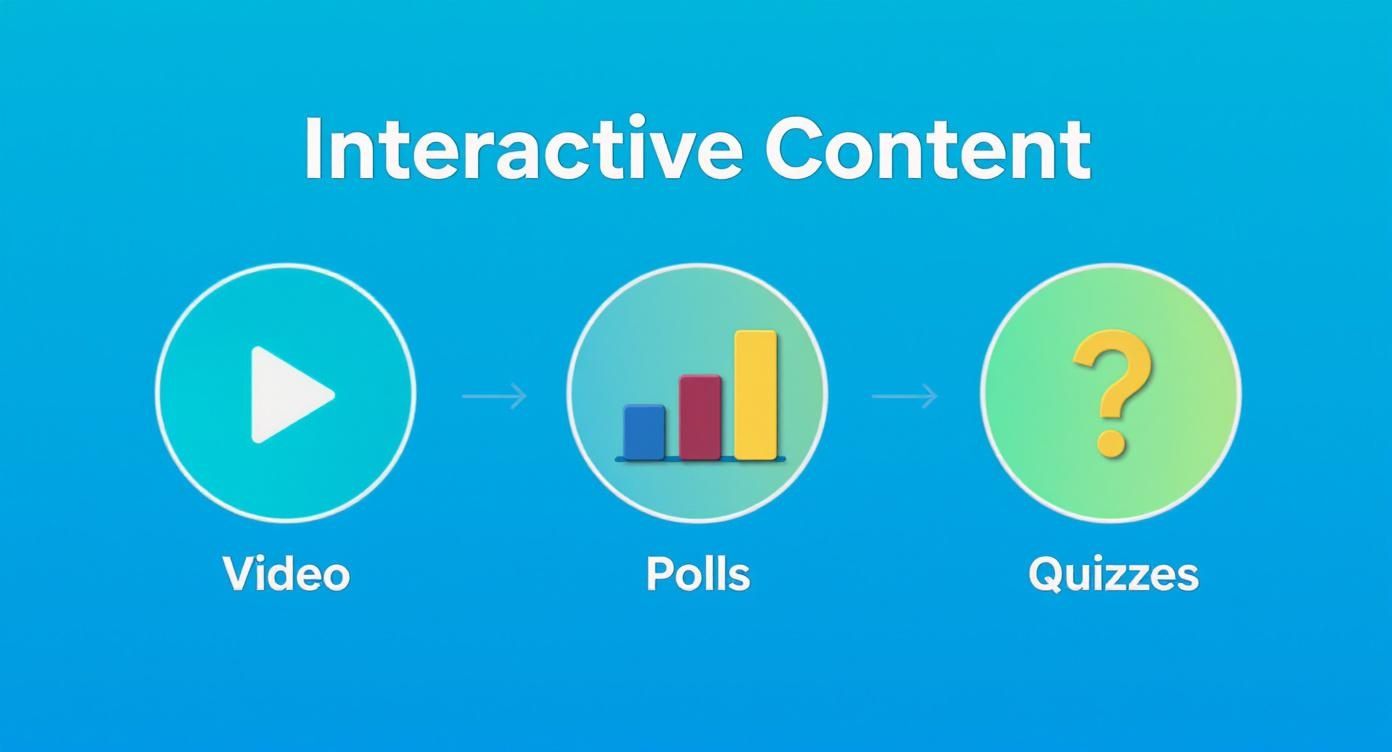
Interactive formats like these are a huge part of the puzzle, giving users an easy, low-friction way to participate. Mastering social media engagement means becoming a multilingual communicator—someone who can fluently speak the native language of every single platform you're on.
Finding Your Rhythm: The Art and Science of When to Post

You can craft the most brilliant, engaging content in the world, but if you publish it when everyone’s asleep, it's just shouting into the void. This isn’t about being a minor detail—timing is a massive multiplier for all your hard work. When you post at the exact moment your followers are scrolling, you give your content the initial push it needs to catch fire with the algorithm.
Getting this right is a fundamental piece of the engagement puzzle. It’s what ensures your efforts actually connect with the people you’re trying to reach. If you’re just posting whenever you have a spare moment, you're leaving a ton of potential engagement on the table.
Ditch the Generic "Best Times to Post" Guides
We’ve all seen those infographics claiming "The Best Time to Post on Instagram is Tuesday at 11 AM." While they aren't totally useless, think of them as a very general starting point. They're based on averages from millions of different accounts. Your audience is unique, and their online habits are all their own.
The real answers are waiting for you in your own analytics. Most platforms give you these tools for free, showing you exactly when your followers are most likely to be online.
Instagram Insights: Head to your professional dashboard, tap "Total Followers," and scroll all the way down. You'll see a chart that breaks down active times by day and hour. It's incredibly specific.
TikTok Analytics: In your creator tools, the "Followers" tab has a "Follower activity" section. This shows you the precise hours and days your audience is scrolling their For You page.
Facebook Page Insights: Check the "Posts" section for "When Your Fans Are Online." It gives you a clear visual of peak activity, taking all the guesswork out of the equation.
Keep an eye on these for a couple of weeks. You might find your B2B audience is all over LinkedIn during their lunch break, or that your community of gamers comes alive after 10 PM. This data is infinitely more valuable than a generic report.
Key Insight: Stop guessing when your audience is online—find out for sure. A few minutes digging into your own analytics can easily double your initial post reach, giving your content a real fighting chance in a crowded feed.
Build a Rhythm with a Consistent Posting Cadence
Beyond just when you post, how often you post makes a huge difference. Consistency is all about training your audience to expect content from you, which keeps your brand at the forefront of their minds.
A steady cadence also signals to the algorithms that you’re an active, reliable creator who’s worth showing to more people. Posting erratically—five times one week and then radio silence the next—kills your momentum and can seriously hurt your visibility. Aim for a frequency you can actually stick with, like 3-5 times per week on your main platforms.
The data backs this up. The average person uses around 6.83 social media platforms every month, so staying visible is crucial. Brands that post consistently often see engagement rates that are up to 30% higher, and 80% of marketers say a strategic schedule boosted their exposure. If you're a data nerd, you can find more social media statistics and insights over at ClearVoice.com.
Use Tools to Work Smarter, Not Harder
Let's be real: maintaining an optimized schedule across several platforms can feel like a full-time job. This is where scheduling tools become your best friend. They let you batch your content creation and plan your calendar out in advance, saving you from the daily pressure of having to post live.
Some platforms, like NicheTrafficKit, take it a step further. They can analyze your performance and automatically publish your content at the scientifically best times for each platform. It’s a great way to remove the guesswork and ensure every post gets maximum impact.
Here’s a simple workflow to get started:
Weekly Analytics Check: At the end of each week, pop into your insights and pinpoint your top 3-5 posting slots.
Content Planning Sesh: Block out some time to plan the posts for the coming week, making sure they align with your core content pillars.
Schedule It All: Use a scheduling tool to load up everything—your posts, captions, hashtags, the works.
This system transforms a chaotic daily scramble into a streamlined weekly process. You'll never miss a perfect posting window again, helping you build the kind of reliable presence that’s absolutely essential for long-term growth.
Turning Followers into a Thriving Community
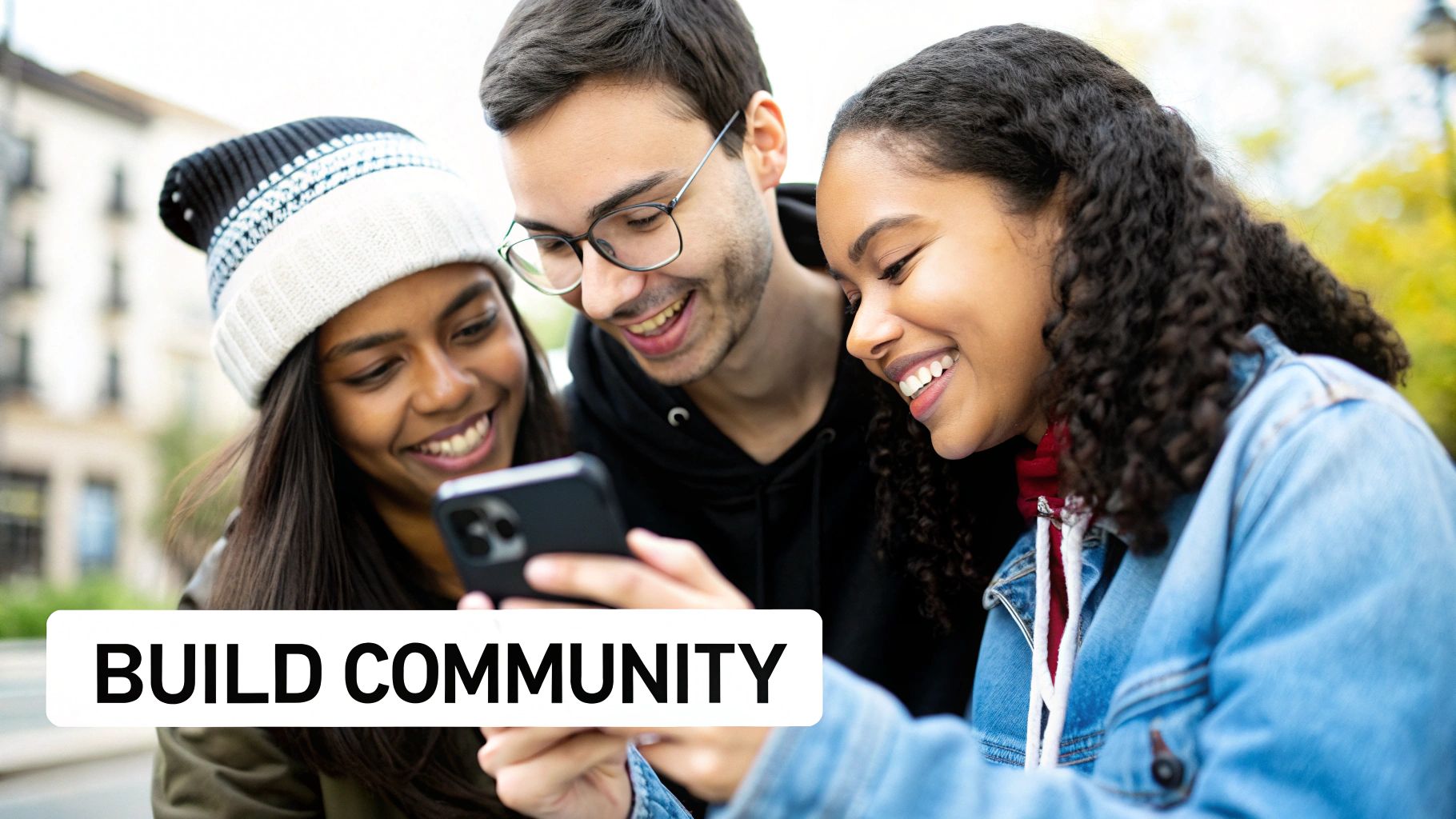
Let's be real: engagement isn't just a numbers game. It's about turning a passive audience into an active, invested community. A high follower count looks impressive, but if no one is talking, you're just broadcasting to an empty room. The real win is creating a space where people feel seen, heard, and genuinely connected to your brand.
This shift happens when you stop thinking in terms of one-way messages and start fostering actual two-way conversations. Every post becomes an invitation for your audience to join a dialogue, transforming them from silent scrollers into loyal advocates who feel like they're part of something special.
Spark Conversations with Better Captions
Your captions are probably the most underutilized tool in your engagement toolkit. Instead of just describing your photo or video, think of each caption as the opening line of a conversation. The goal is to make it nearly impossible for someone not to respond.
The easiest way to do this? Ask good, open-ended questions that demand more than a one-word answer.
Instead of asking: "Do you like our new design?"
Try something like: "What's the first thing you'd do with our new backpack on an adventure?"
That small tweak prompts a story, not just a "yes" or "no." It encourages people to share a little piece of themselves, which is the bedrock of any real community.
Fill-in-the-blank prompts are another fantastic, low-effort technique. Practical Example: A coffee brand could post a photo of their morning brew with the caption, "My week doesn't truly start until I've had _______." It's a simple, fun way for people to share their opinion and feel included.
The most engaging brands treat their comment section like a dinner party. They ask great questions, listen intently to the answers, and make everyone feel welcome. Your caption is the invitation.
Connect with Niche Communities Using Hashtags
Hashtags aren't just for discoverability; they're your direct line into niche communities that are already passionate about your topics. A classic mistake is to lean solely on massive hashtags like #marketing or #fitness. Sure, they have reach, but they're also incredibly crowded and rarely attract a truly targeted audience.
A much smarter strategy is a tiered approach that blends broad appeal with niche relevance. This is a proven way to attract followers who are genuinely interested in what you have to say.
Broad Hashtags (1-2): These are your high-level topics (e.g., #SocialMediaMarketing).
Niche Hashtags (3-5): Get more specific to your sub-topic (e.g., #CommunityManagementTips).
Community Hashtags (2-3): These connect you to a specific group of people (e.g., #ContentCreatorsOfInstagram).
This mix ensures you're visible to a wider audience while still speaking directly to the people most likely to engage. Practical Example: A brand selling sustainable home goods could use #SustainableLiving (broad), #EcoFriendlyHome (niche), and #ZeroWasteCommunity (community) to attract the right kind of followers.
Master the Art of Active Community Management
Building a community is an active, ongoing process. You can't just post great content and walk away. You have to show up, listen, and participate—every single day. This is how you prove there's a real person behind the account who actually values their audience's input.
Start by making it a rule to respond to as many comments as you can, especially within the first few hours of posting. Actionable Insight: Go beyond a simple "Thanks!" Ask a follow-up question. If someone comments, "Love this tip!" respond with, "So glad it was helpful! What's the biggest challenge you're facing with this right now?" This keeps the conversation rolling.
And one of the most powerful moves you can make? Feature user-generated content (UGC). When you share a customer's photo or story, you're not just getting free content; you're publicly celebrating them. This encourages others to post about you, creating a positive feedback loop that strengthens community bonds and provides incredible social proof. Brands like Duolingo are masters of this, using a distinct personality and rapid-fire responses to build a fanbase that feels like an inside joke they're all in on.
Measuring What Matters to Refine Your Strategy
If you really want to know what’s working, you have to stop guessing and start measuring. This isn't about chasing vanity metrics like follower counts. It's about digging into the data that tells you what actually connects with your audience.
The single most powerful KPI to track is your engagement rate by reach. This tells you the percentage of people who actually saw your post and decided to do something. It’s a much more honest look at your content's quality than engagement by followers, especially since algorithms mean only a fraction of your followers will see any given post.
Identifying Your Strongest Content
Getting specific is where the magic happens. To really sharpen your strategy, you need to track the metrics that reveal what your audience truly values.
Shares: Think of a share as the ultimate compliment. Someone found your content so valuable they were willing to put their own name on it and pass it along to their network. High shares mean you've struck a nerve.
Saves: This is a huge signal that you’ve created a genuine resource. When someone saves your post, they're saying, "I need to come back to this." It's a massive win for educational, inspirational, or tutorial-style content.
Comments: A like is easy and passive. A comment requires real effort. It means your post sparked an idea, a question, or an emotion strong enough to make someone stop scrolling and type.
By focusing on these three actions, you get past surface-level applause and start to understand the real impact your content is having.
And if you're building a community over on Reddit, you can use our free Reddit analytics tool to get detailed insights into what’s driving the conversation there.
Key Takeaway: The goal is to create a feedback loop. Your data isn't just for reporting on the past; it's for making smarter, more informed decisions about what you create next.
This data-first mindset opens the door to simple but incredibly effective A/B tests. For instance, you could post two similar carousels but tweak the call-to-action. One week, end your caption with a question. The next, prompt users to "Save this for later."
By comparing the comments and saves, you'll quickly learn what kind of language actually drives the behavior you’re aiming for.
Common Questions (and Real Answers) About Social Media Engagement
Even with the best strategy in place, social media can throw you a curveball. Let's tackle some of the most common questions I hear from brands and creators who are in the trenches, trying to boost their engagement.
"Help! My Engagement Suddenly Dropped. What Do I Do?"
First, don't panic. An engagement dip happens to everyone, and it’s usually a signal, not a catastrophe. Before you overhaul your entire strategy, start with a quick audit.
Dive into your analytics. Has your audience's behavior changed? Maybe the time they're most active online has shifted, meaning your old "perfect" posting time is now missing the mark.
Next, look at your recent posts. Did you experiment with something new that didn't quite land, or did you stray too far from the core topics your audience loves? Actionable Insight: Look at your top-performing posts from the last 3 months. What do they have in common? Were they Reels, carousels, or personal stories? Double down on the formats and topics that have already proven to work.
"Which Social Media Platform Is Actually the Best for Engagement?"
This is the classic "it depends" question, but here's the real answer: The best platform is simply where your people hang out. Chasing a platform just because it has high overall engagement numbers is a recipe for burnout.
If your brand is all about connecting with Gen Z through fun, snappy videos, TikTok is probably your playground. You'll get much higher engagement there than you would on a more professional network.
But if you're a B2B company trying to connect with industry leaders, you'll find far more meaningful conversations and leads on LinkedIn. The key to real, sustainable engagement isn't being everywhere; it's being in the right place for your niche.
"How Should I Deal With Negative Comments?"
It’s tempting to just hit delete and pretend it never happened, but that's rarely the right move. How you handle criticism in public says a lot about your brand. A quick, calm, and professional response shows everyone else that you're listening and you care.
My Golden Rule: Never, ever get into a back-and-forth public argument. Address the person's concern politely and, if it’s a specific customer service issue, offer to take the conversation to DMs. This approach shows you're accountable without airing dirty laundry.
Of course, this doesn't apply to comments that are just spam or abuse. For those, feel free to delete and block without a second thought. Your page, your rules.
Ready to stop guessing and start growing? NicheTrafficKit uses AI to research trends, create platform-specific content, and post at the perfect time for maximum impact. See how you can automate your growth by visiting their website.