How to Generate Content for Social Media That Actually Works
Learn how to generate content for social media with proven strategies for ideation, creation, and scheduling. Turn your social channels into engagement engines.
Tired of the endless social media content scramble? The secret isn't just posting more often—it's about building a repeatable system that works for you. Think of it less like a daily chore and more like building an engine. This engine has three core parts: finding out what your audience actually cares about, creating content designed for specific platforms, and then scheduling it to post at just the right time.
Putting this system in place is what separates the brands that struggle from the ones that see consistent, meaningful growth.
Building Your Modern Social Media Content Engine
So, how do you actually build a social media presence that drives results? The answer lies in creating a smart, repeatable workflow that blends deep audience research, platform-specific content creation, and intelligent automation. This is how you move from a constant state of "what do I post today?" to a predictable and powerful content machine.
The ultimate goal here is to create a feedback loop. You post content, analyze what works, and that data directly fuels your next batch of ideas. You're no longer guessing; you're making informed decisions that get better over time.
To give this engine a clear destination, it's always best to build it on the foundation of a comprehensive social media strategy template. A solid plan ensures every piece of content you create has a purpose.
The Core Content Workflow
At its heart, the entire process is a simple, continuous cycle: research, create, schedule, analyze, and repeat.
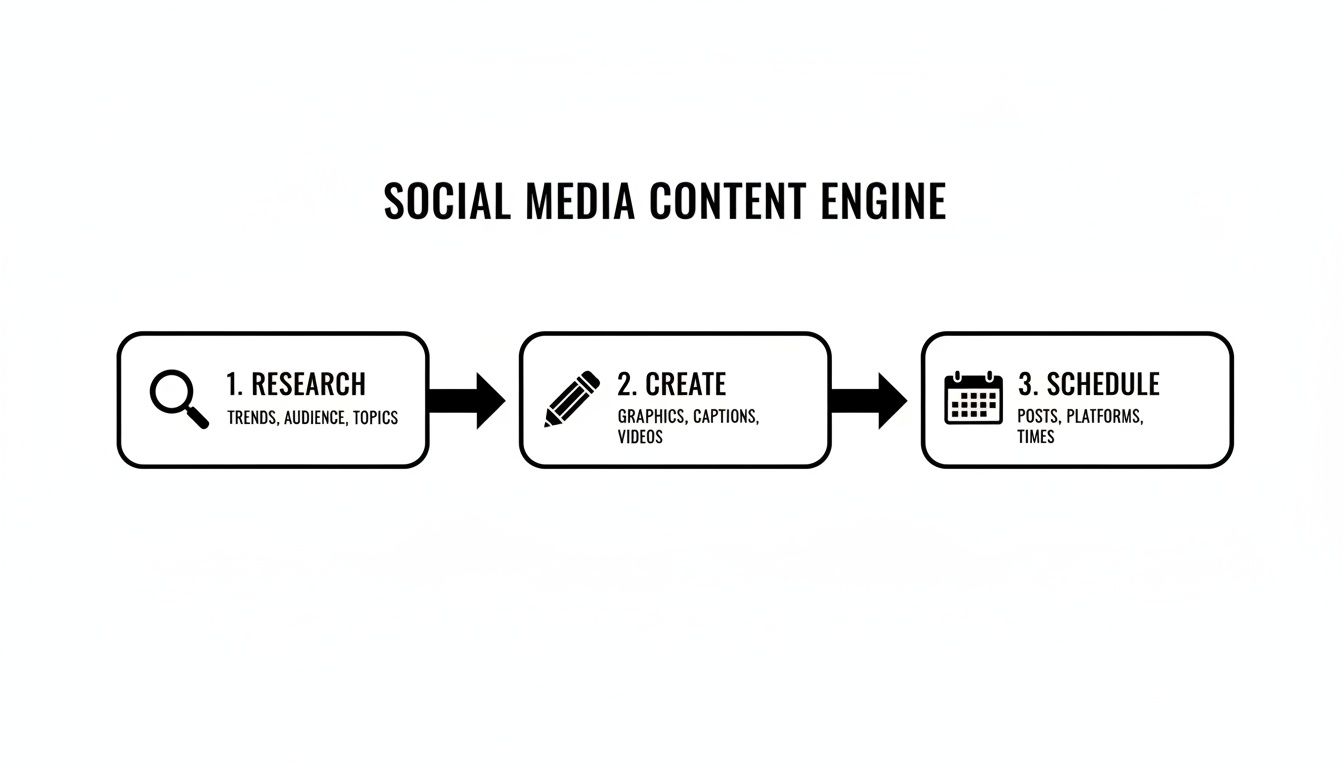
This isn't a one-and-done checklist. It’s an ongoing loop where each stage flows into the next. The analytics from your scheduled posts should be the starting point for your next round of research and content ideas.
To really nail this down, it helps to think of modern content generation as resting on three key pillars. Each one has a distinct goal and relies on specific activities to succeed.
Here’s a breakdown of how they fit together:
Three Pillars of Modern Content Generation
Pillar | Primary Goal | Key Activities & Tools |
|---|---|---|
Audience-Centric Ideation | Discover what your audience genuinely wants to see and discuss. | Forum/community mining (Reddit, Quora), keyword research (SEMrush, Ahrefs), competitor analysis, trend spotting (TikTok, Google Trends). |
Platform-Native Creation | Produce content that feels natural and engaging on each specific platform. | Video editing (CapCut), graphic design (Canva), AI writing assistants (Jasper), user-generated content (UGC) campaigns. |
Automated Distribution | Schedule and publish content efficiently to maximize reach and consistency. | Social media schedulers (Buffer, Later), content repurposing tools, analytics dashboards, peak-time publishing analysis. |
By focusing on these three areas, you create a holistic system where your ideas are validated by real audience interest, your content is perfectly suited for its environment, and your distribution is both consistent and data-informed.
The New Reality: Automation and AI
Let's be honest, the game has changed. The rise of AI isn't just a trend; it's a fundamental shift in how content gets made. As of early 2026, a staggering 83% of social media marketers say AI is helping them create significantly more content, which is a lifesaver when you look at the demands.
Today, some brands are posting between 48 to 72 times per week across all their channels just to stay relevant. Trying to do that manually is a recipe for burnout. Automation is no longer a luxury; it's a necessity.
The real power of a content engine isn't just producing posts—it's about creating a system that frees up your strategic thinking. When you automate the repetitive tasks, you gain the mental space to analyze what’s truly connecting with your audience and double down on it.
This guide is your practical framework for putting this theory into action. We’re going to walk through how to systematically:
Find endless content ideas that your audience will actually love.
Create platform-native content that doesn't feel out of place.
Build an automated scheduling system for hands-off consistency.
Use analytics to get smarter with every post you publish.
By the end, you'll have a clear plan to move from feeling overwhelmed by social media to being in complete control of its growth.
Finding Endless Content Ideas That Actually Connect
Let’s be honest, staring at a blank content calendar is the worst. The pressure to come up with brilliant ideas on demand is real. But the best content isn’t born from brainstorming sessions in a vacuum; it comes from listening.
You have to become a digital anthropologist. Your audience is constantly talking about their problems, wants, and frustrations online. Your job is to find those conversations, listen in, and create content that speaks directly to them.
Dig for Gold in Online Communities
Forget polished market research for a minute. The real, unfiltered truth lives in places like Reddit and Quora. These platforms are treasure troves of customer pain points, described in their own words.
Actionable Tip: Don't just search for your main keyword. Instead, search for phrases like "how do I...", "frustrated with...", or "best way to..." related to your industry. The results will be questions and complaints you can directly answer.
Selling a skincare product? Head over to the r/SkincareAddiction subreddit. You might find dozens of posts from people confused about how to layer serums or what "niacinamide" actually does. Boom—that's a perfect idea for an Instagram Reel or a carousel post titled "3 Niacinamide Mistakes You're Probably Making."
Running a B2B software company? A quick search on Quora for "project management headaches" will uncover a long list of complaints about clunky software and terrible team communication. That’s your cue to write a LinkedIn article on "The Real Reason Your Team Hates Your PM Software" or create a short video showing how your tool solves one of those exact issues.
The most powerful content ideas come directly from the language your audience uses to describe their own challenges. When you can articulate their problem better than they can, they instinctively believe you have the solution.
This isn’t about just making noise. It’s about being genuinely helpful, which is the cornerstone of learning how to generate content for social media that builds real authority.
Turn Your Competitors’ Comments into Your Content
Your competitors' social media profiles are more than just a place for competitive analysis—they're a focus group you don't have to pay for. Don't just skim their posts; the real magic is in the comment section.
Pay close attention to the questions people are asking. Are users constantly asking for tutorials? Do they seem confused about a certain feature? Are they asking how the product compares to others? Every one of those questions is a content gap just waiting for you to fill.
Actionable Tip: Create a simple spreadsheet. In one column, list a competitor. In the next, copy and paste a question a customer asked in their comments. In the third, brainstorm a piece of content that answers that question better than they did. Do this for 15 minutes a week, and you'll never run out of ideas.
Also, take note of which of their posts get the most likes and shares. This tells you what's currently hot in your industry. Use that as a starting point, but always find a way to add your unique spin or go deeper than they did. For a huge list of thought-starters, check out these engaging social media content ideas to get the ball rolling.
Build Your Own Personal 'Swipe File'
Inspiration strikes at the weirdest times, and if you don't have a system to capture it, it's gone forever. This is why a digital swipe file—or an 'inspiration hub'—is non-negotiable for anyone serious about content.
This isn't just about saving things you think are pretty. It's about creating a personal library of proven ideas you can deconstruct and learn from. You can use a simple tool like Notion, Trello, or even a secret board on Pinterest.
Actionable Tip: Organize your swipe file by format or goal. Create folders or tags like "Great Hooks," "Carousel Layouts," "Funny Reels," and "Strong CTAs." When you need to create a specific type of content, you can go directly to that folder for proven examples.
Here’s what you should be saving:
Killer Hooks: Screenshot the first line of a caption or the first 3 seconds of a video that made you stop scrolling.
Trending Audio: Save sounds directly from Instagram or TikTok that you could potentially use in your own content.
Compelling Questions: Did you see a poll or a question in a forum that got a ton of engagement? Jot it down.
Smart Formats: If a carousel post broke down a complex topic in a super simple way, save it and analyze how they did it.
Over time, you'll build an incredible resource you can turn to whenever you feel stuck. The goal isn't to copy what you see, but to mix and match elements—a hook from one post, a format from another, and a topic from your community research—to create something entirely new and effective.
Creating Platform-Specific Content That Connects
A brilliant idea is only as good as its execution. When you're trying to generate content for social media, one of the fastest ways to get ignored is by blasting the exact same post across every platform. It just doesn't work. Each network has its own unspoken rules, a unique culture, and very different audience expectations.
The real key is learning how to translate a single core idea into multiple, platform-native formats. This approach respects the user's experience on each app and dramatically increases your chances of actually connecting with them. It’s not about creating ten times more ideas; it’s about making one great idea work ten times harder.

From One Idea to Many Formats
Let’s get practical. Imagine you have a fantastic customer success story. A client used your project management software and managed to cut their weekly meeting times by a whopping 40%. Instead of a generic post, let's see how we can spin this single win for different platforms.
For LinkedIn: This crowd is here for professional insights and hard data. You could build a polished, multi-slide carousel. The first slide needs a bold hook: "They Cut Their Weekly Meetings by 40%. Here's How." The next few slides can break down the client's problem, your software as the solution, and the impressive results, all leading to a final slide with a CTA to download a full case study.
For Instagram Reels/TikTok: On these platforms, speed and entertainment are everything. A 15-second video would be perfect. Start with on-screen text like, "My boss's face when I said I cut meetings by 40%." Then, use a trending audio clip of someone looking shocked or impressed, followed by a quick screen recording of the software feature that made it happen.
For Instagram Stories: This is where you can be a bit more raw and interactive. Use the "Poll" or "Quiz" sticker to engage your audience directly: "How much time do you really waste in meetings each week?" After they vote, follow up with a short, authentic video of the actual client sharing their experience.
This multi-format strategy ensures your core message doesn't just get seen, but gets felt by different segments of your audience in the way they actually want to consume content.
Mastering Platform Culture
Adapting your content goes beyond just the format—it’s about tapping into the unique culture of each platform. What feels authentic and engaging on one network can come across as awkward or tone-deaf on another.
Think of it like being a good guest at a party. You wouldn't act the same way at a professional networking event as you would at a casual backyard barbecue. Each social platform is its own party with a distinct vibe.
Here’s a quick guide to reading the room on the major platforms:
LinkedIn is the industry conference. Actionable Tip: Share a personal story about a professional failure and what you learned. This kind of vulnerability builds trust and stands out from the typical corporate-speak.
TikTok is the talent show. It's fast, creative, and completely driven by trends, humor, and raw authenticity. Actionable Tip: Find a trending meme or audio clip and connect it back to a common problem in your industry. The humor makes your brand more relatable.
Instagram is the lifestyle magazine. It's visually driven and highly curated. Actionable Tip: Create a "behind-the-scenes" Reel showing how your product is made. This adds a layer of authenticity and storytelling to a visually polished platform.
The Power of the Human Touch
While automation can help you scale, it can't fake a genuine human connection. This is where user-generated content (UGC) and creator collaborations become your secret weapons for building real trust.
Even with the rise of AI, human-generated content is what people value most. Recent research shows that consumers see it as the number one thing they want from brands. This isn't just a preference; it has real impact. A massive 65% of consumers say that relatable content from creators is what drives their purchase decisions. You can explore more about these content strategy findings to see just how much this is shaping modern marketing.
Bringing this human element into your strategy is pretty straightforward.
Encourage UGC: Run a contest asking customers to share photos of them using your product with a unique hashtag. If you're a coffee brand, a "#MyMorningMug" campaign is a perfect example.
Feature Your Audience: Make it a regular practice to reshare the best UGC to your feed or Stories (always ask for permission and give credit!). This gives you a steady stream of authentic content and makes your customers feel seen and appreciated.
Collaborate with Creators: Partner with influencers or creators in your niche who genuinely align with your brand's values. Their endorsement acts as powerful social proof that feels much more authentic than a traditional ad, bridging the gap between efficiency and the real connection that modern audiences crave.
Mastering Short-Form Video for Audience Growth
Let's be honest: short-form video isn't just a "trend" anymore. It's the main currency on platforms like TikTok, Instagram Reels, and YouTube Shorts. If you want to grow an audience today, you have to speak the language of vertical video, where the first three seconds are everything.
This format has completely rewired how we consume content. It’s so powerful that TikTok, with an estimated 1.7 billion global users, is now the third-largest social network. It's even become a primary news source for 20% of U.S. adults—a staggering jump from just 3% back in 2020. This isn't just a fad; it's a fundamental shift in how people connect and learn.
The Anatomy of a Viral Video
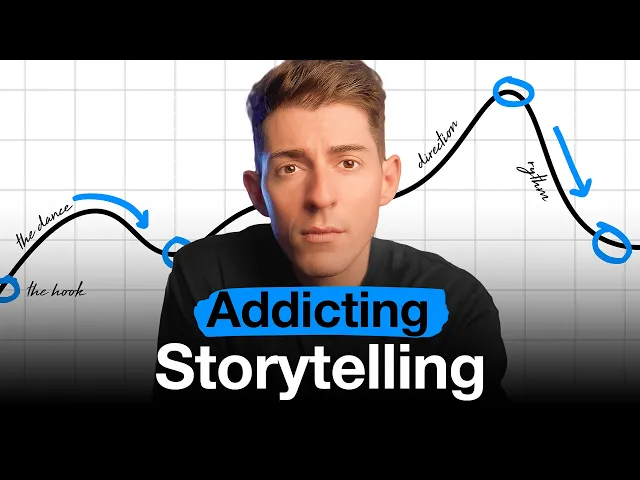
Viral videos aren’t accidents. They’re built on a structure designed to grab and hold attention in a feed that never ends. The single most important part is the hook, and you have about one to three seconds to nail it.
A good hook instantly tells the viewer, "Here's why you should stop scrolling."
Weak Hook: "Today, I'm going to show you how to organize your desk." (Boring.)
Strong Hook: "Your messy desk is costing you an hour every day. Here are 3 fixes." (Intriguing and promises a benefit.)
Actionable Hook Example: Start your video with a bold statement like "You're using [product] all wrong," and then immediately show the right way to do it.
Once you have them hooked, the goal is to keep the energy up. Use quick cuts, pop-up text to emphasize your points, and jump on trending audio to make your content feel like it belongs on the platform.
Practical Formulas for Compelling Videos
You don't need to come up with a brilliant, original idea every single time. Leaning on proven formulas is the secret to producing great content at scale.
Here are a couple of my go-to structures that just plain work:
Problem-Agitate-Solve (PAS): This is gold for any educational or service-based content. You start by calling out a problem your audience has. Then, you poke at the frustration it causes. Finally, you swoop in with your solution.
SaaS Tool Example: Text on screen: "Still wasting hours on manual reports?" (Problem) -> Show a quick clip of someone looking stressed at their computer. (Agitate) -> "Automate it in 30 seconds with this." (Solve)
Point-of-View (POV): This is all about creating relatable, human moments. You drop the viewer right into a familiar situation, often using a touch of humor or empathy to connect.
Coffee Brand Example: Text on screen: "POV: You're trying to function before your first cup of coffee." -> Show a funny, clumsy clip that perfectly captures that groggy, pre-caffeine feeling.
The best short-form videos feel less like ads and more like inside jokes or shared experiences. You want people to nod their heads, laugh, and think, "That is so me."
Creating High-Impact Faceless Videos
One of the biggest myths out there is that you have to be on camera to make it with video. Not true. "Faceless" videos, built with stock footage, screen recordings, and text overlays, can perform exceptionally well.
This is the perfect route for anyone who's a bit camera-shy or for brands that want to create a clean, aesthetic vibe.
Actionable Tip: Create a "how-to" video using only screen recordings. Use a tool to zoom in and highlight where you're clicking. Add simple text overlays like "Step 1: Click here" to guide the viewer. This is incredibly effective for software tutorials or process walkthroughs.
Use High-Quality Stock Footage: Find clips that match the tone and story you're telling.
Lean on AI Narration: Modern text-to-speech tools can give you a professional voiceover without you ever touching a microphone.
Make Your Text the Star: The words on the screen have to carry the narrative. Use bold, clear fonts and simple animations to keep the viewer’s eyes moving.
Optimizing Videos for Search
TikTok and Instagram are basically becoming the new Google for a younger generation. People aren't just scrolling for entertainment; they're actively searching for tutorials, reviews, and answers.
This means you need to start thinking about your videos like a search engine would.
Put Keywords on the Screen: If your video is about "easy dinner recipes," those words need to be in the on-screen text.
Write Descriptive Captions: Don't just throw in a few emojis. Your caption is prime real estate for keywords that describe what the video is about.
Use Hashtags Strategically: Don't just use the biggest ones. Mix broad hashtags (#foodie) with more specific, niche ones (#15minutemeals) to hit different audiences.
Getting smart about repurposing is a game-changer here. You can learn how to create YouTube Shorts from existing video to get more mileage out of the content you already have. When you treat your videos as searchable assets, you're building a content library that works for you long after you hit "publish."
Building an Automated Content Scheduling System
If there's one non-negotiable for social media growth, it's consistency. Random, sporadic posting just doesn't cut it. But let's be realistic—who has the time to be glued to their phone all day? This is exactly why an automated scheduling system is a game-changer. It turns the daily content grind into a smooth, efficient operation.
The secret sauce here is something I swear by: content batching. It’s a simple idea with massive benefits. Instead of panicking about what to post every single day, you block off a specific chunk of time—maybe a few hours one day a week—and create everything in one go.
Actionable Tip: Structure your batching days. For example, spend the first hour writing all captions, the second hour designing all graphics, and the third hour recording all video clips. This "task batching" keeps you in a state of flow and is far more efficient than switching between different creative tasks.
The Power of Batching and Scheduling
Once you’ve got a month's worth of content sitting in a folder, the next step is to put its distribution on autopilot. This is where a good scheduling tool becomes your best friend. You simply upload all that batched content, plug in the dates and times for each post to go live, and you're done.
Think of it as your virtual assistant, pushing out perfectly timed content when your audience is most active, even if you’re asleep or on vacation. This is fundamental if you want to generate social media content that actually works without letting it take over your entire life.
The real objective isn't just to publish posts. It's to build a system that frees you up to do the high-level work—analyzing what's working, talking to your community, and planning your next big move.
By creating a dependable workflow, you ensure your brand is always present and active. That constant visibility builds trust and familiarity, which is how you cultivate a loyal audience. For a more detailed look, our guide on how to automate social media posting breaks down the entire process.
Building an Evergreen Content Queue
Let’s talk about your greatest hits. Some of your content is timeless—think tutorials, foundational advice, or popular success stories. New followers haven't seen them, and old followers might appreciate a reminder. An evergreen content queue is the smartest way to keep these valuable assets in rotation automatically.
Most modern schedulers let you create a special library just for this purpose. You can set rules for how often these posts get recycled, filling the natural gaps in your calendar with proven, high-value content.
It’s easy to set up:
Find Your Winners: Dive into your analytics. Pull out the posts with great engagement that aren't tied to a specific date or event.
Create Your Queue: Add these posts to a dedicated "Evergreen" folder or category within your scheduling tool.
Set the Frequency: Configure the queue to publish an evergreen post every few days or once a week.
This strategy keeps your best work in the spotlight, continuously driving engagement and educating your audience long after you first hit "publish."
Using AI to Accelerate Captions and Hashtags
The last piece of this automation puzzle is letting AI handle the more repetitive tasks. Let's face it, writing dozens of unique captions and hunting down the right hashtags for every single post is a major time drain.
Actionable Tip: Use an AI tool to generate 5 different hooks for a single piece of content. Test them out on different platforms or at different times to see which style of hook performs best. This turns a repetitive task into a valuable data-gathering exercise.
AI-powered writing assistants can now spit out several caption ideas from a single prompt. This is fantastic for A/B testing different hooks or tones to see what your audience responds to. In the same way, AI can quickly generate targeted hashtag groups—a mix of popular, niche, and trending tags—to help each post reach as many people as possible.
Using Analytics to Fuel Your Next Great Idea
Posting content is only half the job. The real trick to generating great social media content consistently is figuring out what your audience actually loves—and why. This is where your data stops being a boring report card and becomes a goldmine for your next big idea.
Forget chasing vanity metrics. Raw follower counts and simple likes don't tell you the whole story. To really get a feel for what’s working, you need to zero in on the numbers that signal a genuine connection.
Metrics That Actually Matter
When you pop open your analytics dashboard, these are the indicators that deserve your attention:
Engagement Rate: Think of this as your content’s pulse. It’s a measure of your likes, comments, and shares against your follower count, showing you what percentage of your audience is actually paying attention. A high engagement rate is a clear sign you’ve hit a nerve.
Shares and Saves: These are pure gold. A 'like' is easy and passive. But when someone shares your post or saves it for later, they're telling you it was so valuable they couldn't risk losing it. That’s a powerful signal.
Click-Through Rate (CTR): If you're trying to drive traffic, this is your number. It shows you how many people were inspired enough by your post to actually click that link in your bio or story. This directly ties your social media work back to real business goals.
Keeping an eye on these data points helps you move from guesswork to smart, informed decisions. It’s also the first step toward a system where you can accurately measure your social media ROI and prove the value of your work.
Performing a Simple Monthly Content Audit
You don't need a complex spreadsheet. Just block out an hour each month to look back at what you’ve published and spot the patterns.
Your top-performing posts aren't just victories to celebrate. They're clues. Deconstruct them to understand the 'why' behind their success.
While you're reviewing everything, ask yourself a few simple questions:
Which formats took off? Did those carousels get way more saves than the single-image posts? Did the short-form videos get all the shares?
What topics got people talking? Dive into the comments. Was it a tutorial? A behind-the-scenes glimpse? Or a post where you asked a direct question?
When was my audience online? Pinpoint the days and times when your posts really popped.
Actionable Tip: At the end of your audit, write down three simple takeaways. For example: "1. Reels with trending audio get more views. 2. Carousel posts explaining 'how-to' get the most saves. 3. My audience is most active on Tuesday mornings." This simple summary becomes your direct instruction manual for the next month's content.
Frequently Asked Questions
When it comes to creating social media content, a few questions always seem to pop up. Getting straight answers is key to building a workflow that actually works without burning you out. Here's my take on some of the most common ones I hear.
How Often Should I Be Posting?
Honestly, consistency beats frequency every single time. It's far better to post three truly valuable, well-crafted pieces a week than it is to churn out seven rushed, forgettable ones.
Start with a pace you know you can stick with.
Instagram & LinkedIn: Aiming for 3-5 posts per week is a great sweet spot.
X (formerly Twitter) & TikTok: These move faster. 1-3 times a day can work wonders if your content is timely and relevant.
Ultimately, your own analytics will tell you the real story. Dive into your data to see when your audience is actually online and ready to engage.
What Are the Best Tools for Creating Content?
You don't need a million different apps. A smart, simple tool stack that covers your entire process from idea to analysis is what you're after.
If I were building a content toolkit from scratch, I'd make sure I had:
An All-in-One Hub: A central platform for brainstorming, scheduling, and tracking performance is non-negotiable.
A Solid Design Tool: Something user-friendly like Canva is perfect for creating graphics, carousels, and thumb-stopping visuals.
A Go-To Video Editor: For short-form video, an easy-to-use editor like CapCut is essential.
An Audience Insight Tool: You need to know what people are actually asking. I often browse Reddit communities in a specific niche or use a tool like AnswerThePublic to find real-world questions.
What Do I Do When I Have No Content Ideas?
Creative block is real, and it happens to all of us. When you hit that wall, stop trying to invent something new and start looking at what already exists.
First, look at your own analytics. What were your biggest hits in the last few months? Is there a way to expand on that topic or present it from a new angle? Then, see what's resonating for others in your space—not to copy, but for inspiration.
And never forget the power of repurposing.
A single well-researched blog post can easily become a 10-slide educational carousel, a 60-second video tutorial, and a handful of insightful text posts. This one tactic can multiply your content output without you having to come up with a single new idea.
Ready to stop the daily content scramble and put your social media on autopilot? NicheTrafficKit uses AI to handle the entire content lifecycle—from research and creation to scheduling and analytics. Spend minutes, not hours, generating on-brand content that grows your audience. Discover the smarter way to manage social media at https://nichetraffickit.com.