How to Use Hashtags Effectively: Master Social Reach Today
Learn how to use hashtags effectively with platform-specific tips, research tricks, and expert guidance to boost social engagement.
Using hashtags well isn't about chasing the biggest numbers or what's trending. It's about strategically picking a mix of community, branded, and campaign tags to connect with a very specific audience. This is how you turn simple labels into powerful tools for building your brand and getting people to actually engage. For example, instead of just using #fitness, a personal trainer could use #bodyweightworkout (community), #TrainWithTara (branded), and #Taras30DayChallenge (campaign) to attract the right clients.
Building a Modern Hashtag Strategy That Works

Before you slap another hashtag onto your next post, let's take a step back. A truly effective plan isn't about reaching everyone—it's about reaching the right people.
Today's social media algorithms are smart. They care more about relevance and engagement than sheer volume, which means a well-chosen niche hashtag will almost always outperform a generic one with millions of posts.
The secret to a solid strategy is knowing the different jobs hashtags can do. Think of them as different tools in your marketing toolbox. When you learn how to mix them correctly, you start building a loyal audience instead of just chasing fleeting views. This mindset is central to a winning social media plan. You can see how this works in practice by looking at other successful social media strategy examples to see how different brands nail this.
The Three Pillars of Your Hashtag Plan
A balanced strategy really boils down to three core types of hashtags, each with its own job to do.
Community Hashtags: These are the tags that plug you into an existing conversation. They’re how new people find you based on shared interests, locations, or identities. Actionable Insight: Search for terms like
#[yourcity]foodieor#[yourhobby]loverto find active communities.Branded Hashtags: This is your signature tag. It’s unique to you—your company name, a tagline, or a specific product line. It's perfect for tracking mentions and collecting all that great user-generated content. Actionable Insight: Make it short, memorable, and unique. For example, use
#NTKgrowthinstead of a long, clunky tag.Campaign Hashtags: Think of these as short-term, special-use tags. You'll create them for a specific product launch, a contest, an event, or a marketing push to build buzz and track how that one initiative is doing. Actionable Insight: Always include your brand name in campaign tags, like
#NikeRunClub2024, to boost brand association.
Putting the Pillars into Practice
So, how does this look in the real world?
Imagine a local bakery posting about their new summer scone. A smart mix of hashtags for their post would look something like this:
Community:
#SupportLocalBakers,#BostonFoodies,#BakeryLifeBranded:
#SweetCrumbBakeshopCampaign:
#SweetCrumbSummerTreats
This simple combo lets the bakery tap into the local foodie scene, build its own brand recognition, and keep an eye on how the new seasonal menu is being received. To really level up, it's worth digging into understanding core, adjacent, and long-tail hashtags to refine your reach even further.
The goal isn't just to be seen; it's to be found by the right people. A smart mix of community, branded, and campaign hashtags ensures your content lands in front of an audience that is genuinely interested in what you have to offer.
How to Find the Right Hashtags for Your Audience
Picking the right hashtags is less about guesswork and more about smart detective work. If you want to find tags that do more than just rack up a few views, you need a solid process—one that helps you find the communities that are genuinely ready to engage with what you're putting out there.
The best place to start is right where your audience lives: on the social platforms themselves. Jump onto Instagram or TikTok and pop a core keyword for your post into the search bar. You'll immediately see a list of related hashtags and, crucially, how many posts are using them. This gives you an instant feel for what’s trending and what's more of a niche conversation.
Analyze Your Competitors (But Don't Just Copy Them)
Take a look at the hashtags your top competitors or favorite creators in your niche are using. The key here isn't to just copy and paste their list; it's to figure out their strategy. Are they mixing big, broad tags with smaller, more focused ones? Are they tapping into local communities or specific subcultures you hadn't thought of?
Actionable Example: Let's say you run a local coffee shop and see a competitor using #BostonCoffeeCulture. That's a huge clue that there's an active local community you should be a part of. Your actionable step is to click on that hashtag. Look at the "Top" posts. Who is posting? What other hashtags are they using? You might discover less-crowded gems like #BostonCoffeeRoasters or #CambridgeMAcafes that you can make your own.
Master the Hashtag Tier System
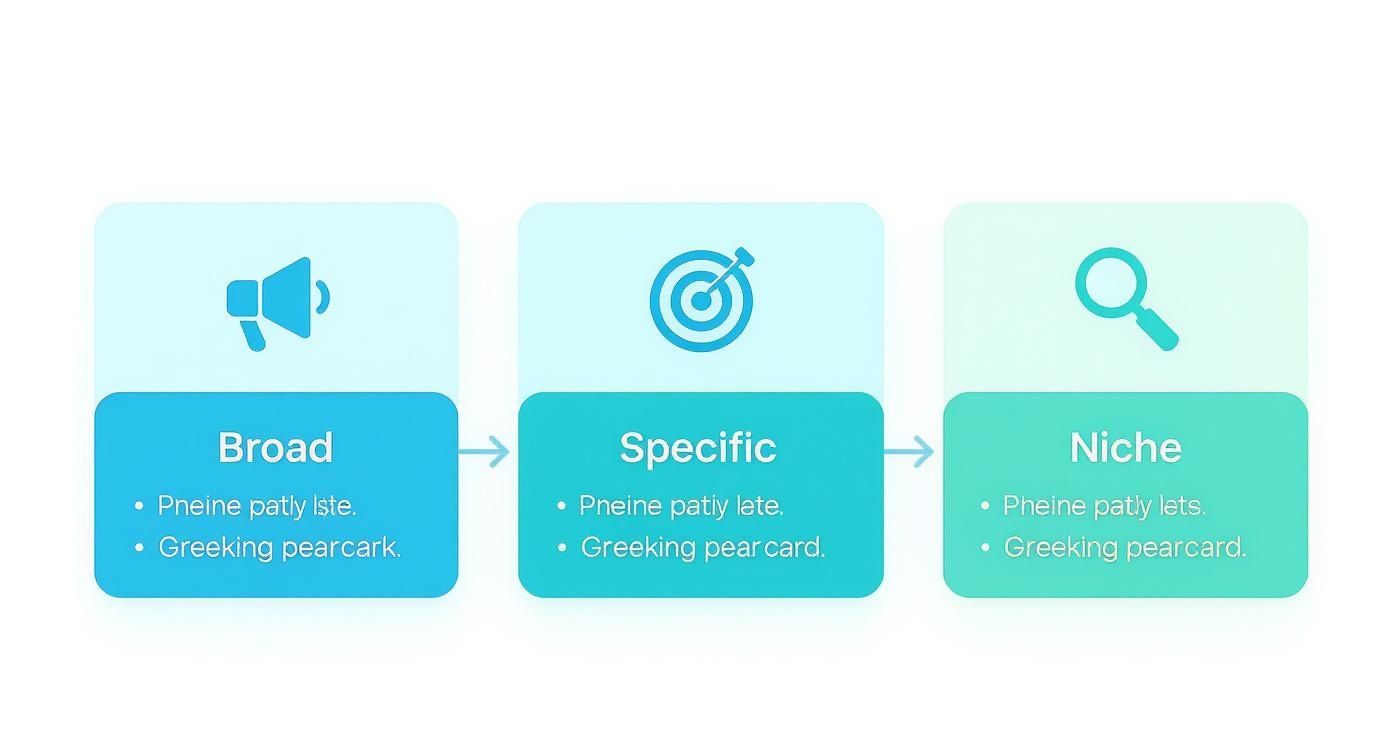
A smart hashtag strategy is all about balance. Throwing a massive tag like #fitness (with over 500 million posts) on your content is like shouting into a hurricane—you'll be drowned out in seconds. A much better approach is to use a tiered system that helps you reach different pockets of your audience all at once.
Think of it as blending tags from three different buckets:
Broad (High-Volume): These are the mega-popular tags with millions of posts, like
#FitnessMotivation. Sprinkling in one or two can give you a quick, initial burst of visibility.Specific (Mid-Volume): These get a bit more focused and describe your content more accurately, like
#KettlebellTraining. They're great for connecting with people who are actively looking for what you have to offer.Hyper-Niche (Low-Volume): These are the super-specific tags, often tied to a location or a unique specialty, like
#MiamiFitnessCoach. They might not have a huge search volume, but the people who find you through them are often your most qualified and engaged followers.
A mix of all three tiers lets you cast a wide net while also dropping a line right where your ideal customer is swimming. A single post can suddenly appeal to someone casually browsing fitness content and someone specifically looking for a coach in their city.
Use Tools to Speed Up Your Research
Digging for hashtags manually is a fantastic way to get a feel for the landscape, but you can uncover some real hidden gems by bringing in some outside help. Third-party tools can save you a ton of time and surface trending topics you might have missed.
Tools like RiteTag or Inflact can give you real-time suggestions based on your image or text. They often come loaded with data on a hashtag's potential reach and engagement, which helps you make decisions based on numbers, not just a hunch. By building a simple workflow—platform search, competitor peek, and a quick tool check—you'll consistently land on powerful hashtags that actually move the needle.
Tailoring Your Hashtags for Each Social Platform
A one-size-fits-all approach to hashtags is a surefire way to waste your effort. What gets your content seen on a fast-paced platform like TikTok could completely flop in the buttoned-up world of LinkedIn. Each network has its own culture, algorithm, and audience expectations, so you’ve got to adapt your strategy to get any real traction.
Think of it this way: instead of just copying and pasting the same block of tags everywhere, treat each platform as a unique conversation. Understanding the subtle differences is what drives discovery and gets people to actually engage.
Instagram: The More, The Merrier (Usually)
Instagram is arguably the most hashtag-friendly platform out there. A generous mix of tags isn't just accepted; it's practically required for growth. The sweet spot for most accounts is a blend of broad, specific, and super-niche hashtags that helps you reach different pockets of your audience all at once.
The platform allows up to 30 hashtags per post, and the data is pretty clear: using more of them can seriously boost your interaction rates. In fact, accounts with fewer than 1,000 followers see a staggering 79.5% increase in engagement when they use 11 or more hashtags. Why? Because every tag is another potential pathway for someone new to find you. You can dive deeper into this by checking out our guide on how to increase engagement on Instagram.
Optimal Number: 11-20 hashtags is a great target.
Placement: You can drop them at the end of your caption or tuck them away in the first comment. The algorithm doesn't care which you choose, and putting them in the comments keeps your caption looking clean.
Practical Example: A travel blogger posting a photo from Italy might use
#ItalyTravel(broad),#TuscanyAdventures(specific),#SanGimignanoViews(hyper-niche),#ItalianSummer(community), and#WanderlustEurope(broad).
TikTok: All About the Trends
TikTok’s discovery engine, the "For You" page, is powered by hashtags. They’re essential for categorizing your content and getting it in front of the right eyeballs. Here, the name of the game is a mix of trending sounds or challenges, community-specific tags, and a few descriptive ones.
You don’t need a massive wall of hashtags like on Instagram. A few highly relevant ones are much more effective. Actionable Insight: Spend 5 minutes on the "For You" page before posting. What sounds and hashtags are appearing repeatedly? If one fits your niche, use it.
Optimal Number: Keep it concise with 3-5 hashtags.
Placement: Right in the video caption.
Practical Example: A baker trying a viral recipe could use
#CloudBread(the specific trend),#BakingTikTok(the community), and#EasyRecipes(a descriptive tag).
This tiered approach is a solid strategy across most platforms. You start broad to catch a wide net, then get more specific to connect with a highly engaged, niche community.
X (Formerly Twitter): Real-Time Conversations
On X, hashtags are all about the now. They act as real-time sorting tools for conversations, making them perfect for joining trending topics, participating in live events, or just adding a bit of context to a quick thought.
Overloading a post with hashtags on X is a big mistake—it looks spammy and desperate. Stick to one or two that are directly relevant and add genuine value to the conversation.
Optimal Number: Just 1-2 hashtags.
Placement: Woven naturally into the body of your post or added at the very end.
Practical Example: A tech company announcing a new feature might post, "We're excited to launch our latest update for
#AI-powered analytics. Our goal is to make data more accessible for every #SaaS founder."
LinkedIn: Professional and Niche-Focused
LinkedIn hashtags are your key to professional discovery. They help your content reach people outside your immediate network who are searching for specific industries, skills, or topics of discussion.
This is not the place for fun, quirky, or overly broad tags. Keep them professional and directly related to your industry to increase your visibility among peers, potential clients, and recruiters. Using a few targeted hashtags can make a huge difference in who sees your posts.
To make it even clearer, here’s a quick-reference table breaking down the best practices for each major platform.
Optimal Hashtag Usage Across Major Social Platforms
Platform | Optimal Number | Best Placement | Key Strategy |
|---|---|---|---|
11-20 | End of caption or first comment | Mix broad, specific, and niche tags to maximize reach. | |
TikTok | 3-5 | In the video caption | Focus on trending, challenge, and community-specific tags. |
X | 1-2 | Within the post or at the end | Use for real-time conversations, events, and trending topics. |
3-5 | End of the post | Stick to professional, industry-specific, and niche topic tags. |
As you can see, what works on one network is often the opposite of what you should do on another. Taking a few extra minutes to customize your hashtags for each platform is a small investment with a big payoff.
Choosing the right platform-specific hashtag strategy isn't just a "best practice"—it's the difference between being discovered by a relevant audience and shouting into the digital void. Tailor your tags, and you'll tailor your results.
How to Measure and Improve Your Hashtag Performance
Using hashtags without tracking what works is like driving with your eyes closed. You might move forward, but you have no idea where you're going. If you really want to master hashtags, you have to ditch the 'set it and forget it' mindset and start looking at the data.
Thankfully, most social media platforms have built-in analytics that show you exactly how people are finding your content. This data is your roadmap to refining your strategy and making sure your hard work is actually paying off.
Dive into Your Native Analytics
You don't need expensive third-party tools, at least not at first. The free analytics baked right into platforms like Instagram and TikTok offer a treasure trove of information about your hashtag performance.
Actionable Insight: On Instagram, you can see exactly how many impressions came from your hashtags. Just open up one of your posts, tap "View Insights," and scroll down. You'll find a clear breakdown of where your impressions came from, including a line item for "From Hashtags." If that number is consistently below 10% of your total reach, it’s a huge red flag that your current hashtag set isn't connecting with the right audience.
Run Simple A/B Tests
One of the best ways to get better results is to experiment. Treat it like a mini-science project for your content.
Here’s a straightforward way to run a quick A/B test:
Create Two Hashtag Groups: Come up with two different sets of relevant hashtags for a similar piece of content. For instance, a local bakery could test one group of community-focused tags (
#ChicagoBakery,#LincolnParkEats) against a group of niche-specific tags (#SourdoughLife,#ArtisanBread).Post and Track: Publish two similar posts at similar times, but use a different hashtag group on each one. Pro Tip: Post a photo of sourdough bread on Tuesday with Group A and another photo of sourdough on Thursday with Group B. Keeping the content type consistent gives you cleaner data.
Compare the Results: Give it a few days, then dive into the insights for both posts. Which one pulled in more impressions from hashtags? Did one have noticeably higher engagement? This process turns guessing into knowing.
This simple process takes the guesswork out of your strategy, giving you real data on what actually grabs your audience's attention.
Constantly rotating and testing your hashtag groups is crucial. Not only does it help you discover new opportunities, but it also prevents your account from looking spammy to the algorithm, which can happen if you copy-paste the same block of tags on every single post.
Effective measurement is about understanding both the numbers and the story they tell. After implementing your hashtag strategy, it's crucial to understand your impact by learning how to measure social media engagement in a broader context. Real growth comes from being specific and making adjustments based on what your analytics are telling you.
Ultimately, connecting your hashtag performance to real business outcomes is the final, most important step. Our guide on how to measure social media ROI can help you bridge that gap.
Common Hashtag Mistakes You Need to Avoid

It’s easy to fall into a few common hashtag traps—even seasoned social media pros do it. But these simple mistakes can quietly sabotage your reach. Knowing what to watch out for is the first step to making sure every hashtag you use is actually working for you, not against you.
One of the biggest culprits? Copy-pasting the same block of hashtags on every single post. Sure, it saves a few seconds, but it's a red flag to the algorithms. Platforms can see this as spammy, repetitive behavior, which might get your visibility throttled. Your content is unique, and its hashtags should be too.
Using Irrelevant or Overly Broad Tags
It's tempting to slap a massive tag like #fyp or something generic like #marketing on your post, hoping to catch a wave of views. The problem is, this strategy usually backfires. Your post just gets swept away in a tidal wave of millions of other posts, and you end up attracting an audience that has zero interest in what you're actually offering.
Let's look at a practical example:
Don't Do This: A boutique hotel in Miami posts a gorgeous Reel of its oceanfront view and uses: "Your perfect escape awaits. #fyp #travel #vacation #hotel"
Do This Instead: The same hotel gets specific with tags that attract the right people: "Your perfect escape awaits. #BoutiqueHotelGetaway #MiamiBeachHotel #LuxuryTravelFlorida #OceanfrontViews"
See the difference? The second approach connects the hotel with people actively searching for that exact experience, which is where real engagement comes from.
Ignoring Banned or Broken Hashtags
This one is a silent killer for your reach. Platforms "ban" or "break" certain hashtags when they get flooded with content that violates community guidelines. If you use even one of these shadowbanned tags, the algorithm can hide your post from all hashtag feeds.
Actionable Insight: Before you add a new hashtag to your rotation, do a quick search for it on the platform. If the results look thin, show a warning message like "Recent posts from #... are currently hidden," or just seem off, steer clear. It’s a two-second check that can save your post from disappearing into the void.
Sidestepping these common mistakes isn't about chasing perfection. It's about being intentional. A quick audit of your habits—like spot-checking for banned tags and customizing your lists for each post—can immediately boost your performance.
Forgetting Platform-Specific Nuances
Every platform has its own culture and its own rules of engagement for hashtags. What works on Instagram might fall completely flat on LinkedIn.
For example, on X (formerly Twitter), tying hashtags to live events can boost brand engagement by around 50%. Meanwhile, one analysis of 18 million Instagram posts found that using about 20 relevant tags often delivered the best reach.
You have to play by the rules of the platform you're on. Always adapt your strategy to the specific audience you're trying to reach. You can discover more insights about hashtag performance on AMA.org.
Got Hashtag Questions? We've Got Answers
Even the best-laid plans can leave you with a few nagging questions. Getting hashtags right often comes down to sweating the small stuff—those little details that can make or break your entire strategy. Let's tackle some of the most common questions I hear all the time.
Should My Hashtags Go in the Caption or the First Comment?
When it comes to getting discovered, it makes absolutely no difference. Instagram’s algorithm sees hashtags in the caption and the first comment as one and the same.
So, the choice really boils down to aesthetics.
Putting your block of hashtags in the first comment gives your caption a much cleaner, more polished look. It keeps the focus squarely on your message, which is why so many brands prefer this method. On the other hand, you can weave one or two of your most important hashtags right into the caption text itself to add immediate context.
Practical Tip: A great hybrid approach is to place your single most relevant hashtag in the caption and then drop the rest into that first comment. For example: "Our new sourdough recipe is live! We've been perfecting this for months. #SourdoughBaking" Then, add your other tags like #ArtisanBread, #BakingFromScratch, and #BreadLovers in the first comment.
How Can I Find and Steer Clear of Banned Hashtags?
A "banned" hashtag is one that social platforms have flagged for violating their rules. Using one is a surefire way to kill your post's reach. If your post includes a banned tag, it can be completely hidden from all hashtag searches, making it practically invisible to new audiences.
The easiest way to check a tag's status is to simply search for it on the platform. If you see a message pop up saying that recent posts are hidden for community guideline reasons, you've found a banned one. You’d be surprised what gets flagged—even seemingly innocent tags like #desk have been banned in the past. It’s a good habit to periodically check on your go-to hashtag lists to make sure they're still safe.
A mix of hashtags is always more effective than relying on just one type. Think of it like a pyramid: you need a broad base to reach a lot of people, but you also need to get specific to connect with the niche communities that will actually care about what you're posting.
Is It Better to Use a Ton of General Tags or Just a Few Specific Ones?
Honestly, the magic is in the mix. If you only use massive, general tags like #marketing, your content will be a tiny drop in an ocean of millions of other posts, gone in a flash. But if you only use super-specific, niche tags, you might not reach anyone at all.
The best strategy is to think in tiers for every single post:
Broad & Popular (1-2 tags): These are your lottery tickets for wide visibility. Think big, like
#coffeeor#digitalart.Niche & Community (Several tags): This is where you connect with your people. Get more specific, like
#pourovercoffeeor#procreateart.Hyper-Specific (A few tags): These are for your core audience. Think branded hashtags or location-specific ones, like
#BostonCoffeeRoasters.
A local coffee shop using #coffee (broad), #pourovercoffee (niche), and #BostonCoffeeRoasters (specific) in a single post is a perfect example. This layered approach lets you cast a wide net while also spearfishing for the exact audience you want.
Ready to stop guessing and start growing? NicheTrafficKit uses AI to research trending topics, generate platform-specific posts, and find the perfect hashtags to maximize your reach. Automate your entire social media workflow and watch your engagement climb. Try it free today at https://nichetraffickit.com.