
How to Find Trending Topics and Create Viral Content
Learn how to find trending topics using powerful dashboards, social listening, and AI tools. Get actionable strategies to create content that goes viral.
The secret to finding trending topics is deceptively simple: you need to be where the conversations are, right when they're happening. This isn't about guesswork; it's about actively listening. For instance, you can use free and powerful tools like Google Trends to see what people are searching for, dive into the TikTok Creative Center to catch viral moments as they ignite, and even lurk in niche Reddit communities to spot ideas before they hit the mainstream. The real magic happens when you connect these different signals to figure out what your audience is obsessed with right now.
Why Trending Topics Are a Growth Superpower

Have you ever poured your heart into creating fantastic content, only to watch it get lost in the digital void? It’s a frustratingly common experience. The hard truth is that even the most brilliant work will struggle if it doesn’t connect with an existing conversation. Learning how to find trending topics is probably the single most powerful skill you can develop to break through that noise and reach a massive, highly engaged audience.
This isn’t about mindlessly chasing every viral dance or fleeting meme. Think of it as a repeatable strategy for building genuine relevance and authority. For example, if you're a finance blogger and notice a spike in searches for "AI stock trading," creating a guide on that topic meets your audience exactly where their attention is focused. It’s a powerful way to get immediate feedback and traffic, offering a refreshing alternative to the slow-and-steady pace of traditional SEO.
The Real Benefits of Riding the Wave
Jumping on a trend is about so much more than a temporary spike in page views. It’s a smart, strategic move that can deliver some very real results for your brand. When you get it right, this approach becomes a powerful engine for growth.
Here’s what you actually stand to gain:
Skyrocket Your Organic Visibility: When search interest in a topic suddenly explodes, Google’s "freshness" algorithm kicks in, prioritizing new and relevant content. For example, when a new social media platform launches, being one of the first to publish a "how-to" guide can land you on page one for high-volume keywords, often leapfrogging competitors who are stuck on evergreen terms.
Boost Audience Engagement: Trending topics are natural conversation starters. Since the subject is already on everyone’s mind, people are far more likely to comment, share, and react to your content. A real estate agent sharing a video about a trending interior design style will likely get more comments than a generic "tips for buyers" post. All that activity sends strong positive signals to platform algorithms, which in turn amplifies your reach even further.
Build Your Topical Authority: Consistently covering emerging topics in your niche establishes you as a go-to expert—the person who’s always in the know. If you're a tech reviewer who consistently breaks down new AI tools the week they're released, you not only build incredible trust with your audience but also strengthen your site's authority in the eyes of search engines over the long haul.
The secret to viral growth isn’t just creating great content; it’s creating the right content at the right time. Trends provide the roadmap, showing you exactly what your audience is eager to consume.
How Trends Spread in the Digital Age
The rise of social media completely changed the game for how trends are born and how fast they spread. By October 2025, there were a mind-boggling 5.66 billion social media 'user identities' scattered across the globe. To put that in perspective, that number was just 2.08 billion back in 2015—a 2.52x increase in only ten years.
With 7.8 new users joining every single second, the speed of information is just staggering. The average person now juggles 6.83 different platforms, creating a powerful ecosystem where a single idea can catch fire and ripple across multiple networks almost instantly. You can explore more of this data on the global social media landscape over at DataReportal.
Using Free Dashboards and Native Platform Tools
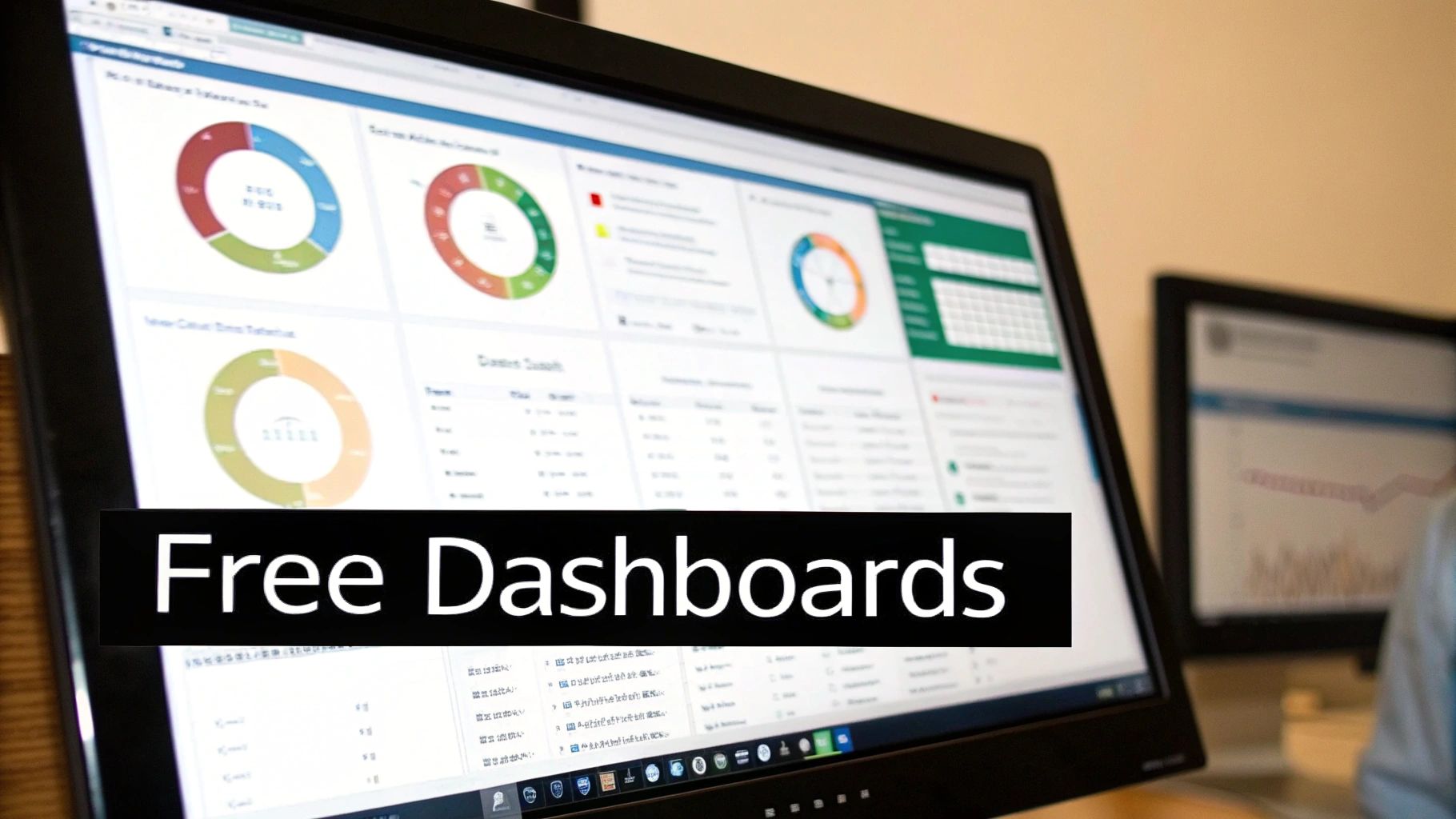
You don't need a huge budget to get ahead of the curve. In fact, some of the most potent tools for spotting trends are completely free and already baked into the platforms you use every day. The trick is knowing how to look past the surface-level numbers and pull out real, actionable intelligence.
The old media landscape is history. Social platforms have become the world's primary discovery engines, far outpacing traditional news cycles. With global social media ad spend hitting around $247.3 billion in 2025 and giants like Meta poised to overtake linear TV ad revenue, it's clear where the eyeballs are.
This isn't just about ads, though; it’s about a fundamental shift in how people find information. A massive 80% of marketers see better content exposure from social media, and 73% point to it as a major source of traffic. With Facebook alone boasting 3.07 billion monthly active users, trends can ignite in a tiny niche community and explode into the mainstream overnight. You can see more data on this shift over at ClearVoice.
Your Go-To Trend Discovery Toolkit
To make sense of all this data, you need a few core tools in your back pocket. These free dashboards are my go-to starting points for digging into what's gaining traction right now.
Tool | Best For | Actionable Insight to Look For |
|---|---|---|
Validating search demand and finding breakout queries before they peak. | Example: Find "Breakout" related queries (over 5000% growth) like "AI recipe generator" to see what's about to explode in the food niche. | |
Spotting viral formats, sounds, and challenges as they emerge. | Example: See a rising audio track being used by beauty influencers for "get ready with me" videos. This is your cue to create one for your brand. | |
Predicting consumer behavior and visual trends, especially for seasonal topics. | Example: Notice searches for "maximalist home decor" starting to climb in August. This is the signal to create your fall decor content early. | |
Tapping into raw, unfiltered community conversations and pain points. | Example: In r/skincareaddiction, find a post with a high comment-to-upvote ratio where users are debating a new, controversial ingredient. |
Each of these platforms gives you a different piece of the puzzle. Google shows you what people are actively searching for, TikTok reveals what they’re engaging with, and Reddit tells you what they're truly passionate about.
Master Google Trends for Search Insights
Almost everyone knows about Google Trends, but most people only scratch the surface. Don't just type in a keyword and look at the graph. The real magic is buried a little deeper.
Navigate to the "Related queries" section at the bottom. You’ll see two tabs: "Top" and "Rising." "Top" is fine, but "Rising" is where the gold is. This shows you the search terms that have had the most significant growth spurt recently.
Keep your eyes peeled for any query labeled "Breakout." This is Google's signal that a term has grown by more than 5000%. For instance, if you're in the fitness industry and see "hyrox training" marked as Breakout, you've struck oil. It’s a clear sign that a topic is about to hit the big time, and you get a head start.
Pro Tip: Use the "Compare" feature to pit a new, rising term against an established keyword in your niche. If you compare "hyrox training" to the established term "crossfit," you can see if the new trend has a similar growth trajectory, confirming it's a solid topic to pursue. This gives you much-needed context.
Dig into the TikTok Creative Center
TikTok is a veritable trend factory, and its Creative Center is your all-access pass. This dashboard is overflowing with data on what’s capturing attention right now. Don't just glance at the top trending hashtags—use the filters to drill down into your specific industry and region.
One of the most powerful and underused features is the ability to filter by trending audio. A sound that’s just starting to bubble up is often a leading indicator of a new meme, challenge, or content format. By spotting that rising sound early, you can create content that feels incredibly timely and native to the platform, dramatically increasing your chances of getting swept up by the algorithm.
Here’s a quick, actionable guide:
Filter by Industry: Go to the "Hashtags" tab and select "Beauty & Personal Care." You might discover #skincycling is trending, giving you a specific content idea.
Analyze Video Examples: The Creative Center shows you top-performing videos for each trend. Watch them. Notice the pacing is fast, captions are bold, and the first 3 seconds are highly engaging. Replicate that style.
Check Audience Insights: For some trends, you can even get basic demographic data. This helps you confirm if the people engaging with the trend are the people you’re trying to reach.
Uncover Niche Conversations on Reddit and Pinterest
While they aren’t traditional dashboards, Reddit and Pinterest are incredible sources for community-driven insights. They're essential for finding topics that have real, passionate people behind them.
Reddit's Power of Community: Reddit is a sprawling network of thousands of niche communities, or "subreddits." The trends you find here are often raw, honest, and a few steps ahead of the mainstream. For example, in the r/personalfinance subreddit, look for posts with a high comment-to-upvote ratio. A thread titled "Is anyone else completely confused by high-yield savings accounts?" with hundreds of comments is a perfect signal to create a blog post or video explaining that exact topic. For a deeper dive, check out our guide on how to use free Reddit analytics tools to analyze any community.
Pinterest's Predictive Visual Trends: Think of Pinterest Trends as a visual crystal ball. It’s fantastic for predicting future consumer behavior, especially around seasonal or event-based topics. You can use it to see exactly when searches for terms like "summer recipes" or "fall home decor" start to climb. If you create your content just before that upward curve begins, you position yourself to ride the entire wave of seasonal interest. For instance, creating your "fall tablescape ideas" content in late August, right as the search interest begins to rise, ensures you capture peak traffic.
Uncovering Trends Before They Go Mainstream
While free dashboards are great for seeing what's hot right now, the real magic happens when you spot a trend before it hits the mainstream. This is where you shift from being a trend follower to a trendsetter. It takes a bit more detective work, but the payoff is huge.
Getting ahead of the curve means listening to conversations that are still just whispers. You’re not looking at broad data sets here; you’re digging for qualitative insights—the subtle shifts in language, sentiment, and problems bubbling up in niche communities.
Mastering Proactive Social Listening
First things first, you need to automate your monitoring with surgical precision. Instead of just passively scrolling through feeds, you can build a network of alerts that brings emerging conversations straight to your inbox. It’s way more efficient than hoping to stumble across gold.
Google Alerts is a fantastic free tool for this, but most people use it too broadly. The trick is to combine it with advanced search operators to cut through all the noise. This lets you zero in on specific conversations happening on forums, blogs, and news sites.
Imagine you're a meal prep blogger. You could set up an alert like this:
"new favorite" OR "obsessed with" intitle:"meal prep hack" site:reddit.com
This command doesn't just search for "meal prep hacks." It specifically hunts for posts on Reddit with that phrase in the title that also contain glowing terms like "new favorite" or "obsessed with." It’s a direct pipeline into what real people are getting excited about at this very moment, long before it ever lands on Google Trends.
The Art of Trend Arbitrage
One of my favorite strategies for early trend-spotting is trend arbitrage. This is where you find a trend that’s exploding in one niche and figure out how to apply it to your own. A concept gaining traction with gamers on Twitch might have a brilliant, untapped application for productivity software—but nobody has connected the dots yet.
This is where true innovation happens.
Look for Crossovers: Keep an eye on industries adjacent to yours. For example, if you see the "cozy gaming" trend taking off, a productivity app could create content around "how to design a cozy and productive home office setup," applying the same aesthetic principles.
Translate the Language: A meme format or slang term taking off with Gen Z on TikTok might seem irrelevant to a B2B audience. But if you see a trend like "day in the life of a..." you can translate it to "day in the life of a project manager using our software," creating relatable content that feels incredibly fresh.
By looking for patterns in unrelated fields, you can import a trend into your niche before anyone else. You're not just copying what works; you're creating a new, hybrid idea that captures attention because it feels both familiar and novel at the same time.
Decoding Competitor Comment Sections
Your competitors' comment sections are an absolute goldmine of audience intelligence. While they're focused on the content they're publishing, the real insights are often in the conversations happening right below it. This is where your target audience shares their unfiltered thoughts, pain points, and wishes.
Start scanning the comments on posts from industry leaders. Look for recurring themes:
Unanswered Questions: A competitor posts a video on making sourdough bread, but five different comments ask, "How do you know when the starter is really ready?" That’s a glowing neon sign pointing to a content gap you can fill with an in-depth guide.
Shared Frustrations: See multiple comments like, "I wish there was an easier way to..." or "This part is always so confusing"? These are direct requests for help.
"What If" Scenarios: Look for people brainstorming alternative uses or applications for a product or idea. This is the birthplace of new trends.
For a deeper dive into these niche communities, a tool like a Reddit threads finder can be a game-changer. It helps you surface the most engaged discussions quickly, saving you hours of manual scrolling.
Understanding where trends come from geographically and demographically is also key. Social media adoption is expanding fastest in Asia and Africa, which now account for the largest share of new users, adding 241 million in the past year alone. Younger groups, especially those aged 15-24 where internet usage hits 79% worldwide, are the primary engines of trend creation.
Meanwhile, income levels create distinct trend ecosystems. With 93% of people in high-income countries online versus only 27% in low-income markets, you can see how trends often start in specific regions before they go global. If you want to dig deeper into these global patterns, BroadbandSearch.net has a great breakdown of social media facts and statistics.
Choosing the Right Trends for Your Brand
Finding a hot trend feels great, but the real work starts after you spot it. The big question is: should you jump on it?
Hopping on the wrong trend can do more harm than good. It can make your brand look clueless or, even worse, desperate. The goal isn't just to get attention; it's to get the right kind of attention from the right people.
This means you need a quick way to sift through the noise and find the gold. Before you spend a single minute creating content, you have to validate if a trend is a smart move or a potential disaster. It's about making calculated bets that build your brand while tapping into what people are talking about right now.
Your Trend Validation Checklist
Before you dive in, run the trend through this quick four-point check. If you can't get a confident "yes" on most of these, it's probably best to sit this one out.
Brand Alignment: Does this feel like my brand? A serious law firm should probably avoid a silly dance trend, but a quirky coffee shop could nail it.
Audience Resonance: Will my target audience actually get this and care about it? If your audience is primarily Baby Boomers, a Gen Z meme might not land well.
Potential Pitfalls: Are there any hidden meanings, controversial roots, or ways this could be completely misinterpreted? (Do your homework!) A quick search can reveal if a viral sound has problematic origins.
Effort vs. Reward: Is the potential payoff in engagement and visibility worth the time and effort it'll take to do it well? A quick meme is low-effort, but a highly-produced video for a fleeting trend might not be worth it.
This simple gut check stops you from just chasing shiny objects and helps you participate in a way that actually makes sense.
Real-World Scenarios: Good Fit vs. Bad Fit
Let’s get practical. Imagine you run a B2B software company that sells productivity tools for teams. You see a meme about the agony of back-to-back Zoom calls going viral.
That’s a perfect fit. The topic speaks directly to your audience’s daily headaches. Whipping up a clever, on-brand version of that meme is a low-effort, high-reward move that shows you get it. It reinforces your whole mission.
Now, imagine that same company tries to nail a viral TikTok dance challenge.
That’s a potential mismatch. Unless the company’s brand personality is super quirky and playful, it’s going to feel forced and weird. The effort is high, the link to productivity software is a huge stretch, and you risk looking silly to your professional audience.
The best trend-based content feels authentic and natural. If you have to bend over backward to make a trend fit your brand, your audience will smell it a mile away, and it will flop.
Assess the Trend's Lifespan and Meaning
Not all trends are built the same. Some are 24-hour fads, while others tap into a deeper cultural conversation. You have to figure out which you're dealing with before you commit.
First, dig into the trend's origin. A quick search on TikTok or X (formerly Twitter) will usually tell you where it started. Is it from a fun, creative community? Or does it have sketchy, problematic roots? Skipping this step is how brands stumble into a PR nightmare.
Next, think about its longevity. Is this a meme that will be dead by tomorrow, or is it part of a bigger discussion? For example, the "girl dinner" trend was more than a fad; it tapped into a larger conversation about convenience, female experiences, and food culture. This helps you decide if you should create a quick Instagram Story that will disappear or invest in something bigger, like a blog post or video.
Ultimately, choosing the right trend is about being selective, not just being fast.
Using AI to Automate Your Trend Workflow
Let's be honest: manually keeping up with trends across every platform is a full-time job. The moment you get a handle on one conversation, another one has already taken off somewhere else. This is where AI stops being a buzzword and becomes your most valuable assistant, helping you put trend-spotting and content creation on autopilot.
Modern AI tools aren't just fancy keyword finders. Think of them as a 24/7 monitoring team that scans everything—social feeds, forums, news sites, even podcasts. They can pick up on the slightest shifts in conversation and flag emerging topics long before they hit the mainstream dashboards. This isn't about replacing your gut feeling; it's about backing it up with powerful data.
From Trend Signal to Content Draft
The real magic happens when AI connects the dots between finding a trend and creating content around it. Once an AI spots a relevant, growing topic, it can instantly spin up multiple content angles that are a perfect fit for your specific niche and brand voice.
Picture this actionable workflow:
The Signal: Your AI tool notices a 150% spike in chatter around "quiet luxury travel" among your target audience of affluent millennials.
The Ideas: Instead of just flagging the keyword, it generates five distinct content ideas: a TikTok script on "3 Quiet Luxury Spots Without the Crowds," a LinkedIn post breaking down the "Economics of Understated Tourism," and a few Instagram carousel concepts.
The Draft: With one click, it drafts the script, the post, and the carousel captions, all in your established brand voice, ready for your final review and polish.
This fluid movement from insight to action can shave hours off your workload. You end up spending less time digging for ideas and more time polishing and publishing content that actually connects.
Of course, you can't just jump on every trend. It's critical to validate your ideas first to make sure they're a good fit. This simple framework is what I use to keep my content strategy on track.
Before I go all-in on a topic, I make sure it aligns with my brand, speaks directly to my audience, and has a real potential to make an impact.
Scale Your Content with AI-Powered Repurposing
One of the biggest wins with AI is how efficiently you can repurpose content. A single great idea can fuel your content calendar for an entire week, but manually chopping up a blog post into a video script and then into social media snippets is a serious time-sink.
AI tools can handle this whole sequence for you. Give it your core piece of content—say, a top-performing blog post about a new industry trend—and let it do the heavy lifting.
For instance, you could feed it a 1,000-word article on AI in project management and provide this practical prompt:
"Create a 60-second TikTok script based on this article. Pull out the 3 most surprising stats and present them in a 'myth vs. reality' format."
"Generate a five-slide Instagram carousel from this article. Each slide should have a headline, a short bullet point, and a suggested image."
"Draft a professional LinkedIn post summarizing the article's findings. End with the question: 'How is your team using AI to improve project workflows?'"
Automating your repurposing process keeps your brand message consistent across platforms and squeezes every last drop of value from your original research. It’s how solo creators and small teams can go toe-to-toe with bigger brands—by working smarter, not harder.
This strategy makes high-level content marketing something anyone can do. For a deeper dive into these tactics, check out our guide on https://nichetraffickit.com/blog/ai-for-social-media-marketing.
Go Fully Automated with Agentic Workflows
Ready to take it to the next level? The real future is in building fully automated systems that manage the entire trend lifecycle from start to finish. This involves setting up AI "agents"—specialized AI programs designed to perform specific tasks and work together toward a common goal.
Imagine building a system where one agent's only job is to monitor niche subreddits (like r/marketing) for new customer pain points. When it finds a promising one, it hands the info off to a second agent that checks the trend's search volume on Google Trends. If it hits a certain threshold, a third agent creates a detailed content brief and drops it in your inbox for a final look.
This hands-off system ensures you never miss a beat. If you want to get really advanced with this stuff, you can explore agentic workflows for comprehensive AI automation. This is how you stop chasing trends and start building a machine that brings them to you.
Frequently Asked Questions About Finding Trends
Even with a solid game plan, you're bound to have questions as you get the hang of spotting new trends. Let's tackle some of the most common ones I hear, so you can sharpen your strategy and act with more confidence.
How Often Should I Be Looking for New Trends?
This is a great question, and the answer really comes down to which platforms are most important to you. Not everything moves at the speed of light.
Here is a practical schedule you can adopt:
Quick Daily Scans (5-10 minutes): For platforms like TikTok and X (formerly Twitter), a daily check-in is non-negotiable. Trends can explode and burn out in less than 24 hours. Your goal is just to spot emerging sounds or memes.
A Few Times a Week: On places like Instagram and Facebook, trends have a longer shelf-life. Popping in every 2-3 days is usually plenty to catch rising formats and important conversations before they peak.
Weekly Deep Dives: When it comes to your bigger content strategy—things like SEO and YouTube—you need to see the forest, not just the trees. Set aside an hour on Mondays to use a tool like Google Trends to spot those larger, more meaningful shifts in interest, not just passing memes.
What’s the Difference Between a Trend and a Fad?
Getting this right is crucial. Confusing a fad for a trend can mean you either waste a ton of time on something fleeting or miss a massive opportunity.
A fad is like a firework—a short, intense burst of popularity. Think of a specific viral dance challenge or a meme that's everywhere for a week and then vanishes. Fads are perfect for quick, low-effort posts (like an Instagram Story) to show you’re paying attention and get a fast engagement boost.
A trend, on the other hand, has real legs. It points to a larger shift in interest or behavior. Think of the "quiet luxury" movement—that’s a trend. A viral video about a single, specific luxury bag is a fad within that trend. You build your pillar content (blog posts, in-depth videos, entire series) around trends because they'll stay relevant for months, or even years.
Don't write fads off completely. They're great for a quick win. But your core content strategy should be built on the back of durable trends that show where your audience's attention is actually going.
Can I Get Penalized for Jumping on a Trend Too Late?
There’s no official "penalty" from an algorithm, but you'll absolutely suffer from diminishing returns. The real risk of being late to the party isn't technical—it's perception.
Once a trend is completely saturated, adding another generic take just makes your brand look out of touch, like you're just following the herd. Your content will get buried in the noise and engagement will be next to nothing.
So, what do you do if you miss the first wave? You have two good options: find a completely unique angle that nobody has thought of yet (e.g., instead of another "How to use ChatGPT" post, write "5 ways ChatGPT fails for marketers"), or just let it go. It's almost always better to skip a crowded trend and put that energy into being early for the next one.
Ready to stop chasing trends and start automating your growth? NicheTrafficKit uses AI to discover viral topics, generate platform-specific content in your voice, and publish it at the perfect time. Stop the manual grind and let our platform handle the research, creation, and scheduling for you. Start your free trial today and see the difference.