Discover AI for social media marketing: Boost Engagement with Smart Strategies
Explore practical, real-world strategies and tools to apply ai for social media marketing, boost engagement, and accelerate results.
Think of using AI for social media marketing not as some far-off, complicated technology, but as a seriously smart assistant. It's software that helps you automate the tedious stuff, analyze what's actually working, and sharpen your entire social media plan. It’s like having a dedicated team member for content, another for data, and another for scheduling, letting you step back from the grunt work and focus on the bigger picture.
Why AI For Social Media Marketing Matters Now

Let's be real. Trying to juggle multiple social media accounts is a grind. You're constantly trying to keep up with conversations, spot the next big trend, and push out fresh content every single day. It's a recipe for burnout, and you're always playing catch-up. This is exactly where AI flips the script.
Imagine having a data analyst who sifts through thousands of posts to tell you precisely when your audience is most active. Or a creative partner that can brainstorm a dozen clever caption ideas in the time it takes you to sip your coffee. That's what AI brings to the table. For example, it can act as a trend spotter, flagging a viral TikTok sound before it blows up so you can get in on the action early.
This isn't just about saving time; it's about shifting your entire role. You move from being a reactive task manager to a forward-thinking strategist. Instead of staring at a blank page, you’re refining AI-generated ideas. Instead of guessing what might work, you're making calls based on solid data. It’s a smarter, more proactive way to work.
The Competitive Edge in a Crowded Space
Every minute, millions of posts are fighting for a sliver of attention. To stand out, you need to be fast and relevant. AI delivers on both fronts. It can quickly analyze what your competitors are doing, find gaps in their content, and help you produce high-quality posts at a scale that a human team just can't sustain.
This is why so many marketers are jumping on board. Recent studies show that AI adoption in marketing has hit about 88%. An incredible 83–84% of those marketers say it has made them more efficient and helped them deliver content much faster. If you're curious about the numbers, you can dig into the latest research on social media statistics.
AI doesn't just make you faster; it makes you smarter. By taking over the repetitive tasks, it frees up your most valuable resource—your creativity and strategic mind—to focus on what truly matters: building a community and hitting your business goals.
Core Functions of Social media AI
To really get a feel for how AI works in practice, it helps to see what it actually does. These tools are built to tackle the biggest headaches in social media management, from coming up with ideas to measuring what worked.
Here’s a quick rundown of the main jobs AI can take off your plate:
Content Ideation and Creation: Stuck for ideas? AI can brainstorm topics, draft captions, and write video scripts. Actionable insight: Feed an AI tool your latest blog post and ask it to generate 5 social media hooks based on the key points.
Intelligent Scheduling: Forget guessing when to post. AI digs into your audience's activity data to find the absolute best times to publish, then schedules your content automatically for maximum impact.
Trend Discovery: These tools are always watching. They spot emerging trends, viral audio, and popular hashtags in real-time, giving you a heads-up to join the conversation while it's still hot.
Performance Analytics: AI goes way beyond likes and shares. It serves up deeper insights into your performance, predicts which posts will be winners, and helps you draw a straight line from your social activity to your business ROI.
To put it all together, here’s a simple table breaking down how AI tackles common social media problems.
Core AI Functions in Social Media Marketing
Common Challenge | How AI Solves It | Key Benefit |
|---|---|---|
Running out of post ideas | Generates topics, headlines, and content drafts based on trends and audience data. | A never-ending well of inspiration, ending creative block. |
Writing engaging captions | Drafts multiple caption variations in different tones (witty, professional, etc.). | Saves hours of writing and ensures a consistent brand voice. |
Posting at the wrong times | Analyzes audience activity to pinpoint optimal posting times for each platform. | Maximizes reach and engagement without manual guesswork. |
Missing out on viral trends | Scans platforms for emerging sounds, hashtags, and formats in real-time. | Allows you to jump on trends early and stay relevant. |
Proving social media ROI | Connects social metrics to business goals like leads and sales with predictive analytics. | Provides clear, data-backed proof of your impact on the bottom line. |
Ultimately, these functions work together to create a smarter, more efficient workflow, allowing you to focus your energy on strategy instead of manual execution.
Getting Your Content Creation Under Control

Let's be honest: content creation is where most social media managers feel the squeeze. It’s a relentless treadmill of brainstorming, writing, designing, and starting all over again. This is where AI makes its biggest and most immediate difference. It’s like having a super-powered assistant who helps you get more quality content out the door in a fraction of the time.
Think of AI as a creative amplifier. You can give it a single piece of raw material—a customer quote, a new product feature, an interesting industry stat—and it can spin that one idea into an entire week's worth of posts. This gets you away from staring at a blank screen and lets you step into the role of an editor and strategist, not just a content factory.
This isn't just a theory; it's how the industry is already shifting. A recent social media trends report found that 93% of marketers using AI said it helped them create content much faster. What's more, 83% reported it freed them up to finally work on the bigger-picture strategy.
From One Good Idea to a Full Content Calendar
Let’s make this real. Say you get a fantastic customer testimonial. Doing it the old way, you might spend hours figuring out how to slice and dice it for different channels. With AI, that process is completely turned on its head.
Give it the core asset: You start by feeding the full testimonial into an AI content tool.
Ask for variations: You could ask, "Create five different Instagram captions from this. Make one funny, one focused on the problem it solved, and one that asks a question."
Repurpose across platforms: Next, you tell the AI to turn the core message into a professional LinkedIn post and three punchy tweets.
Get visual ideas: You can even have it generate a script for a quick TikTok or come up with a design concept for a simple graphic based on the testimonial.
Suddenly, in just a few minutes, that one piece of social proof has become a mini-campaign ready for your final review and scheduling. If you're curious about the platforms that make this possible, we have a complete rundown of the best social media automation tools.
By taking over the grunt work of first drafts and repurposing, AI doesn't just save you time. It multiplies the value of every single idea you have, ensuring you get the most mileage out of your best content with way less manual effort.
Practical AI Prompts to Get You Started
The secret to getting great results from AI is telling it exactly what you want. Vague prompts give you bland, generic content. Clear, specific instructions are your best friend.
Here are a few examples you can steal and adapt for your own brand.
For Instagram Captions (based on a product feature):
"Write three Instagram captions for our new [product feature]. The first needs to be short, witty, and use an emoji. The second should be all about the benefits, focusing on how it saves customers time. The third needs to end with an engaging question to get people talking in the comments."
For LinkedIn Posts (based on an industry stat):
"Draft a 150-word LinkedIn post using this statistic: '[insert statistic]'. Start with a strong hook, explain why this matters to people in [your industry], and close with a question for my network."
For TikTok Video Ideas (based on a blog post):
"Give me five TikTok video ideas based on my blog post, '[Blog Post Title]'. For each idea, give me a quick script outline, suggest a trending sound that would fit, and list a few on-screen text callouts."
Expanding Your Creative Toolkit
To really get good at this, you have to stay curious. The AI world moves incredibly fast, with new tools and better ways to generate text, images, and video popping up all the time.
The key is to play around with different platforms to see what clicks with your workflow. For anyone looking to build out their toolbox, this guide on the best AI tools for content creators is a great place to find new options. The goal is to build your own custom set of tools that can take an idea from a spark to a finished post, creating a powerful and efficient content engine.
Going Deeper: Uncovering Audience and Trend Insights

Sure, AI is a fantastic content-creation machine, but its true strategic power comes from making sense of the chaotic world of your audience and the market. Think of social media as one giant, non-stop focus group. Trying to manually listen in on every conversation, track every brand mention, and spot every new trend is a surefire way to get overwhelmed.
This is where AI for social media marketing becomes your secret weapon. It acts as your own personal market research team, working 24/7.
AI-powered social listening tools do more than just count how many times your brand is mentioned. They analyze the sentiment behind those conversations, telling you not just what people are saying, but how they actually feel about you. This is how you spot a potential PR nightmare before it explodes or find a super-fan who could become your next best brand advocate.
Suddenly, you're shifting from educated guesses to data-backed intuition. You can finally understand your audience's emotions at a massive scale, letting you tweak your messaging to connect on a much deeper level and build a genuinely loyal community.
Catching Trends Before They Peak
On social media, timing is everything. Show up to a trend too late, and your brand just looks like it's trying too hard. AI gives you the speed you need to get ahead of the curve, spotting emerging conversations and viral content as it happens.
Picture a fashion brand using an AI tool to keep an eye on TikTok. The system flags a sudden spike in chatter about a niche vintage aesthetic, tied to a new sound that’s just starting to catch on with a few key influencers. By catching this micro-trend early, the brand can jump in and be part of the conversation as it blows up, instead of scrambling to create content after everyone has already moved on.
AI transforms you from a trend follower into a trendsetter. It sifts through the noise to find the signals that matter, giving you a critical window of opportunity to create timely, relevant content that captures audience attention.
This is a massive competitive advantage. While your competitors are busy doom-scrolling, you’re getting automated alerts about the next big thing, allowing you to react fast and make smart moves.
Building Smarter Audience Personas
Let’s be honest, most audience personas are based on broad demographics and a lot of guesswork. AI, on the other hand, builds incredibly sophisticated and accurate profiles by analyzing thousands of data points—from conversation topics and brand loyalties to specific online behaviors.
This process often uncovers hidden pockets within your audience you never knew existed. For instance, a software company might discover that a big chunk of its audience isn't just "interested in productivity." They're specifically talking about "asynchronous work tools for remote creative teams."
That level of detail is pure gold for your content strategy. With these insights, you can create hyper-targeted content that speaks directly to the unique needs of each segment, which almost always leads to way better engagement. It also helps you nail your timing; by knowing when certain groups are most active, you can schedule your posts for maximum impact. To really sharpen this, it helps to cross-reference these insights with data on the best times to post on social media.
Finding the Gaps in Your Competitor’s Strategy
AI also serves as a brilliant competitive intelligence tool. By analyzing what people are saying about your competitors—and how they feel about them—you can quickly pinpoint their strengths and, more importantly, their weaknesses.
For example, an AI tool might scan a competitor’s social comments and flag a recurring complaint about their slow customer support. That's not just a complaint; it's a huge opportunity. Actionable insight: You can immediately create content that shines a spotlight on your brand's amazing support and quick response times, directly hitting a known pain point in the market.
This turns competitive analysis from a boring quarterly report into a live feed of strategic opportunities you can act on right now.
Getting Specific: How to Apply AI to Each Social Media Platform
Blanket AI advice is a recipe for disaster. What kills it on TikTok will die a slow death on LinkedIn. To really get results with AI in your social media marketing, you have to think like a specialist, not a generalist. Each platform is its own world with its own rules, culture, and algorithm.
The real magic happens when you stop thinking of AI as a single, one-size-fits-all content machine. Instead, start matching the right AI capability to the right platform's strengths. This is how you create content that feels native and connects with the audience, avoiding that robotic, out-of-place vibe.
Let's dive into how you can strategically use AI across the major social networks, with some practical examples you can put to work right away.
AI Tactics for Instagram and TikTok
On platforms like Instagram and TikTok, the game is all about speed and trends. You have to be quick, relevant, and consistently creating. AI is your secret weapon here, helping you stay on top of what's hot and churn out high-quality short-form video ideas without burning out.
Think of AI as your creative first mate. It handles the initial brainstorming and foundational work, freeing you up to do what you do best: film, edit, and engage with your community.
Spotting Trends Before They Peak: Use AI to monitor emerging sounds, challenges, and video formats. Instead of endless scrolling, you get a heads-up on what’s gaining steam with your audience, giving you a massive advantage.
Beating Writer’s Block: Staring at a blank screen? Have AI draft a few video scripts for you. A simple prompt can spit out a complete concept, from the opening hook and on-screen text cues all the way to a powerful call to action.
Nailing Your Hashtags and Audio: AI can analyze your video's content and recommend the perfect mix of broad, trending, and niche hashtags. It can even suggest trending audio that matches the vibe of your video, giving you a nice little algorithmic boost.
A Prompt You Can Steal for TikTok: "Generate a 3-part TikTok video script about the top 3 mistakes people in [your industry] make. The first part should be a strong hook, the second should list the mistakes with on-screen text, and the third should be a clear call to action. Suggest a trending sound that fits a 'myth-busting' theme."
AI Strategies for LinkedIn
LinkedIn is a different beast entirely. Here, the currency is authority and professional credibility. The goal is to build your reputation as a thought leader, not to go viral with a dance challenge. AI is brilliant at helping you craft insightful, well-researched content that sparks meaningful conversations.
On this platform, AI becomes your research assistant and trusted drafting partner. It helps you digest complex topics and articulate your unique take in a way that resonates with a professional crowd.
Putting AI to Work on LinkedIn:
Crafting Thought Leadership Posts: Feed a dense industry report or a recent news article to an AI tool and ask for the key takeaways. Then, use a follow-up prompt to draft a LinkedIn post that shares your unique perspective on those findings.
Tapping into Industry Conversations: Use AI to monitor discussions happening under key industry hashtags. It can quickly identify common questions, pain points, and ongoing debates, serving up a constant stream of relevant topics for you to weigh in on.
Polishing Your Profile: AI can help you rewrite your LinkedIn headline and "About" section, peppering in keywords relevant to your field. This small tweak can make your profile much more discoverable to recruiters, potential partners, and new clients.
AI for Pinterest and Visual Platforms
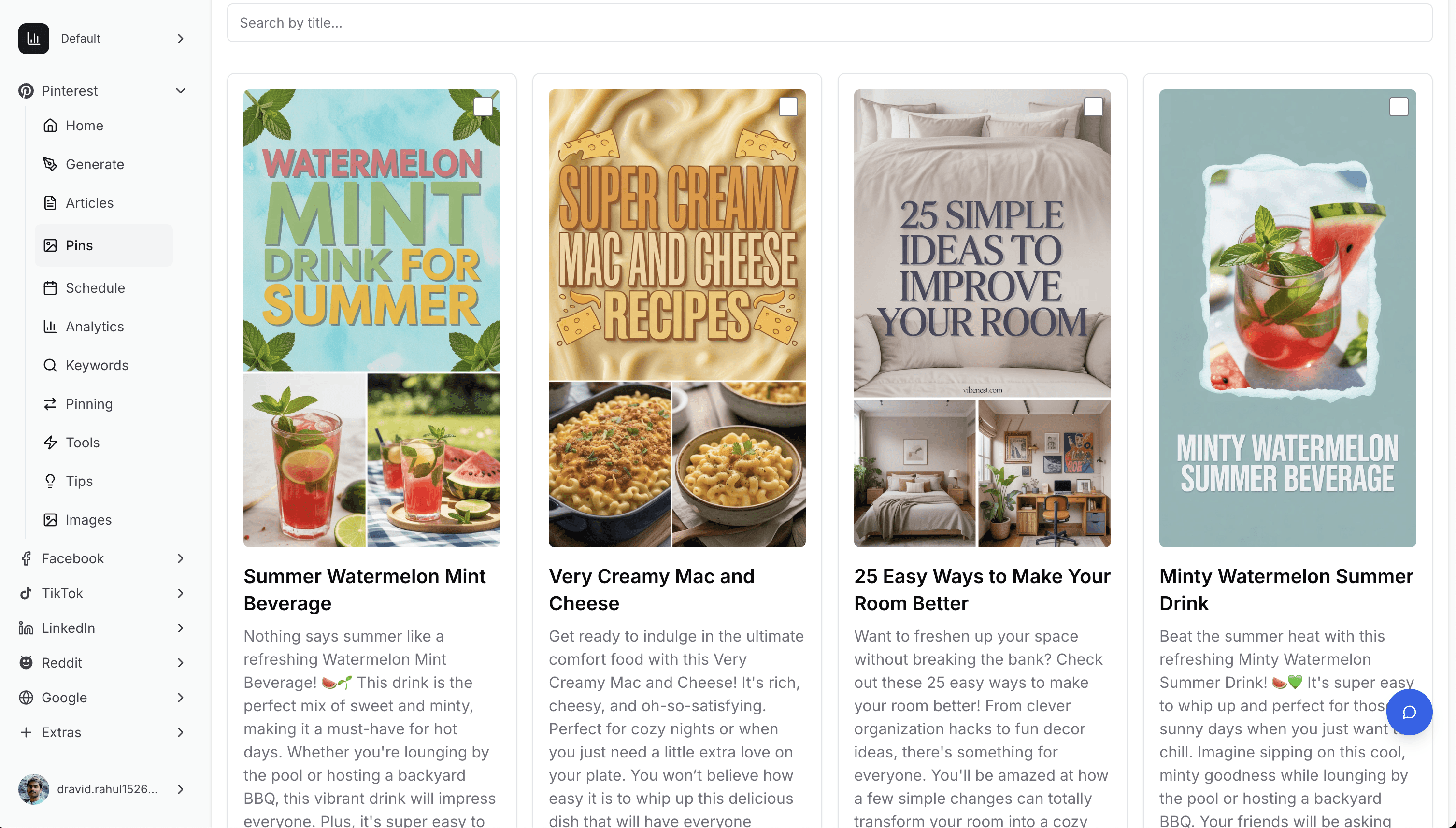
Pinterest is all about visual discovery—it’s a search engine that thinks in images. To win here, you need stunning visuals paired with keyword-rich descriptions that perfectly match what users are searching for. AI can help automate both the design and the SEO, letting you scale up your creation of beautiful, highly-discoverable Pins.
This is where generative AI really gets to flex its muscles, turning simple text prompts into gorgeous visuals and writing copy that drives clicks.
Designing Pins on the Fly: Use AI image generators like Midjourney or DALL-E 3 to create one-of-a-kind Pin designs. Just describe a concept, style, and color scheme, and the AI will generate a whole batch of options, saving you hours of fiddling in Canva.
Writing SEO-Driven Descriptions: Give an AI tool your blog post URL and ask it to write several SEO-optimized Pin descriptions. It will pull out the important keywords and write compelling copy designed to show up in Pinterest search results.
Brainstorming Boards and Ideas: Feeling stuck? Ask an AI tool to generate a list of Pinterest board ideas for your niche. It can even break it down further, suggesting sub-topics and specific Pin ideas for each board to get you started.
Now that we've covered some platform-specific strategies, it’s helpful to see how different AI functions map directly to each network's needs.
AI Tool Application by Social Media Platform
The table below breaks down which AI use cases are most effective for each major platform, helping you choose the right tool for the right job.
Platform | Primary AI Use Case | Example Tool or Technique |
|---|---|---|
TikTok | Trend analysis and short-form video script generation. | Using tools like Jasper for video hooks and scripts. |
AI-driven visual creation and hashtag optimization. | ChatGPT for caption ideas; AI analytics for hashtag performance. | |
SEO-optimized Pin descriptions and AI image generation. | Using Midjourney for Pin visuals; AI writers for keyword-rich text. | |
Drafting thought leadership articles and analyzing data. | Prompting AI with an industry report to generate a unique take for a post. | |
YouTube | Generating video titles, descriptions, and topic ideas. | |
Community monitoring and identifying niche pain points. | AI-powered social listening to track sentiment and find discussion topics. |
As you can see, the application of AI isn't random; it's a deliberate choice based on how each platform functions and what its users expect to see. This targeted approach is the key to making AI a truly valuable part of your social media workflow.
How AI Changes the Game for Social Media Analytics
For the longest time, social media analytics felt like driving while looking only in the rearview mirror. You’d get reports on likes, shares, and follower counts, which was fine for seeing what already happened. But that data was purely descriptive; it told you where you’d been, not where you should go next.
This is where bringing AI into your social media marketing completely flips the script. Instead of just organizing old numbers into charts, AI transforms your analytics dashboard into a strategic roadmap. It takes on the heavy lifting of data collection and highlights the insights that actually matter, saving you from getting bogged down by vanity metrics.
You can finally move past simple reporting and adopt a much smarter, more proactive strategy. AI helps you understand not just what happened, but why it happened—and more importantly, what to do next to get even better results.
Moving From Reporting to Predictive Insights
The real magic of AI analytics is its ability to look into the future. By digging through all of your past performance data—every post, every comment, every click—AI builds complex models that can predict which content formats, topics, and creative styles are most likely to resonate with your audience.
This is a massive upgrade from the old "post and pray" method. Rather than just guessing what might work, you're making decisions based on solid, data-driven predictions. For instance, an AI tool might analyze your engagement patterns and forecast that short-form videos about a specific product feature will outperform static images by 40% next month.
AI turns your analytics from a historical record into a strategic forecast. You gain the power to anticipate what your audience wants, so you can invest your time and resources into content that’s practically guaranteed to hit the mark.
Getting Actionable Prescriptive Recommendations
Predicting what will work is one thing; knowing the exact steps to get there is another. This is where prescriptive analytics comes in, giving you concrete, actionable recommendations. Think of it as having a data scientist on your team who tells you precisely what to do.
And we're not talking about vague suggestions here. AI provides specific, data-backed instructions you can put into action right away.
Optimal Timing: Instead of a generic "post in the morning," AI might tell you, "Post your video carousels on Fridays between 10-11 AM for a 15% higher reach."
Content Mix: It could analyze your performance and suggest, "Increase the frequency of user-generated content features to improve engagement rates among your 18-25 demographic."
Creative Direction: It might even spot visual patterns and advise, "Images with warm color palettes and human faces are currently driving more clicks."
This kind of detailed guidance takes all the guesswork out of your strategy. It lets you make small, consistent tweaks that add up to significant long-term growth.
Finally Proving Your Social Media ROI
For years, one of the biggest headaches for marketers has been proving the return on investment (ROI) of their social media efforts. AI-powered attribution modeling is finally solving this puzzle by drawing a direct line from your social media activities to real business outcomes like leads, sales, and customer lifetime value. For a deeper look, check out our complete guide on how to measure social media ROI.
By tracking the entire customer journey across multiple touchpoints, AI can show you exactly how a specific LinkedIn post contributed to a new lead or how an Instagram campaign influenced a final sale. This clear connection between social efforts and revenue is incredibly valuable. In fact, research shows that brands using AI social listening platforms reported up to ~10% faster revenue growth and were much quicker to handle brand crises. You can learn more about these findings on Sprinklr.com.
When you can demonstrate this kind of clear financial impact, you elevate your role from just a content publisher to a genuine driver of business growth.
Your Step-By-Step AI Integration Roadmap
Diving into AI for social media marketing doesn’t have to be a massive, all-at-once project. Honestly, that’s a recipe for burnout. The smart play is to ease into it, taking a gradual, phased approach. Think of it less like flipping a switch and more like slowly turning up a dial. This way, you and your team can learn and adapt without getting overwhelmed.
Phase 1: Start Small and Solve One Problem
The biggest mistake I see people make is trying to boil the ocean. Don't do that. Instead, look at your daily grind and identify your single biggest time-suck. Is it sweating over first drafts for Instagram captions? Staring at a blank page trying to brainstorm TikTok ideas? Maybe it's the soul-crushing task of manually pulling performance data every week.
Pinpoint that one thing. Then, find a single, easy-to-use AI tool built specifically to solve it. Practical example: If writing captions is your bottleneck, sign up for a free trial of an AI writer and give it this simple goal: draft five different captions for your next post in under three minutes. Your only goal at this stage is to get one small, measurable win. This builds confidence across the team and shows everyone, in a very real way, what this technology can do. To get started, you can explore a solid list of the best AI-powered marketing tools and see what fits your immediate need.
Phase 2: Integrate and Automate Your Workflow
Once you've gotten the hang of your first tool, the next step is to plug it into the systems you already use. Can your AI content generator send drafts straight to your scheduling platform? Can your analytics tool fire off automated reports to your team’s Slack channel every Monday morning?
The idea here is to build a smooth, connected process. You want to eliminate all that tedious manual copy-pasting and administrative busywork. Actionable insight: Look for tools that offer integrations with platforms you already use, like Zapier, to connect your AI writer directly to your scheduling calendar, automatically creating draft posts. This is where you'll start to feel the real magic, reclaiming hours as different parts of your workflow begin to communicate automatically.
The most effective AI integration feels less like adding another task and more like removing three. Focus on building bridges between your tools to create a unified, automated system.
Phase 3: Scale with Data-Driven Insights
Now that you have a basic automated workflow humming along, it’s time to get strategic. Use AI analytics to listen to what your audience is telling you through their actions. Let the data guide your next move.
For example, your AI might analyze your engagement and reveal that video content on LinkedIn is driving 3x more engagement than your text-only posts. Boom. That single insight tells you exactly where to double down. From there, you can use AI to generate video scripts, create simple faceless AI videos, and optimize them for that specific platform. This data-first approach ensures you're scaling what actually works, not just making more noise.
This is the core loop of AI analytics: moving from raw data to smart, actionable recommendations.
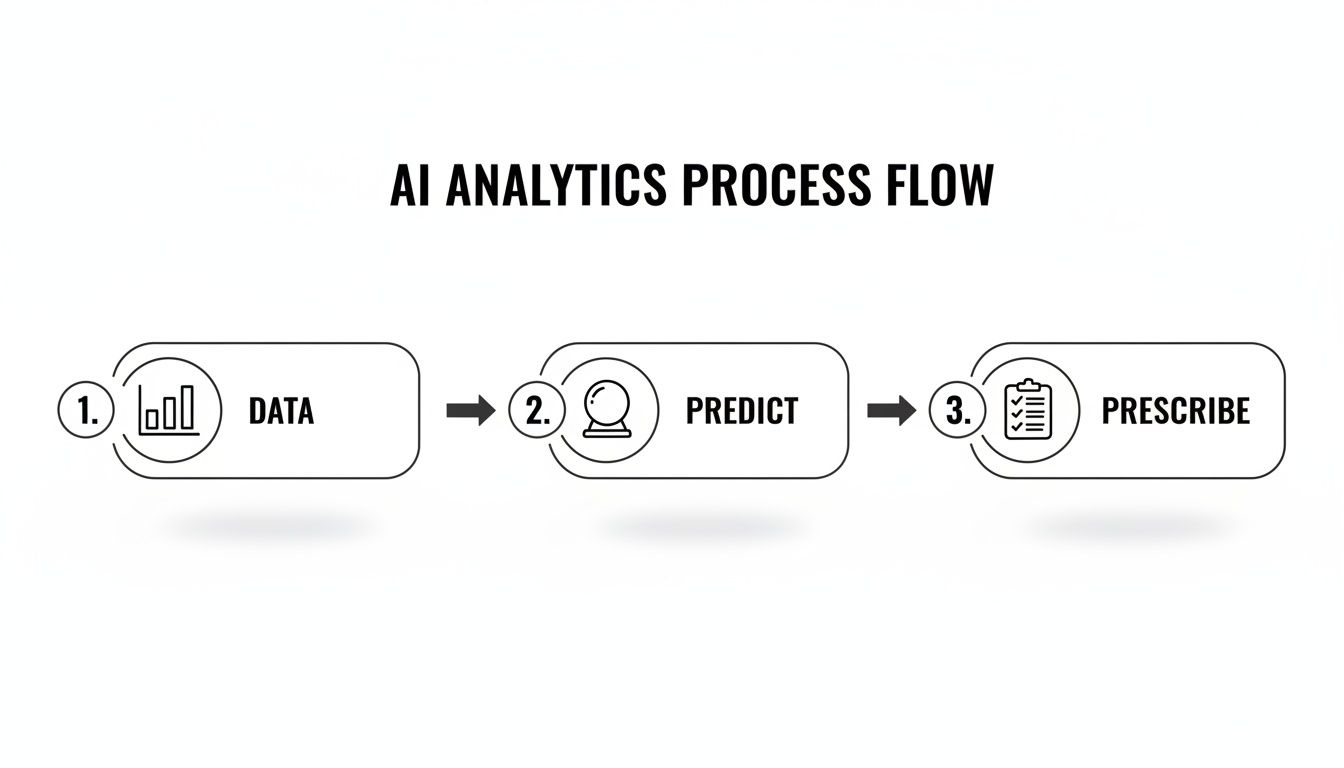
As the diagram shows, AI gathers data, uses it to predict what will happen next, and then suggests specific actions you can take to get better results.
Phase 4: Foster Human and AI Collaboration
Finally, remember that AI is a powerful assistant, not a replacement for your team's expertise. The last and most important phase is creating a balanced partnership between human creativity and machine efficiency. This means setting clear ground rules.
Define Brand Voice Rules: Give your AI a style guide to work from, but make it mandatory for a human to review every single post for the right tone and personality.
Implement a Fact-Checking Process: AI can occasionally misunderstand context or pull up outdated info. A human must always be the final checkpoint for verifying key facts, figures, and claims.
Encourage Strategic Direction: The time AI frees up is its biggest gift. Use those reclaimed hours to focus on big-picture strategy, genuine community engagement, and brainstorming your next knockout campaign.
When you treat AI as a collaborator, you get the best of both worlds: incredible efficiency without losing the authentic, strategic touch that only a human can bring.
Your Top Questions, Answered
Jumping into AI for social media always brings up a few key questions. Let's tackle the big ones head-on, so you know exactly how these tools can—and can't—fit into your daily grind.
Will AI Take My Job as a Social Media Manager?
Let's clear this up right away: No, AI isn't here to replace you. Think of it as the ultimate assistant, not a replacement. AI is fantastic at handling the tedious, time-consuming parts of the job—like churning out first drafts for captions, finding the best times to post, and pulling raw data from your analytics.
This doesn't make your role obsolete; it makes it more strategic. Instead of being buried in manual tasks, you get to focus on what humans do best: shaping brand strategy, building real connections with your audience, and coming up with the next big creative campaign. Your job shifts from being the "doer" to the "director."
What's the Real Cost of AI Social Media Tools?
The price tag on these tools is all over the map, which is actually a good thing. You can find plenty of free or "freemium" options that are perfect for dipping your toes in, maybe for brainstorming a few content ideas.
Once you're ready to get more serious, mid-range tools usually fall between $20 and $100 a month. These typically bundle content creation with scheduling and analytics. For large teams, enterprise platforms can run several hundred dollars, but they come packed with deep predictive insights and collaboration features. My advice? Always start with a free trial to solve one specific pain point before you pull out your credit card.
The key is to match the tool's cost to the value it provides. If a $50/month tool saves you ten hours of work, it's delivering a fantastic return on your investment.
How Can I Use AI Without Losing My Brand's Voice?
This is a huge—and valid—concern. The secret is treating AI as a starting point, never the finished product. Your brand's unique personality is your most valuable asset, and you can't outsource that.
The best workflow involves giving the AI clear guardrails. Feed it a detailed style guide, your core brand messaging, and even a few examples of your best-performing posts. Let it generate the first 80%, then a human (you!) comes in to add that final 20% of nuance, wit, and personality. A practical example: After AI drafts a caption, your job is to swap one generic phrase for a piece of industry slang your audience loves, or add a personal anecdote that the AI could never know. This human touch is non-negotiable; it ensures you get the efficiency of AI without sounding like a robot.
Ready to stop guessing and start growing? NicheTrafficKit is your all-in-one AI platform for creating, scheduling, and analyzing social media content that gets results. Stop the manual grind and automate your growth by starting your free trial today.