
How to Build Social Media Presence and Grow Your Brand
Learn how to build social media presence with proven strategies for audience research, content creation, and community growth. A practical guide.
Before you even think about your first post, the real work of building a powerful social media presence begins. This is where you lay the foundation—figuring out who you're talking to, what you want to achieve, and how you'll stand out from the crowd. Get this right, and you're setting yourself up for success from day one.
Laying the Groundwork for Social Media Success
Jumping onto social media without a plan is like setting sail without a map. Sure, you might float around for a bit, but you'll never reach your destination. The brands that truly win—whether they're a B2B software company or a trendy D2C startup—are the ones who invest time in strategy upfront. This isn't about guesswork; it's about making deliberate, informed decisions that will shape every single piece of content you create.
This initial groundwork is what prevents you from shouting into the void. It stops you from wasting countless hours on platforms your audience ignores or creating content that does nothing for your bottom line.
Go Beyond Basic Demographics to Understand Your Audience
Knowing your audience's age and location is table stakes. It’s just scratching the surface. To really connect, you need to dig into their psychographics—what motivates them, what keeps them up at night, what they value, and how they behave online. This is the secret to creating content that feels like it was made just for them.
Here are some actionable ways to gather this info:
Actionable Insight: Use Instagram Story Polls. Ask direct questions like, "What's your biggest struggle with [your topic]?" or "What kind of content helps you most? A) How-to videos B) Quick tips."
Practical Example: Read Amazon reviews. If you sell skincare, go read the 3-star reviews for a competitor's product. The comments are a goldmine of customer pain points, like "I love the formula, but the packaging is impossible to use." That's a challenge you can solve.
Where do they really hang out online? Don't just assume they're on Instagram. Actionable Insight: Search for your niche on Reddit or in Facebook Groups. If you're a financial advisor for millennials, you might discover they're all asking for advice in the r/personalfinance subreddit. This tells you exactly what questions they have and the language they use.
Here’s how that looks in the real world for a B2B SaaS company: Instead of just targeting "project managers," they got specific. They discovered their ideal user was a frustrated project manager at a mid-sized tech firm who felt buried under a mountain of different software tools. This person was active in subreddits like r/projectmanagement and followed productivity gurus on LinkedIn. That insight was gold—it told them to focus on creating LinkedIn articles about workflow automation and joining the conversation on Reddit.
Set Goals That Actually Matter to Your Business
Your social media goals have to be about more than just vanity metrics. Chasing follower counts is a fool's errand if none of those followers are engaging or buying. A smart strategy ties every social media action back to a tangible business outcome.
A common mistake is chasing a massive follower count instead of building a real community. An engaged audience of 1,000 ideal customers is infinitely more valuable than 100,000 passive followers who will never become customers.
Use the SMART framework (Specific, Measurable, Achievable, Relevant, Timely) to give your goals some teeth.
Weak Goal: "Get more engagement."
SMART Goal: "Increase the average engagement rate on our LinkedIn posts by 15% over the next quarter by sharing two client case studies each month and asking a question in every caption."
Let's look at a Direct-to-Consumer (DTC) Brand: A new sustainable skincare brand knew that in a crowded market, trust was everything. So, they set a primary goal to build brand trust and generate 50 pieces of user-generated content (UGC) in their first six months. This was far more important than early sales. Their entire content plan revolved around this, from featuring customer stories to running a branded hashtag campaign and reposting every photo they were tagged in. Actionable Insight: They included a small card in every package that said, "Show us your glow! Tag #GlowNaturally for a chance to be featured." This simple, physical prompt drove a significant amount of their UGC.
Analyze Your Competitors to Find Your Unique Voice
Spying on your competitors isn't about copying their every move. It’s about finding the gaps. By seeing what they do well and, more importantly, where they fall short, you can carve out a unique space for your own brand. This analysis is how you find a voice that cuts through the noise. It’s also a good idea to ground your strategy in established social media best practices.
Run a quick audit of 3-5 of your direct and indirect competitors. For each one, check out their:
Content Pillars: What are the main topics they always talk about?
Engagement: Which of their posts are blowing up with likes, comments, and shares? And why?
Brand Voice: Are they super formal and corporate? Witty and playful? Educational?
Content Gaps: What are they not talking about that their audience is hungry for?
Practical Example: A new coffee shop is entering a market where all competitors post beautiful, latte-art photos. During their analysis, they notice no one talks about the people behind the coffee. Actionable Insight: They decide their unique voice will be "community-focused." Their content strategy becomes centered on "Meet the Barista" videos, interviews with their local pastry supplier, and featuring customers who work remotely from their shop. This instantly differentiates them.
Choosing Your Platforms and Building a Content Engine
With your strategic groundwork laid, it's time to get into the fun stuff: picking where you'll play and what you'll say. This is where so many creators and businesses go wrong. They get a serious case of FOMO and try to be everywhere at once, burning themselves out in the process.
Let me be clear: the secret to a powerful social media presence isn't being on every platform; it's dominating the few that truly matter to your audience. Spreading yourself thin just leads to generic content and lackluster engagement. You're far better off being exceptional on two platforms than being mediocre on five. A focused approach gives every single piece of content you create the best possible shot at hitting home with the right people.
Selecting Your Core Platforms
You have to go where your audience already is. It’s that simple. And the opportunity is massive. By 2025, there will be an estimated 5.24 billion active social media users across the globe. The average person scrolls through 6.83 different platforms a month, spending a whopping 2 hours and 21 minutes doing it every single day.
To get a piece of that attention, you need to be consistent. Pick 2-3 platforms where you know your ideal customers hang out. For reference, Facebook still leads the pack with 3.07 billion monthly active users, and its largest demographic is the 25-34 age group, making up 31.1% of its user base. Brands that focus their efforts see real results—a prime example is the 71% increase in TikTok users who track products they see on the platform since 2021. You can find more social media user trends to dig into the data yourself.
This chart shows how everything—your audience research, your goals, your competitor analysis—flows directly into making a smart platform choice.
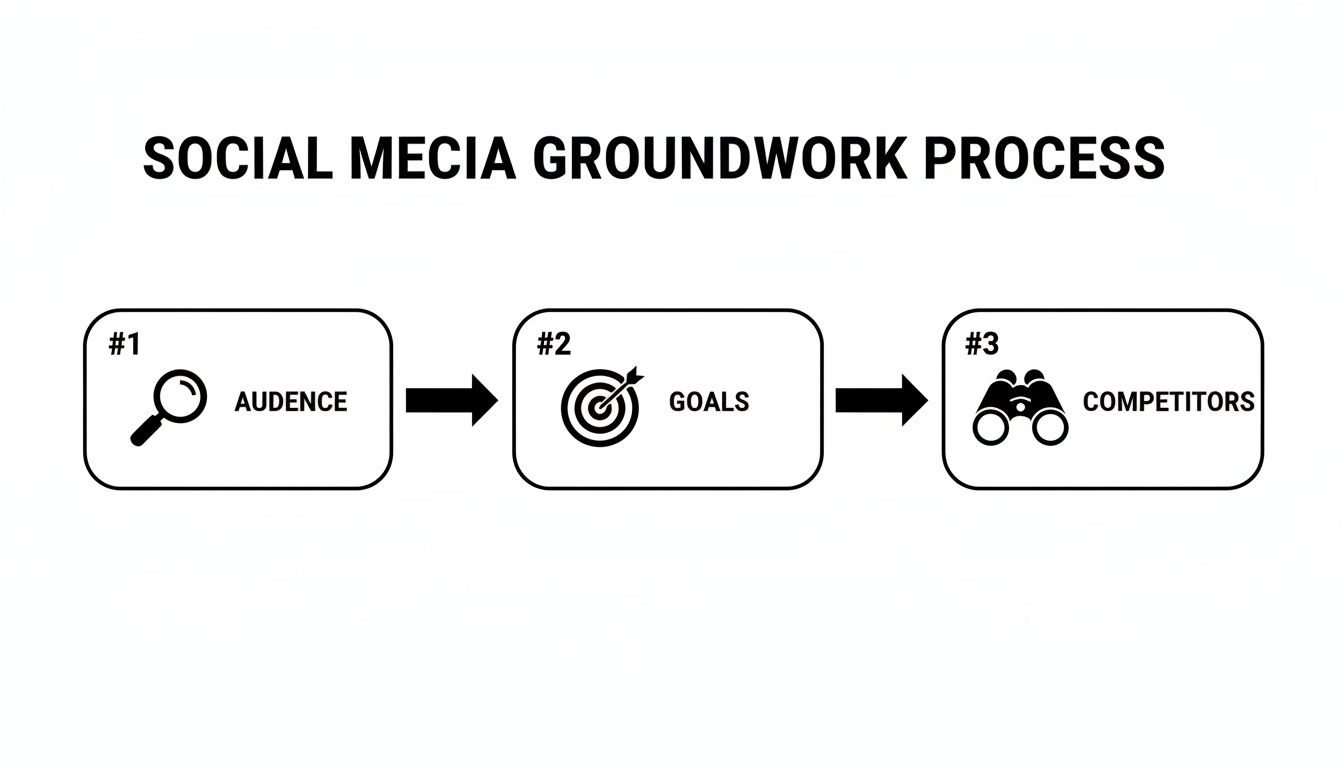
It’s a great reminder that platform selection isn't step one. It's a calculated decision that comes after you’ve done your homework.
To help narrow it down, I've put together a quick matrix that breaks down the best platforms for different types of businesses and creators.
Platform Selection Matrix for Different Business Types
Platform | Primary Audience | Key Content Formats | Best For |
|---|---|---|---|
Millennials & Gen Z (18-34) | High-quality visuals, Reels, Stories, Carousels | B2C, creators, e-commerce, lifestyle, food, fashion, travel | |
TikTok | Gen Z & Young Millennials (16-30) | Short-form video, trends, user-generated content | B2C, entertainment, brands with a strong personality, trend-setters |
Professionals, B2B decision-makers (25-55+) | Text posts, articles, carousels, professional video | B2B businesses, consultants, agencies, personal branding for experts | |
X (Twitter) | Tech-savvy users, journalists, professionals (25-49) | Short text updates, threads, memes, real-time news | Tech, news, media, SaaS, brands engaging in public discourse |
Broad demographic, strong in 35-55+ age range | Video, images, text posts, Groups, live streams | Local businesses, community building, brands with an older audience | |
Predominantly female (25-44), high purchase intent | Vertical images (Pins), Idea Pins, video | E-commerce, DIY, home decor, food, fashion, wedding industry |
The goal here isn't to be on every platform listed. It's to find the one or two where you can really shine and connect with your target audience authentically.
Building Your Content Engine with Pillars
Once you've zeroed in on your platforms, you need a system for creating a steady stream of great content. This is what I call a "content engine," and it runs on content pillars.
Think of content pillars as the 3-5 core themes your brand will own. They are the foundation of your entire content strategy, ensuring everything you post is relevant, valuable, and perfectly aligned with your business goals. They bring predictability for your audience and sanity for you.
Your content pillars are your promise to your audience. They set the expectation for the kind of value you'll provide, which is crucial for turning casual viewers into loyal followers.
Let's make this real. Imagine a local bakery trying to grow its social media presence. Instead of just posting random photos of cupcakes, they could build their strategy around these pillars:
Behind the Scenes: Giving people a peek at the baking process, introducing the team, and sharing the daily chaos and charm of the bakery.
Customer Spotlights: Featuring happy customers with their celebration cakes, sharing testimonials, and tagging them in posts.
Baking Tips & Tricks: Sharing simple recipes, "how-to" videos for frosting techniques, or stories about where they source their ingredients.
Community & Local Love: Highlighting partnerships with local coffee shops or their participation in the town's farmer's market.
Suddenly, they have a clear roadmap. Now, a single event—like creating a custom wedding cake—becomes a goldmine of content.
Reel/TikTok: A short, satisfying video of the final decorating touches, set to a trending audio clip.
Instagram Carousel: A multi-slide post with pro photos of the cake, a shot of the happy couple, and a text slide with their glowing review.
Facebook/Instagram Stories: A series showing the cake's journey from sketch to final product, ending with a poll asking, "What's your dream wedding cake flavor?"
That’s one idea, spun into three distinct pieces of content for different formats. This is how you work smarter, not harder. This is the heart of a powerful content engine that builds a memorable, engaging presence online.
Creating and Scheduling Content That Connects

Alright, you’ve got your strategy and know who you're talking to. Now comes the fun part: actually making the content that brings your brand to life. This is where the rubber meets the road—turning plans into posts that don't just get posted, but get noticed and build genuine connections.
Think of every single post as a handshake. From the first word of your caption to the image or video you choose, it's all working together to grab someone's attention and give them something valuable.
Crafting Scroll-Stopping Content
In an infinite scroll world, your content needs to be the one thing that makes people stop. It has to be compelling enough to make someone pause, think, and maybe even tap that "like" or "comment" button. This really just boils down to getting the basics of copy, design, and video right.
Practical Copywriting Example: Instead of "Check out our new software," try a hook like, "Stop wasting hours on manual reports. Here’s how to do it in 5 minutes." This speaks directly to a pain point.
Actionable Design Insight: You don’t need a design degree. When trying to make your posts look good, using AI image tools for social media can be a massive help. These, along with super-intuitive platforms like Canva, make it easy to whip up eye-catching graphics. Just be sure to stick to your brand's colors and fonts to keep things consistent.
Actionable Video Insight: For video on TikTok and Reels, authenticity almost always wins over high-production value. Simple editing apps like CapCut are perfect for adding text and trending audio. The real trick is telling a quick story that hooks people in the first three seconds. Example: Start a video by saying, "Here's one mistake that's costing you sales," instead of a slow introduction.
The Power of Batching and Scheduling
Consistency is the name of the game on social media, but it's also the hardest part to keep up with. That’s where content batching comes in—it’s a total game-changer. Instead of scrambling to create content every single day, you set aside a dedicated block of time each week or month to get it all done at once.
Practical Batching Example: Every Friday afternoon, dedicate two hours to creating next week's content.
Hour 1: Film 3-4 short videos (Reels/TikToks).
Hour 2: Write the captions for those videos and design one carousel post for the week. Now you're set and don't have to think about content creation again until next Friday.
Content batching transforms social media management from a chaotic daily scramble into a calm, organized system. It frees you up to focus on what really matters—engaging with your community in real-time.
Once your content is ready, scheduling tools like Buffer or Later are your best friends. They let you plan your posts for the week or month and automatically publish them at the best times for your audience. This keeps your feed active and consistent, even when you're swamped with other things.
Building a Sustainable Content Calendar
A content calendar is the backbone of your social media plan. It’s your visual map of what’s being posted, where, and when. This kind of strategic planning makes sure you’ve got a healthy mix of content that keeps your audience engaged while also hitting your business goals.
Your engagement metrics are the pulse of your social media presence. With users worldwide spending an average of 2 hours and 21 minutes on these platforms daily, you have to be strategic. Aiming to post 3-5 times a week and replying to comments quickly can make a huge difference, as real-time interaction is a massive engagement booster. Actionable Insight: Use features like polls ("Which topic should we cover next?") and Q&As in your stories. This can easily lead to a 20-30% jump in interaction and gives you free content ideas.
Here’s a simple weekly content calendar you can tweak to fit your own brand:
Sample Weekly Content Calendar
Day | Content Focus | Example Post | Platform Focus |
|---|---|---|---|
Monday | Educational | A carousel post with "3 Common Mistakes to Avoid in [Your Niche]" | Instagram, LinkedIn |
Tuesday | Behind-the-Scenes | An Instagram Story showing your workspace or a "day in the life" Reel. | Instagram, TikTok |
Wednesday | Community Feature | A post shouting out a customer or sharing a piece of user-generated content. | Facebook, Instagram |
Thursday | Entertaining | A relatable meme or a funny video related to your industry. | X, TikTok |
Friday | Promotional | A post highlighting a new product or service, focusing on the benefits. | All Platforms |
Actively Growing Your Audience and Community
Let's be honest: creating amazing content is a huge win, but it’s only half the job. If you really want to build a presence, you can't just post and pray. That's a classic recipe for stagnation. You need a game plan to get your work in front of fresh eyes.
This is where you switch gears from being a passive content creator to an active community builder. It’s a dance between smart organic tactics that build genuine trust and targeted paid strategies that pour fuel on the fire. The goal isn't just to rack up followers—it's to attract the right people who will eventually become your biggest fans.
Mastering Organic Growth and Reach
Organic growth is the foundation of any strong social media account. It's the stuff you earn, not buy, and it’s what creates a loyal audience that actually sticks around. These strategies are all about showing up in the right places and giving people a reason to share your work for you.
One of the best tools in your organic toolkit is the humble hashtag. Seriously. Think of them as a filing system for the internet. Using the right ones makes your content discoverable to people actively looking for what you offer, even if they’ve never heard of you.
Actionable Insight: Use a tiered hashtag strategy.
Broad (1-2):
#socialmediamarketing(Huge volume, low chance of being seen)Specific (3-5):
#b2bsaasmarketing(More focused audience)Community (3-5):
#womeninconsulting(Hyper-targeted, high engagement)Branded (1):
#YourBrandName(To collect UGC)
This mix ensures you get both broad exposure and targeted engagement from the right communities.
Another powerhouse organic tactic? Collaborations. Teaming up with other creators or brands is like getting a direct introduction to their entire audience. Practical Example: A small B2B agency co-hosted a free LinkedIn Live event with a software company in a related field. That one move exposed them to hundreds of potential new clients in just an hour, all for zero ad spend.
Turning Followers into a Thriving Community
Growth tactics get people in the door. Community management convinces them to stay for the party. This is the art of turning passive scrollers into active, engaged fans who feel like they're part of something.
It all starts with being responsive. Actionable Insight: When someone leaves a thoughtful comment, reply with a question to keep the conversation going. Instead of just "Thanks!", try "Thanks! So glad you liked it. What was your biggest takeaway?" This encourages more replies and boosts your post's visibility.
But don't just wait for them to talk. Spark the conversation yourself! Ask open-ended questions in your captions. Run polls in your stories. Create content that practically begs people to share their own two cents.
Your social media profile shouldn't be a monologue; it should be a conversation. The most successful brands treat their platforms like a digital living room, where they're not just broadcasting, but actively listening and participating.
The holy grail of community engagement is user-generated content (UGC). When a follower posts about your product or service, it’s an authentic stamp of approval that's more powerful than any ad you could ever run. Nudge this along by creating a unique branded hashtag and making a point to feature the best UGC you find.
A Beginner’s Guide to Paid Amplification
While organic growth builds a rock-solid foundation, paid advertising is the accelerator. It lets you put your best stuff right in front of a hand-picked audience, fast-tracking your growth. If you're just starting out, the simplest way in is by boosting your top-performing organic posts.
First, scroll through your feed and find a post that already did well on its own—one with plenty of likes, comments, and shares. That’s your proof of concept. Instead of building a complex ad from scratch, just hit the "boost" button on a platform like Facebook or Instagram.
Here’s a simple game plan for your first boosted post:
Your Goal: Choose an objective like "More Profile Visits" or "More Engagement" to focus on growing your audience.
Your Audience: Build a custom audience based on the demographics and interests of your ideal follower. You can even target people who like pages similar to your competitors.
Your Budget: Start small. A budget of $5-$10 per day for 3-5 days is plenty to get some initial data without breaking the bank.
Practical Example: A creator ran a successful Instagram giveaway and saw their follower growth triple in a month. They put just $50 behind the announcement post to make sure it reached thousands of new people who fit their ideal follower profile. That tiny investment made a massive difference in the campaign's overall success.
Measuring Your Performance and Optimizing for Growth
You can’t improve what you don’t measure. It’s a classic saying for a reason.
Posting consistently and chatting with your community are non-negotiable, but if you aren't looking at the data, you're flying blind. This is where you trade guesswork for certainty, creating a powerful feedback loop that fuels real, sustainable growth.
Decoding Your Key Metrics
Let’s be honest: not all numbers matter. A huge follower count looks great on the surface, but it's just a vanity metric if nobody is actually engaging with your content or clicking through to your site.
To get a real sense of your performance, you need to focus on metrics that tell a story about how people interact with you. A simple way to do this is by grouping them into three core categories that mirror your business goals.
Awareness Metrics: This is all about eyeballs. How many people are seeing your stuff? Key numbers here are reach (the unique number of people who see a post) and impressions (the total number of times your post was seen). High reach is a fantastic sign that you're breaking into new audiences.
Engagement Metrics: This shows you who’s paying attention. We're talking about likes, comments, shares, and especially saves. Actionable Insight: A "save" is often more valuable than a "like." It means your content was so useful that someone wants to come back to it later. Track this to see what content provides the most value.
Conversion Metrics: These are the metrics that hit the bottom line. You'll want to keep a close eye on your click-through rate (CTR) on links, the website traffic you're driving from social, and any direct leads or sales you generate.
When you organize your analytics this way, you can instantly see where your strategy is shining and where it might need a little polish. It helps you look past the fluff and focus on what’s actually moving the needle.
Key Metrics to Track for Social Media Growth
A summary of essential metrics categorized by strategic goal, helping you focus on the numbers that truly reflect your performance and progress.
Goal | Key Metrics to Track | What It Tells You |
|---|---|---|
Increase Brand Awareness | Reach, Impressions, Follower Growth Rate | How effectively your content is spreading and attracting new people to your brand. |
Boost Community Engagement | Likes, Comments, Shares, Saves, Mentions | How much your audience resonates with your content and how actively they participate in the conversation. |
Drive Website Traffic & Leads | Click-Through Rate (CTR), Website Clicks, Landing Page Views | How well your social media efforts are translating into direct interest in your products or services. |
Generate Sales & Revenue | Conversion Rate, Revenue from Social, Cost Per Acquisition (CPA) | The direct financial impact of your social media strategy on your business's bottom line. |
This table isn't exhaustive, but it’s a solid foundation. Focus on the metrics tied to your primary goal first, and you'll avoid getting lost in the data.
The Simple Monthly Performance Review
You don’t need expensive tools, at least not at first. Just block out an hour or so each month to dig into your native platform analytics. Instagram Insights, LinkedIn Analytics, TikTok Analytics—they're all free and packed with the data you need.
During your review, zero in on these three questions:
What was my home run? Identify your single top-performing post by engagement or reach. Was it a Reel? A carousel? A text-only post? What was the topic? This is your audience telling you exactly what they want more of.
What completely missed the mark? Now, find your worst-performing post. Be brutally honest. Maybe you tried a new format that didn't land, or the topic was a dud. This is just as important as knowing what worked.
What patterns are emerging? Look for the common threads. Do posts with your face get more love? Do questions in captions actually spark more comments? Are listicles getting a ton of saves?
Your analytics aren't just numbers on a dashboard; they are direct, unfiltered feedback from your audience. Listening is the single fastest way to sharpen your strategy and accelerate your growth.
Practical Example: A small business owner notices her behind-the-scenes Reels get 3x the engagement of her perfectly polished product photos. That insight is pure gold. It gives her a clear directive for the next month: double down on authentic, unscripted video and reduce the number of static product shots.
Of course, tying these numbers back to business impact is crucial. For a deeper dive, you'll want to understand how to measure social media ROI properly.
Creating Your Data-Driven Feedback Loop
The whole point of tracking performance is to create a cycle of continuous improvement. What you learn in this month's review should directly shape next month's content calendar.
This is how you turn data into action.
If carousels that break down a complex process are getting saved like crazy, you know what to do: make more of them. If you see that a specific hashtag is consistently bringing in new, relevant followers, it becomes a permanent part of your strategy.
Suddenly, you’re no longer just throwing content at the wall to see what sticks. You're building a powerful, intentional presence, one data-backed decision at a time.
Have Questions? Let’s Get Them Answered
As you start putting all these pieces together, you’re bound to have questions. It’s totally normal to wonder if you’re heading in the right direction or what to do when you hit a roadblock.
This is your personal FAQ, built from the most common questions I hear from creators and brands. Let’s tackle them head-on with some straight-up, practical answers.
How Long Until I Actually See Results?
This is the million-dollar question, isn't it? And the honest answer is, it's not overnight. But with a solid, consistent plan, you should start seeing some real traction within 3-6 months. I'm talking about a noticeable uptick in followers and more people actually engaging with your posts.
When it comes to the bigger stuff—like generating reliable leads or seeing a direct impact on sales—you're looking at a longer game, typically closer to 6-12 months. Remember, things like your specific industry, how good your content is, and how much you're actually talking to your audience all make a huge difference. Consistency is your best friend here.
What Are the Biggest Mistakes I Should Avoid?
So many people trip over the same hurdles right out of the gate. If you can sidestep these common mistakes, you’ll be miles ahead of the competition.
Here are the top three I see all the time:
Spreading yourself too thin. Trying to be everywhere at once is a surefire recipe for burnout. Get really good at one or two platforms where you know your people are hanging out. Master those before you even think about adding another.
Going silent for weeks. Algorithms hate inconsistency. When you disappear, you kill all your momentum. A simple content calendar is all you need to keep the content flowing steadily.
The "me, me, me" show. Nobody wants to follow a walking advertisement. Your feed can't just be one big sales pitch. Stick to the 80/20 rule: 80% of your content should be genuinely helpful or entertaining, and only 20% should be about selling your stuff.
Should I Start Running Paid Ads Right Away?
Probably not. I almost always recommend building a solid organic presence first. What does that mean? It means you know who you're talking to, you're posting consistently, and you have a feel for what content actually resonates with your audience.
Paid ads are an accelerator, not a strategy. Think of them as gasoline. You need to have a fire going first before you pour fuel on it.
Once you’ve got that organic engine humming—usually after a solid 2-3 months—then it's a great time to experiment with a small ad budget. A smart way to start is by boosting your best-performing organic posts. You already know people love them, so you’re just paying to get them in front of more of the right people.
Realistically, How Much Time Does This Take Every Day?
To really build momentum from scratch, you should probably plan on spending about 60-90 minutes a day on social media. That initial push is what gets the ball rolling.
Here’s a simple way to break that time down:
20-30 minutes: Creating content (pro-tip: batch this once a week to save a ton of time).
20-30 minutes: Engaging with your community (replying to every single comment and DM is non-negotiable).
20-30 minutes: Proactive outreach (commenting on other accounts in your niche to get on their radar).
Trying to juggle all of this can quickly feel overwhelming. With NicheTrafficKit, you can put your entire content machine on autopilot—from finding ideas and creating posts to scheduling and analyzing performance. This frees you up to do what you do best: grow your business. Discover how NicheTrafficKit can transform your social media strategy.